
Scottish Art News
Latest news
Magazine
News & Press
Publications
Keith McIntyre: What Lies Beyond Exhibition at An Lanntair, Stornoway
By Greg Thomas, 23.02.2026
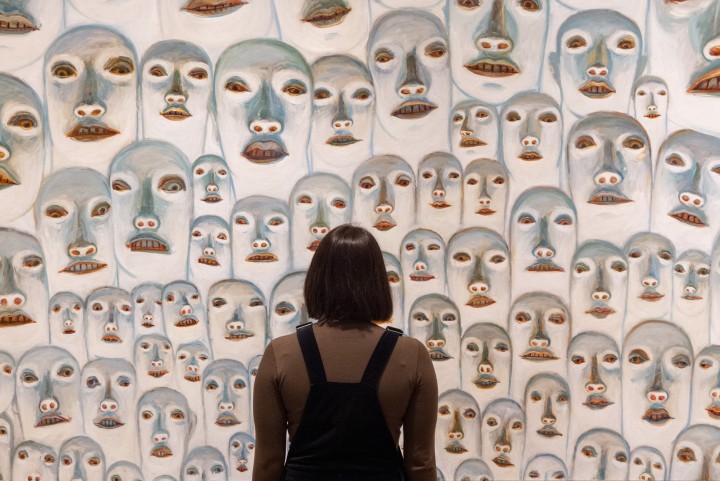
Keith McIntyre is sending me phone snaps of discarded marine apparatus – a boat, a propellor – covered in strange, tessellating faces. Chalky white ovals with turquoise outlines, shadows above the top lip and round the bridge of the nose, as if each was lit eerily from beneath, they fill their surfaces with a horror vacui energy, in Escher-style chevrons. In another photo, the artist stands in the foreground of an old military Nissen Hut now serving as one of his studios (another is a converted church). Behind him are canvases all populated with the same cast of souls, hurtling through a sea or space that they entirely fill, their faces caught in a half-smile that might be subtly threatening.
These works will be included in McIntyre’s new show, What Lies Beyond, at An Lanntair in Stornoway on Harris, opening on 21st February and running until 28th March. Suitably enough, given the strung-out conversation we’re having between Berneray and the M1 Motorway (I’m heading from Glasgow to London for the weekend), this show is a homage of sorts to the odd forms of communication and exchange with the mainland necessitated by the geographical isolation of his home. This became especially acute to the artist during the Covid-19 pandemic, when communing by video-link was particularly common. Rows of dimly lit, blank faces appeared nightly on screens across the Hebrides. “Communication between the island and the over there has been transformed through the digital age”, McIntyre notes, in one of a number of short, lyrical texts prepared for the exhibition. “The Covid pandemic forced us into online gatherings ....I started to draw the heads dominating the screen in front of me.”
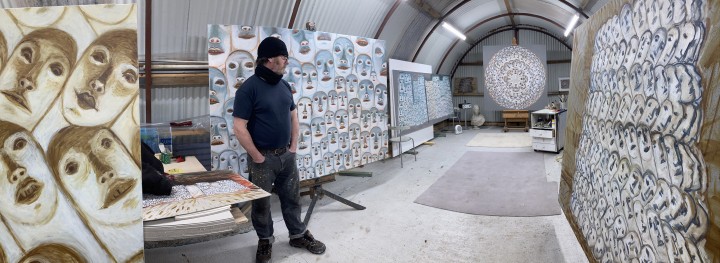 Keith McIntyre, Nissen Hut Studio. © the artist.
McIntyre’s show is part of the 200-year-anniversary celebrations of the Royal Scottish Academy to which McIntyre was elected in 2018. This bicentenary celebration includes events, exhibitions, and rehangs of historical collections across the country. As for McIntyre, he is not an islander by birth but an Edinburgh-er, trained in drawing and painting at Duncan of Jordanstone in Dundee. Teaching at Glasgow School of Art and Northumbria University before becoming Director of Shetland’s Centre for Island Creativity, part of the University of the Highlands and Islands (where he is now Emeritus Professor), McIntyre has become accustomed to island life over the last couple of decades.
It is a truism that islands are not pockets of bucolic – or indeed wretched – isolation, but places defined by the comings and goings of people, things, and ideas from elsewhere. This notion is very much to the fore of McIntyre’s show—not only in its thematic nods to digital communication with the “over there”, but in the formal inspiration it draws from Japanese Butoh Theatre. A modern but curiously ancient-seeming artform, Butoh emerged in 1950s Japan in a society reeling from the emotional trauma of World War Two. As McIntyre describes it, “the artists use white body paint and slow, controlled movements to explore dark themes and challenge traditional ideas of beauty and movement. This aesthetic, along with shaved heads and grotesque forms, is used to strip away the self and express raw human emotions like life, death, and despair.”
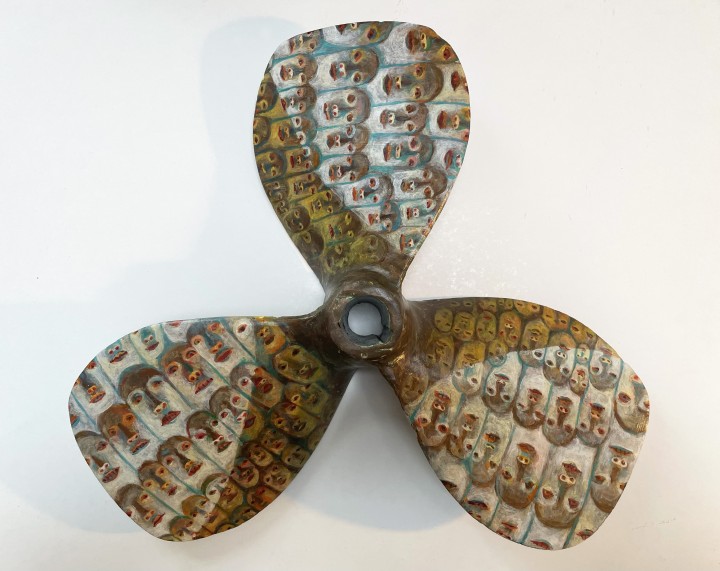 Keith McIntyre, Propellor (c.unknown). © the artist.
The pale hairless heads which fill McIntyre’s picture surfaces are perhaps part Butoh performer, then, part disembodied Zoom-meeting attendee (Zoom is even the name of one of the works). They are also evidence of McIntyre’s past work as a set designer.
“Many years ago [1990] I worked with Gerry Mulgrew [director] and Liz Lochhead [writer] on the Tramway production Jock Tamson’s Bairns”, McIntyre tells me by email. “The congregation of heads first surfaced back then...it’s a bit like unfinished business.”
A work musing on Scottish identity strongly influenced by Burns and Hugh MacDiarmid, Jack Tamson’s Bairn’s is described by the company that staged the show, Communicado Theatre, as “[a] surreal baccanale telling the story of the death and apotheosis of The Drunk Man, and his descent into Hell...,[a]s much mediaeval pageant as play”. In this context, McIntyre’s crowds of leering heads seem to have acted as a Greek chorus of sorts, or perhaps a Scottish one. The fact that McIntyre has chosen to paint onto three-dimensional objects for the current show (as well as boat and propellor, there is a satellite dish) might suggest creating work for a stage rather than a wall.
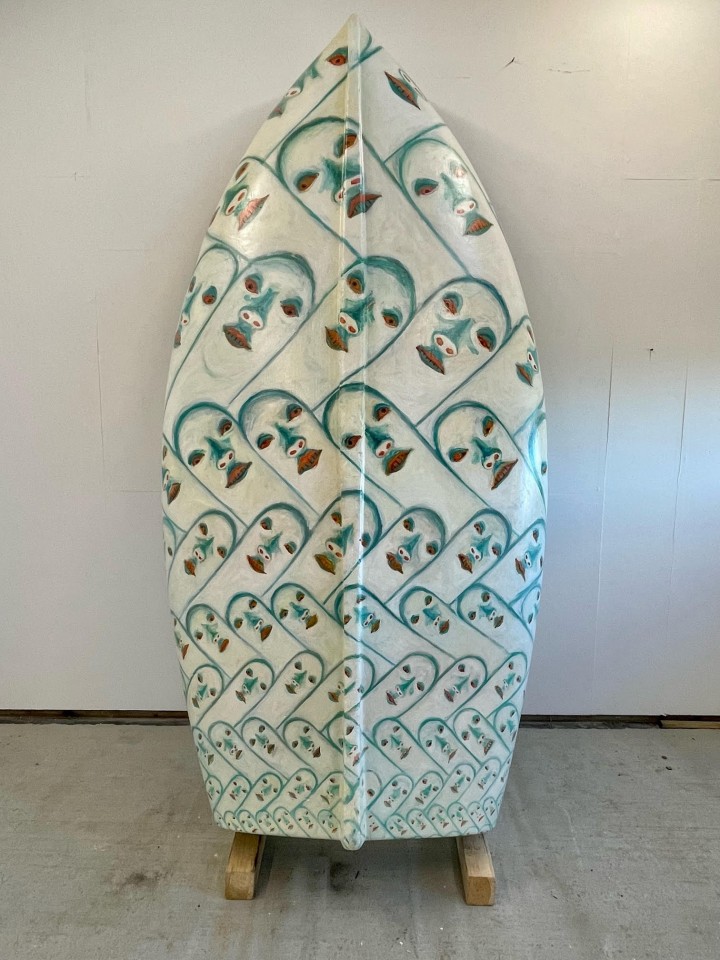 Keith McIntyre, The Coffin Boat (c. unknown). © the artist.
However, to reduce the feverishly repeated motif that defines this exhibition to a series of art-historical, cultural, or national(ist) metaphors is to downplay their strangeness, their inexplicability. There are, in a sense, simply there: like human beings, or like the rocks that pepper the landscapes of Berneray and which McIntyre discusses a great deal in his writing around the show: lumps of Lewisian Gneiss, the product of material (geological) rather than spiritual or symbolic processes, each one ancient and unique.
Indeed, working with rocks – building with them, shifting them, walking over them – has evidently been important in carving out the creative space for this exhibition. But “ultimately it’s about paint”, McIntyre tells me, “and how this stuff for me can best explain the human condition when all is stripped back to the bare essentials”.
Keith McIntyre’s exhibition, What Lies Beyond, is exhibited at An Lanntair in Stornoway, Lewis until 28th March


