
Scottish Art News
Latest news
Magazine
News & Press
Publications
Highlights at Visual Arts Scotland’s Open Exhibition
By Lena Kammerer, 29.12.2025
For this year’s annual open exhibition, The Thread That Pulls, Visual Arts Scotland presents the work of artists “who follow the pull; whether it’s the tug of memory, the weight of a material, the slow draw of an unfinished thought.” Among the many exceptional artworks on display, here are five you should not miss.
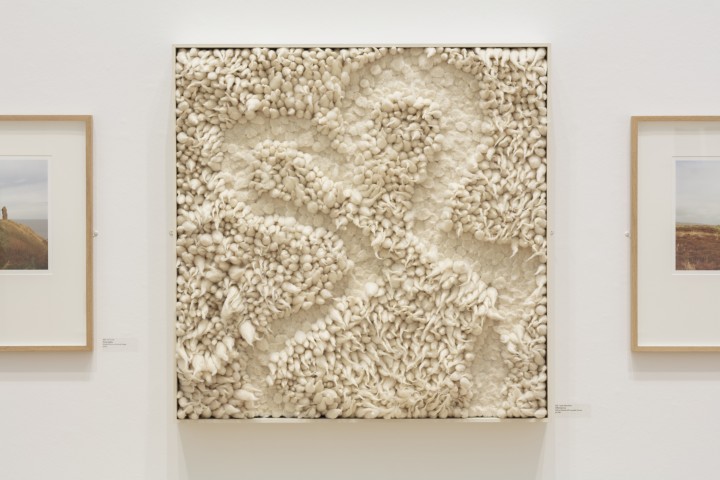
Leah Macmillan, ‘Inflorescence’, Felt on Board with Wooden Frame
Leah Macmillan’s ‘Inflorescence’, an abstractly patterned work created out of felt that fills a large wooden frame, encourages visitors to do what most museums and galleries usually discourage them from: to touch it. For Macmillan, an emerging multidisciplinary artist from Glasgow who graduated this year with a BA (Hons) in Fine Art from Duncan of Jordanstone College of Art & Design, accessibility for and inclusion of blind and partially sighted audiences is a central concern in her art practice, rooted in her personal experience of her grandmother, a painter who, in later life, became blind and was no longer able to engage with art as she once had.
Drawing from organic forms and nature, and working with a minimalist, raw colour palette to foreground texture, Macmillan places varied sensory engagement with art, including touch, sound, and smell, at the core of her intriguing work, promoting visitors’ connection with art beyond the visual.
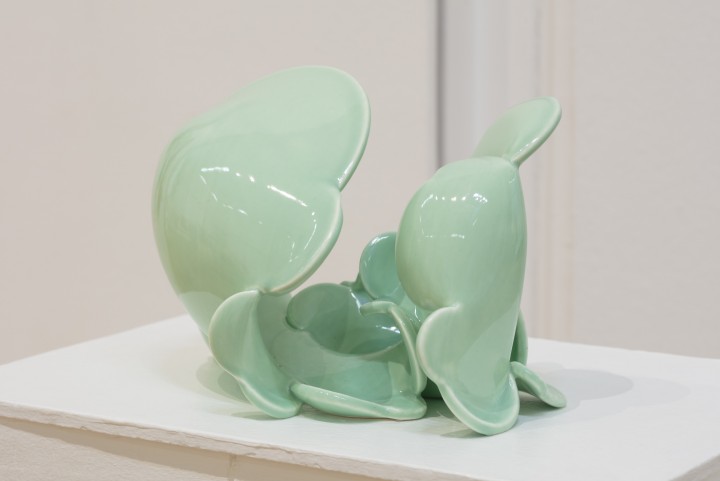 Wei Lin, ‘Generative Blooming’, Ceramic. Image courtesy of the artist.
Wei Lin, ‘Generative Blooming’, Ceramic
Awarded the Powderhall Bronze Foundry Award, the pale jade-coloured ceramic sculpture ‘Generative Blooming’ by cross-disciplinary designer Wei Lin reflects its maker’s approach to bringing together technology and visual expression by combining the use of 3D ceramic printing and generative design. The exhibited work has been created around the organic motif of blooming, symbolising growth and potential, which unfolds through repeated, intersecting arcs. These multiple, curved forms hint at circular structures that do not fully close, evoking a sense of movement, space, direction, relationships and identity. While rooted in digital processes, the ceramic materiality of ‘Generative Blooming’ anchors the sculpture in its physical presence, prompting the viewer to look inward through reflecting on the objects that form their surroundings. Lin’s practice fuses science and art to investigate how nature, craftsmanship, and technology can intersect, seeking to question and challenge the traditional boundaries of these fields through contemporary making.
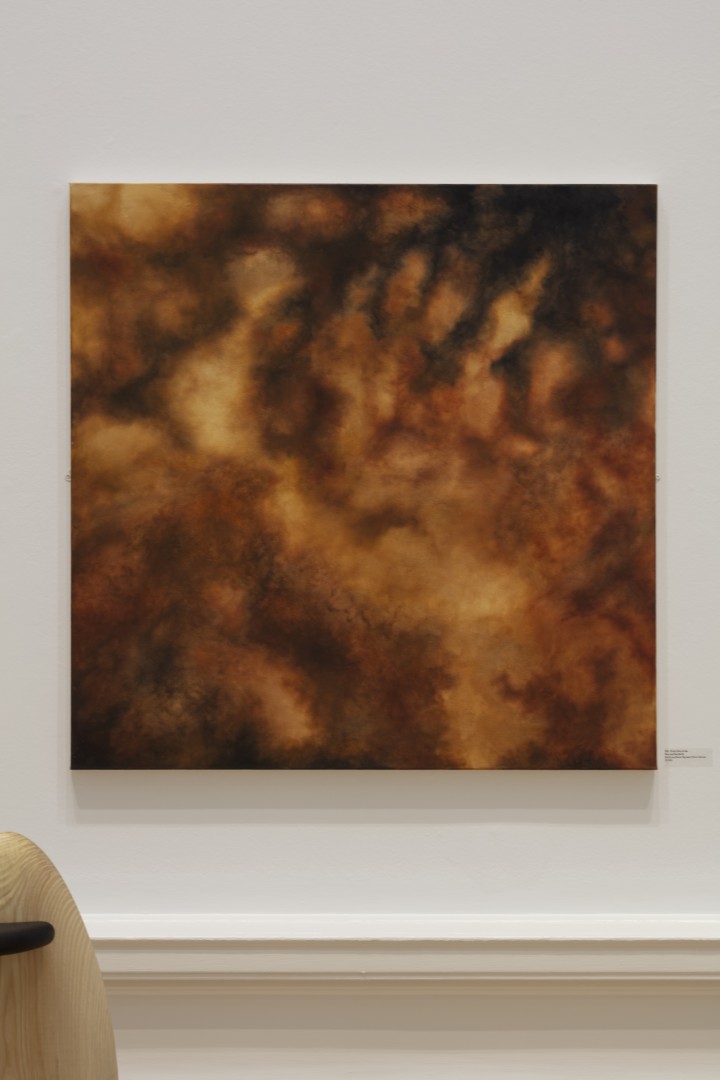 Emily McLatchie, ‘Fox and the Earth’, Earth and Bone Pigment Oil on Canvas. Image courtesy of the artist.
Emily McLatchie, ‘Fox and the Earth’, Earth and Bone Pigment Oil on Canvas
‘Fox and the Earth’, a vast, mesmerising earth-toned oil painting, is the work of another emerging artist to watch, Emily McLatchie, a recent graduate of Gray’s School of Art. McLatchie’s practice is rooted in raw, elemental materials, including stones, bones, and locally gathered earth, which are minimally processed, embracing slowness and care throughout the process of creation. For ‘Fox and the Earth’, she incorporated soil from Dumfries and Galloway and the bone of a fox, imbuing the work with a direct, tactile connection to the natural world. Working across painting, photography, and soundscapes, McLatchie explores the different facets of wilderness and landscapes through themes of connection and memento mori, cultivating an awareness of the cycles of decay and renewal that inextricably bind us to our natural world. Her work reflects the impermanence and fleetingness of life while emphasising its elemental rhythms, offering viewers a meditative and introspective encounter with nature’s enduring yet ever-transforming presence.
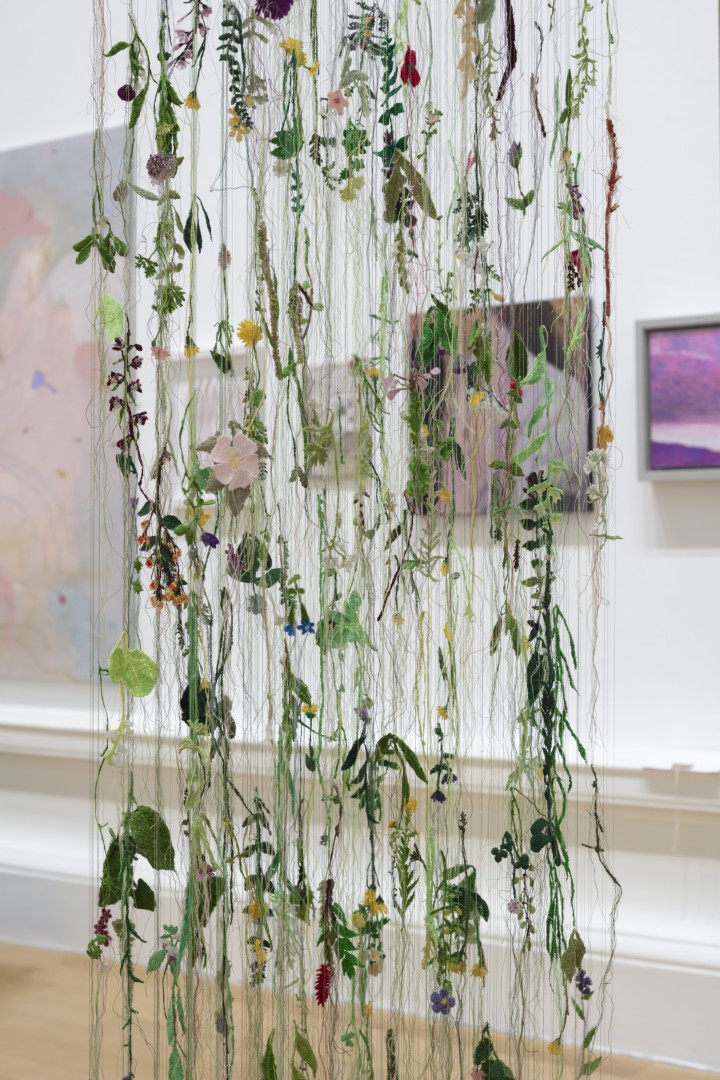 Roxy Russell, ‘Hanging by a Thread,’ Installation; Free Motion Embroidery. Image courtesy of the artist.
Roxy Russell, ‘Hanging by a Thread,’ Installation; Free Motion Embroidery
Among the most visually arresting installations is visual artist Roxy Russell’s ‘Hanging by a Thread’, which has previously been exhibited at Kirkcudbright Galleries. The installation takes the form of a rectangular box frame, through which threads, delicately embroidered with different plant forms, descend, depicting the 233 plant species currently classified as threatened and prioritised for biodiversity conservation in Scotland. Her intricate, floating herbarium draws attention to the fragility of plant life and its fundamental importance to our life on earth, both of which are frequently overlooked. As urbanisation increases, the phenomenon of ‘plant blindness’ limits our ability to distinguish individual plant species, reinforcing a growing disconnection from and unawareness of the natural world. A recipient of the Scottish Gallery Award for an Outstanding Artwork and the SSWA Special Award for High Quality, Innovative Work in Three Dimensions, Russell uses thread and natural materials to explore our increasingly fraught, yet inextricable, relationship with nature.
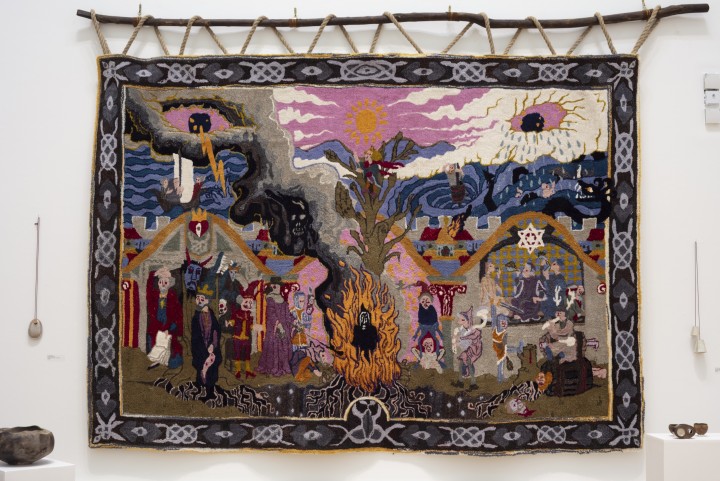 Vincent Deighan, ‘The Laden Land’, Hand Tufted Wool, Wood and Rope. Image courtesy of the artist.
Vincent Deighan, ‘The Laden Land’, Hand Tufted Wool, Wood and Rope
Unmissable for its sheer scale and intricate, vibrant detail, Vincent Deighan’s wall-hanging textile work ‘The Laden Land’, whose visual content is arranged as a horizontal triptych and a vertical diptych, immediately draws the viewer into a kingdom in turmoil. The piece is populated with unsettling figures, including a plague doctor. However, the central panel is
most prominently dominated by Brother Death, burning at the stake. The eerie, chaotic atmosphere and meticulous detail evoke the nightmarish imagination of Hieronymus Bosch. Deighan’s multidisciplinary practice spans performance and installation art, songwriting, singing, drawing, painting, sculpting, videography, rug tufting, voice and film acting, and music production and recording, reflecting a versatility that informs the layered complexity of this work. The Laden Land was originally created as a medieval-style tapestry for Jack Calum Richardson’s debut album, ‘I Care Not’, and was awarded the Stern Award for figurative work, cementing Deighan’s reputation as a boundary-pushing artist.
Visual Art Scotland's open exhibition, The Thread That Pulls, is exhibited at the National Galleries Scotland on The Mound, Edinburgh until 2nd January 2026


