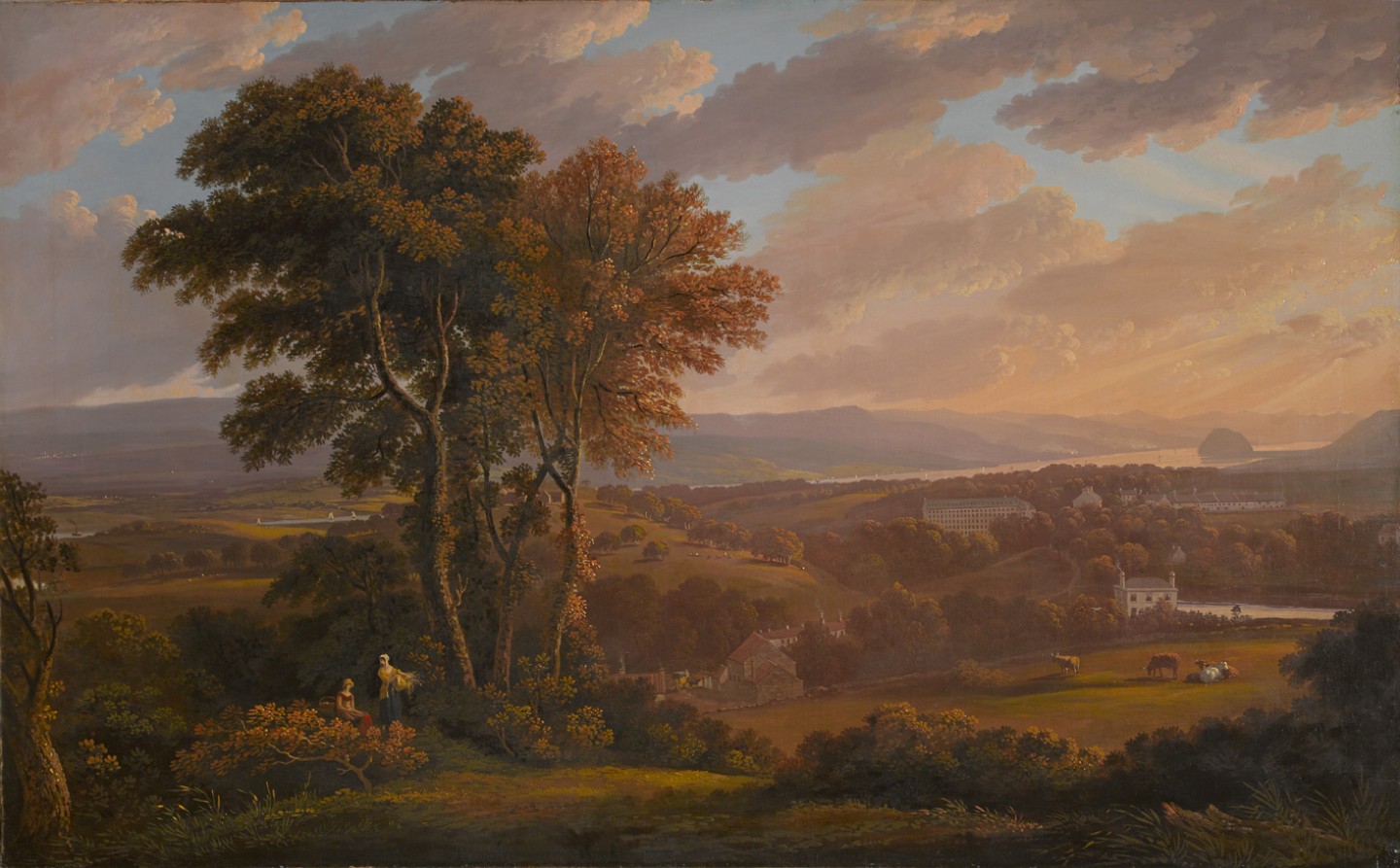
View of the Clyde from Faifley and Duntocher
John Knox


DESCRIPTION
View of the Clyde from Faifley and Duntocher by John Knox (1778-1845) captures a countryside landscape with two women foraging amongst a group of shrubs and trees in the foreground, cattle in the field beyond and in the background beyond the structures is the river running along a horizon of mountains. Small, delicate strokes of oil paint capture the details of the trees' leaves and the edges of the clouds in romantic detail. The golden hour appearance of a low sun is present with the yellow undertones in the colour palette and the sweeping strokes of paint in the distance that create some of the sun's rays from off the canvas. These small, deliberate strokes and the attention to detail capture realistic shadows throughout the work, presenting a picturesque scene.
Knox was well known for his work with landscapes, particularly capturing views of the Clyde as a common subject and creating a picturesque quality to each work. The golden haze present in this work envokes influences of the classical traditions popular at the time for landscapes. Knox is also notable for his presentation of panoramic views, which this work is suggestive of with the expansive horizon it contains.
DETAILS
-
Artist
John Knox
-
Date
c. 1816
-
Medium
Oil on canvas
-
Object number
501
-
Dimensions unframed
91.4 × 147.2 cm
-
Dimensions framed
112 × 170 cm
-
Place depicted
Duntocher (2650646)
-
Marks
Signed bottom right
-
Subject
ARTIST PROFILE
John Knox, 1778-1845
John Knox was a significant and original landscape painter of the nineteenth century who was born in Paisley and died in Keswick. His family moved to Glasgow in 1799 and it is thought that he may have studied under Alexander Nasmyth. His early career as a landscape painter was spent in his Glasgow studio, where he also taught. In addition to fairly conventional views of the Clyde valley and other picturesque sites composed in the classical tradition, he created some highly uncommon and measurable panoramas from unusual viewpoints. He is said to have taught both Horatio McCulloch and Daniel Macnee.