The Queen of the Isles
Herbert James Gunn


DESCRIPTION
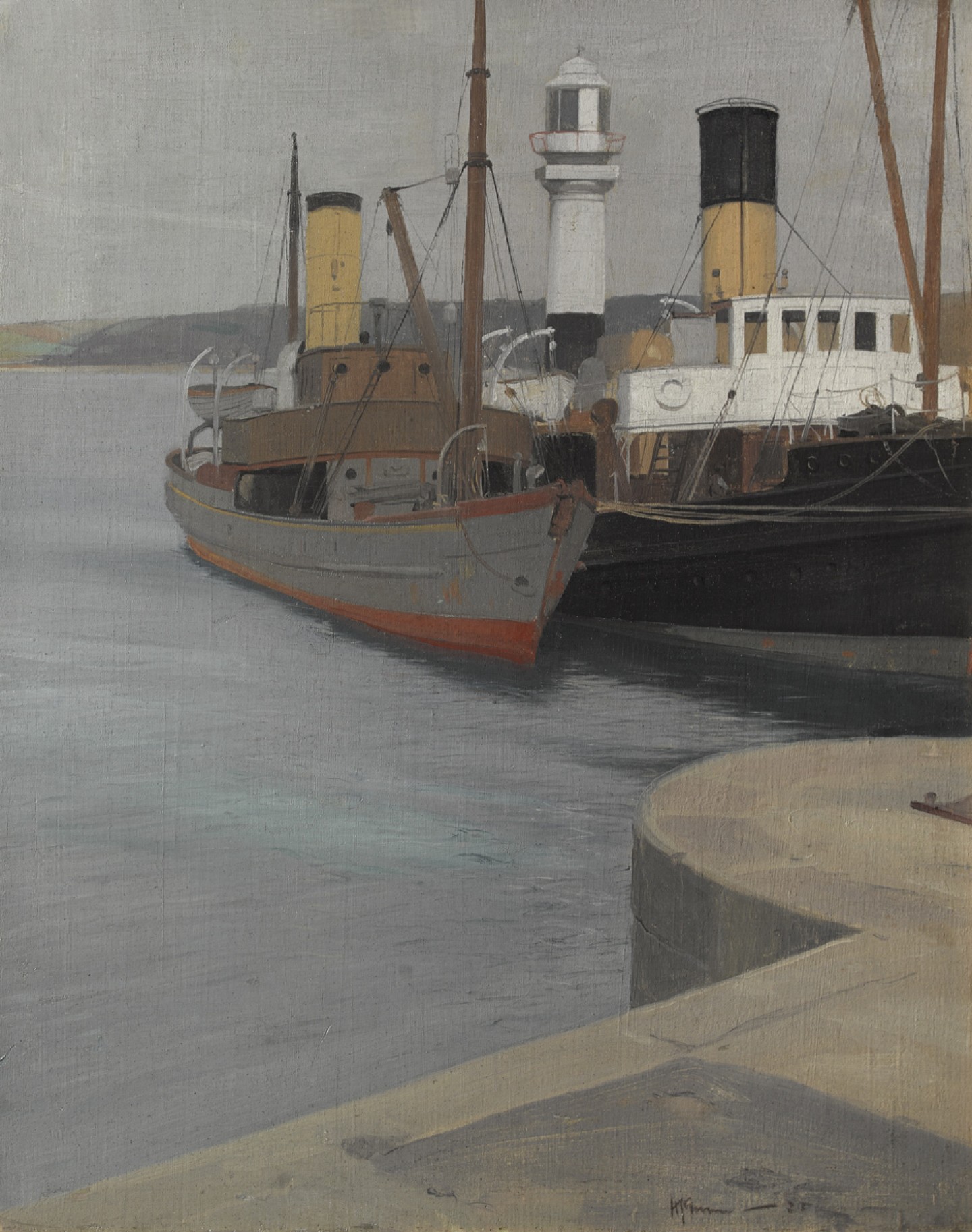
The Queen of the Isles by Herbert James Gunn (1893-1964) depicts two steam ships in a harbour with a lighthouse in the background. Gunn uses controlled layers of paint with sharp lines and stark contrasting tones to capture the scene in realistic detail. Less controlled, narrower lines capture the slight movement of the rippling water, visible especially near the ship's shadows where varying shades of blue colour show the movement and provide depth in the work. The solid layers of rich colour on the ships draw in the viewer's eye. This paired with small, delicate lines of paint give further dimension to the ships and their structure, adding to the realism.
Similar to his notable portraiture, Gunn's attention to detail is present in this work through the way he captures the ships, with smooth layers of paint and thin lines to capture the details of the rigging. These smooth, solid layers of paint that make up the subject's of his work also gained Gunn recognition as a prominent artist. While well known for his portrait paintings, this work speaks to the skillset Gunn had when it came to capturing subject's in realistic detail.
DETAILS
-
Artist
Herbert James Gunn
-
Date
Unknown
-
Medium
Oil on canvas
-
Object number
402
-
Dimensions unframed
59.3 × 44 cm
-
Dimensions framed
76 × 60 cm
-
Marks
Signed bottom right
-
Copyright
Ⓒ The Artist's Estate. All Rights Reserved 2019/Bridgeman Images
ARTIST PROFILE
Sir Herbert James Gunn RA, 1893-1964
Born in Glasgow, the son of a tailor, Gunn spent a brief period at Glasgow School of Art before enrolling at Edinburgh College of Art in 1910. He spent some time in Paris before returning to settle in Scotland, where he exhibited his first two portraits at the Royal Scottish Academy in 1913. Gunn was a friend and contemporary of the Edinburgh Group painted William Oliphant Hutchison, and his and Hutchison's portraits were recognised as being far superior to those of other portrait painters at this time. Hutchison's diploma picture in the Royal Scottish Academy was a portrait of Gunn.
Although Gunn's reputation was to be made as a portrait painter, his early success came with fluently painted landscapes executed in France and Spain before the First World War. After his demobilisation Gunn settled in England, although he maintained strong links with his native Glasgow. His career as a society portrait painter took off, and in 1953 he was commissioned to paint the Queen at the beginning of her reign.