
Sir George Reid PRSA
James MacGillivray


DESCRIPTION
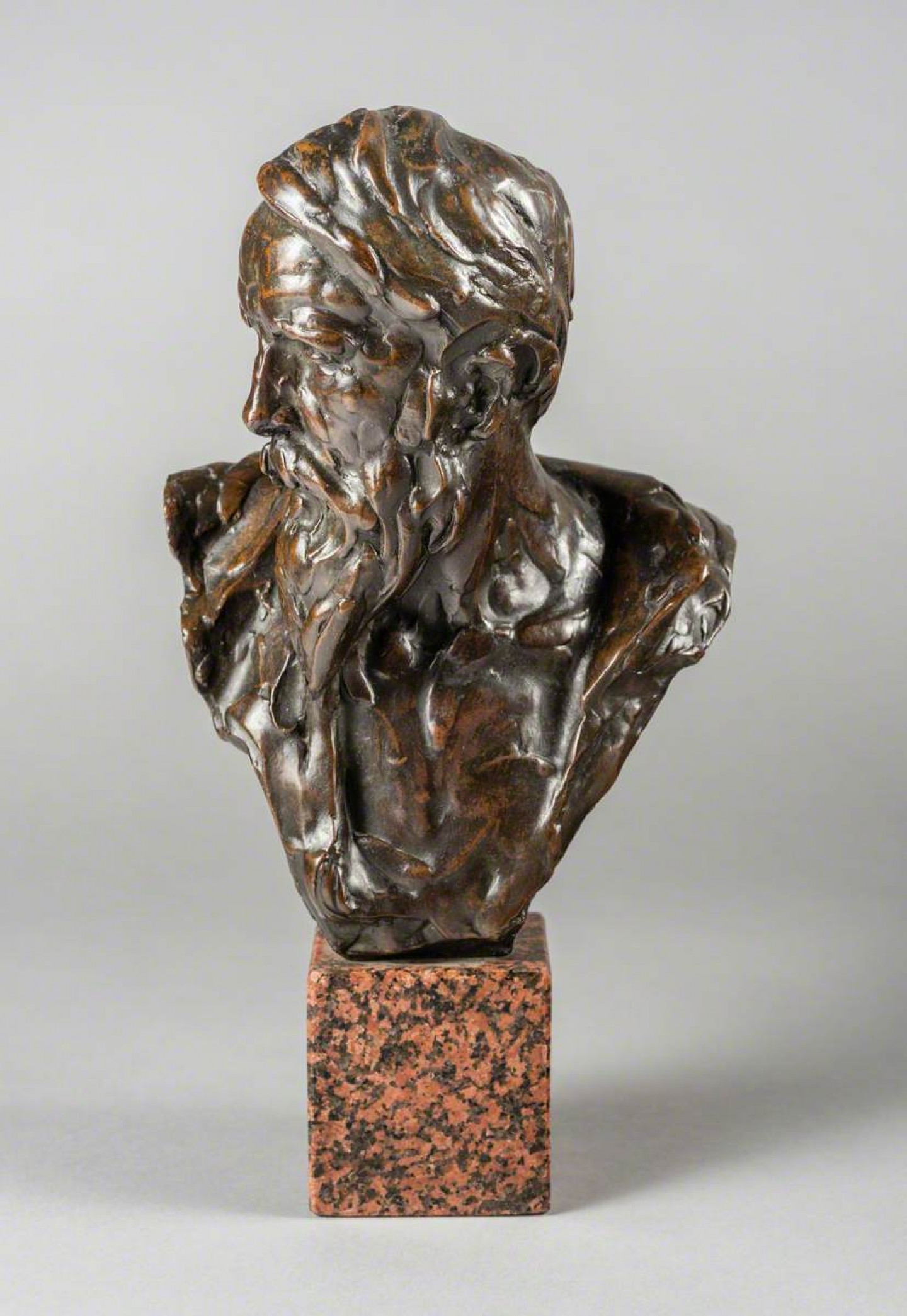
Sir George Reid PRSA by James MacGillivray (1856-1938) is a bronze bust showing Sir Reid looking towards his right. The bronze is in thick, rounded layers to capture the loose texture of Reid's hair and clothing, also creating a softer appearance to his face. The lack of small details creates more movement in the way Reid is looking away, almost as though it was a movement captured in time.
MacGillivray's talent as a sculptor is present here through the way he captures the intensity of Sir Reid's focused stare to the right and the feeling of movement in the work. Sir George Reid was a fellow Scottish artist known for painting portraits and landscapes.
DETAILS
-
Artist
James MacGillivray
-
Date
Unknown
-
Medium
Bronze
-
Object number
967
-
Dimensions unframed
34 × 16 × 7.8 cm
-
Marks
Inscription - MacGilivray / No. 6
-
Subject
ARTIST PROFILE
James MacGillivray, 1856-1938
James Pittendrigh MacGillivray was born in the Aberdeenshire village of Port Elphinstone son of a sculptor. He learned sculpture in Edinburgh and Glasgow under William Brodie and John Mossman. He was a well-known and accomplished sculptor, poet, painter, printmaker, and photographer. During the 1870s, he met the Glasgow Boys, a group of young painters who influenced MacGillivray to take up painting and become a member of the Glasgow Art Club for over fifty years. He married painter Frieda Röhl in 1886. Throughout his career, MacGillivray primarily worked as a bronze sculptor. In 1895, he provided illustrations to the Spring and Autumn volumes of The Evergreen: A Northern Seasonal, published in Edinburgh by Patrick Geddes and Colleagues. In the late 1890s, he joined the Scottish Arts Society. In 1901, he was elected to the Royal Scottish Academy and designed the Academicians' robes. In 1921, he was named King's Sculptor in the Ordinary for Scotland. He was instrumental in the growth of arts education in Scotland, having been involved in the founding of Edinburgh College of Art. After the deaths of his wife in 1910 and his daughter in 1917, he shifted his emphasis to poetry and photography. MacGillivray was an outspoken nationalist who supported Home Rule.