Self Portrait
William Johnstone


DESCRIPTION
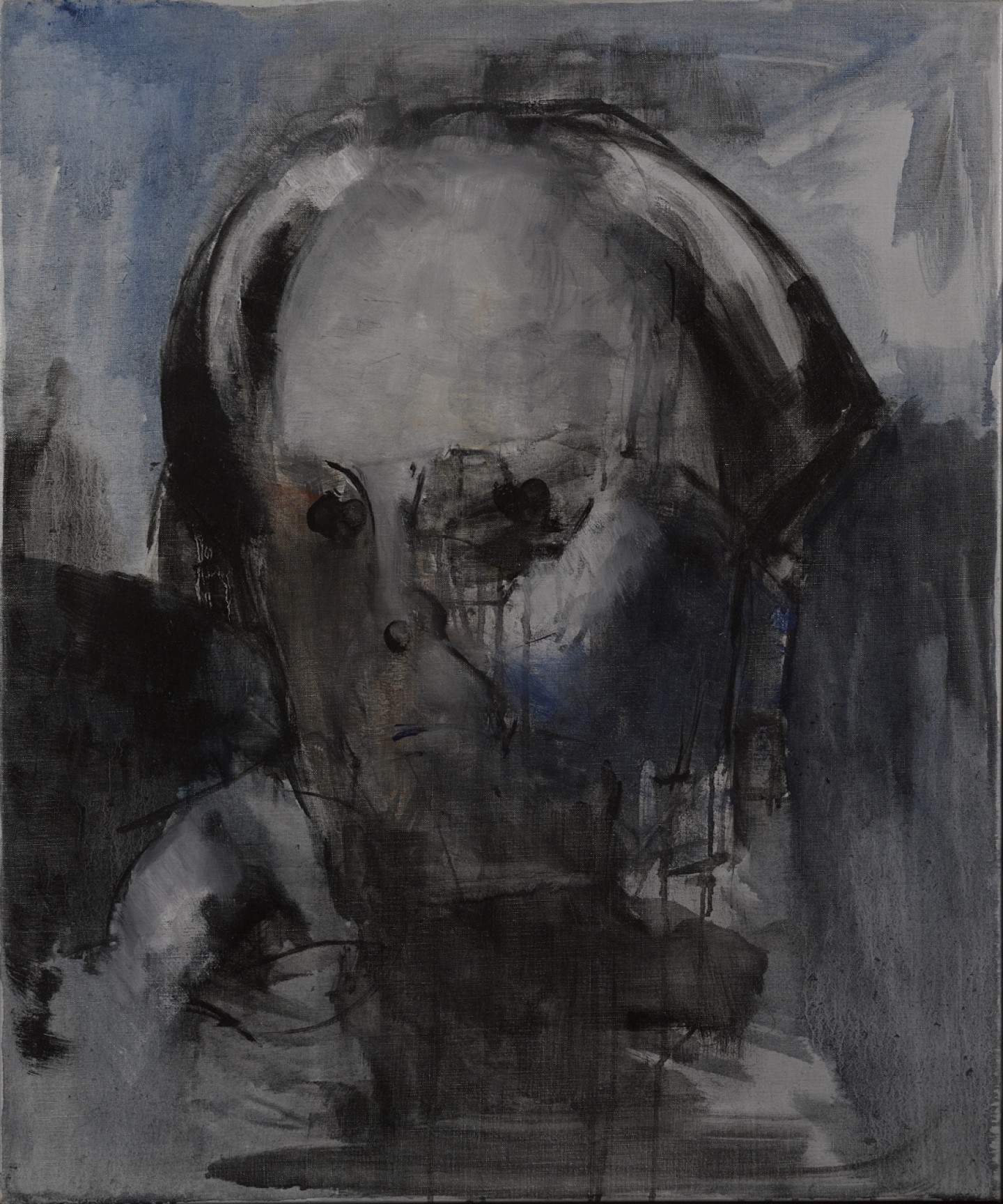
Self Portrait by William Johnstone (1897-1987) is a contemplative piece that employs blended strokes of grey and blue colour with black lines in varying thickness to loosely capture the face of the artist. Two black circles, with square strokes sweeped underneath one to capture the shadows of an eye socket, create the suggestion of a blank stare. Slightly wiped away black lines form the suggestion of the bridge of a nose, with a curved stroke making the point, that then falls into a single downturned line for the mouth. The wet, sweeping strokes of dark grey on the bottom half of the piece add to the overall gloomy atmosphere. Some of the paint has even dripped down the canvas, further evoking an emotion of sadness for the viewer.
Johnstone often employs a wetter technique to his work, showing paint running down a work and blending with other elements. Through these more abstract elements, Johnstone captures emotion in unique ways. While this is done in oil, it is suggestive of his earlier influences from watercolourists, of letting the paint drip and pool into multiple areas and possess a flowing quality to it. The smearing technique present in this work shows Johnstone's developed skillset attributed to gestural expressionism, where paint is applied throuch very active, physical movements.
DETAILS
-
Artist
William Johnstone
-
Date
1978
-
Medium
Oil on canvas
-
Object number
1035
-
Dimensions unframed
76 × 64 cm
-
Dimensions framed
82 × 69 × 3.5 cm
-
Subject
-
Copyright
© The Estate of Sarah Johnstone
ARTIST PROFILE
William Johnstone OBE, 1897-1987
Johnstone, born at Denholm, near Hawick, Roxburghshire. had his interest in art encouraged by the watercolourist Tom Scott. He attended Edinburgh College of Art from 1919 to 1923, and in 1925 a travelling scholarship enabled him to study under André Lhote in Paris. He married and spent about a year in California and two or three years teaching art in Scotland before moving to London in 1931. He became Principal of Central School of Arts and Crafts in 1947, retiring in 1960.
Johnstone was an inspired and influential teacher and writer on art, and in his paintings, he was one of the most original artists of his generation. His work is almost wholly abstract, although much of it has a basis in landscape. Early in his career he developed a form of surrealistic abstraction, which later led on to a gestural expressionism.