After John Flaxman
Ian Hamilton Finlay


DESCRIPTION
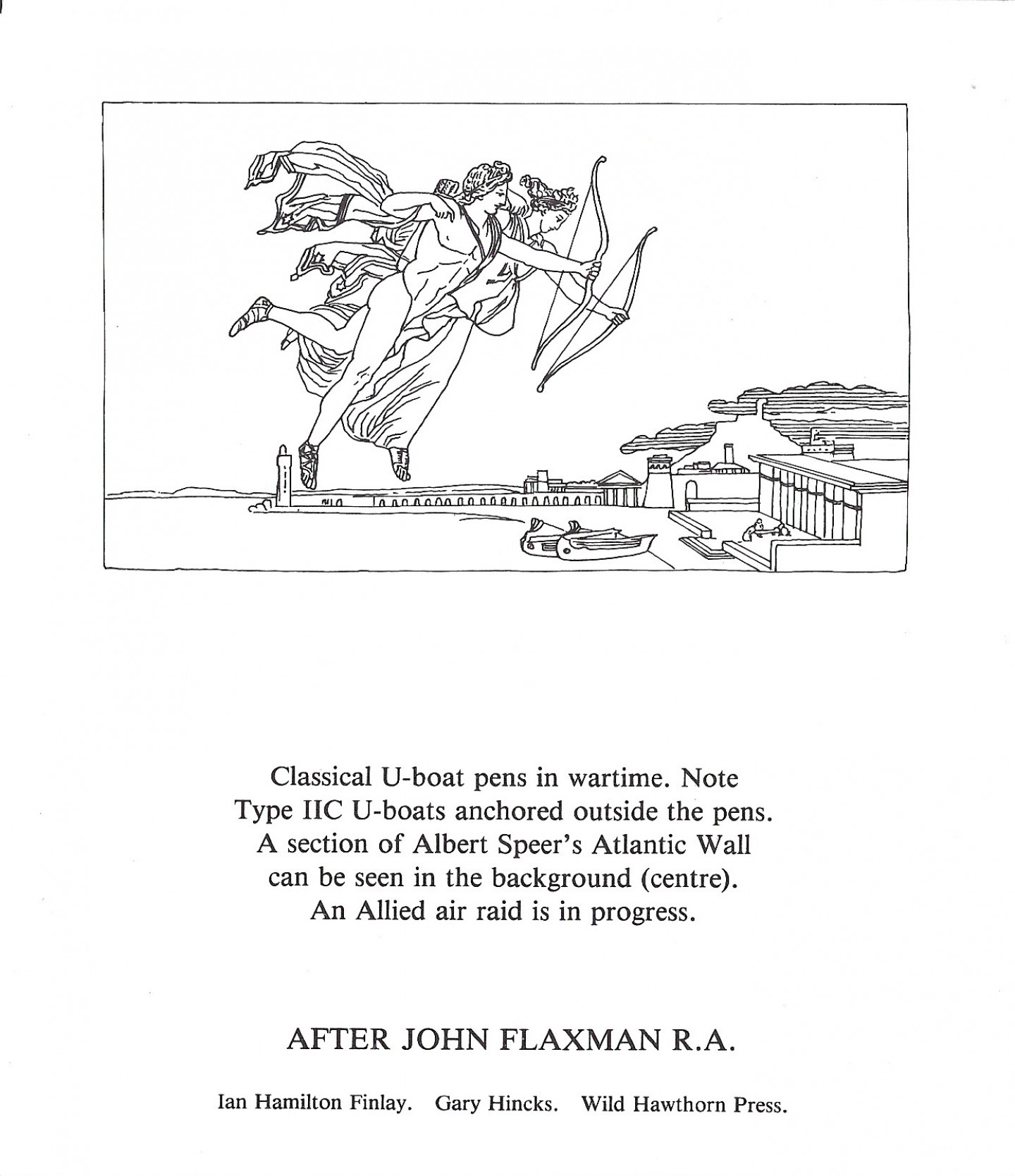
After John Flaxman by Ian Hamilton Finlay (1925-2006) is a print with one black and white section depicting Artemis and Apollo with their characteristic bows and quiver above a harbour that mixes architecture of ancient Greece and modern Europe. Below this is a poem that describes the presence of U-boats in the scene and the architectural components. Within this, Finlay describes the mythological twins as an 'Allied air raid', almost implying a comparison of an act of god in terms of the Allies work during the war.
This print reflects Finlay's reflections on WWII and his use of combining poetry and art in his work. This work particularly connects classical elements with modern history, suggestive of the large influence the war had across the world.
DETAILS
-
Artist
Ian Hamilton Finlay
-
Date
1980
-
Medium
Print on card
-
Object number
3252
-
Dimensions framed
34.3 × 29.3 × 3.4 cm
-
Copyright
© Courtesy of the Estate of Ian Hamilton Finlay
ARTIST PROFILE
Ian Hamilton Finlay CBE, 1925-2006
Although he studied at Glasgow School of Art, Finlay’s first creative success was as a writer. His discovery of concrete poetry in the 1960s was a major breakthrough in his practice and he began to produce booklets, posters, and wall-mounted works combining text and form. Major works of conceptual sculpture using text were produced by craftsmen to his specifications. Drawing on ideas from classical philosophy and the French Revolution, he began to exhibit widely and was shortlisted for the Turner Prize in 1985. His garden at Little Sparta in the Pentland Hills, begun in 1966 and now looked after by a trust, is considered to be the finest manifestation of his work.