
Scottish Art News
Latest news
Magazine
News & Press
Publications
Unravelling the riddle of William Johnstone
By Beth Williamson, 19.04.2026
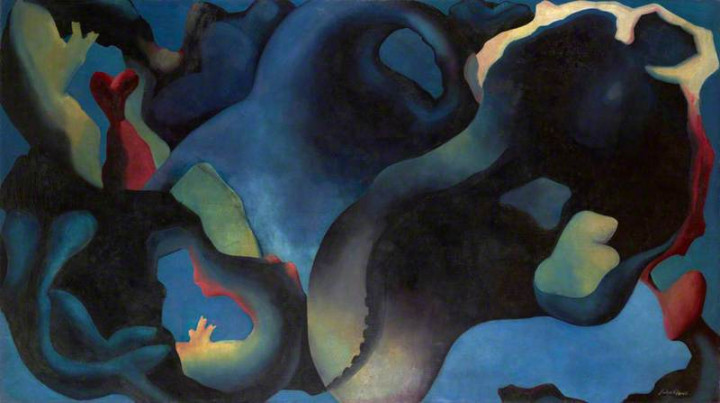
In a radio broadcast on the BBC Home Service in October 1939, Winston Churchill eloquently described a difficult to comprehend situation as 'a riddle wrapped in a mystery inside an enigma'. He was thinking about the early developments of the Second World War, but could equally well have been describing a painting by William Johnstone (1897–1981), 'A Point in Time' (1929/1937). If you visit the Scottish galleries at the National in Edinburgh, it is the first painting you encounter. Of this and two other paintings, Johnstone said they were anti-war paintings that ‘grew out of my horror of the disease of war, of the anticipation of future tragedy – they were never intended for drawing rooms’. Large in scale and ambition, 'A Point in Time' also embodies Johnstone's approach to making. That approach meant having a vast skill-set at his disposal, while remaining alert for that 'point in time' when he felt intuitively that something of consummate creative value could be achieved, sometimes in an instant.
Johnstone is known in Edinburgh and the Borders as a Scottish painter. In London, he is known as an educator, if indeed he is known at all. My intent in the research for this book was aways to bring these two aspects of his long career together with his own art education at Edinburgh College of Art (ECA). It seemed incredulous to me that Johnstone's making, teaching and learning would have developed independent of one another. Further, I wanted to explore how unique cultural and intellectual contexts may have impacted upon him and played out in his practice, hence why it was approached as a cultural biography.
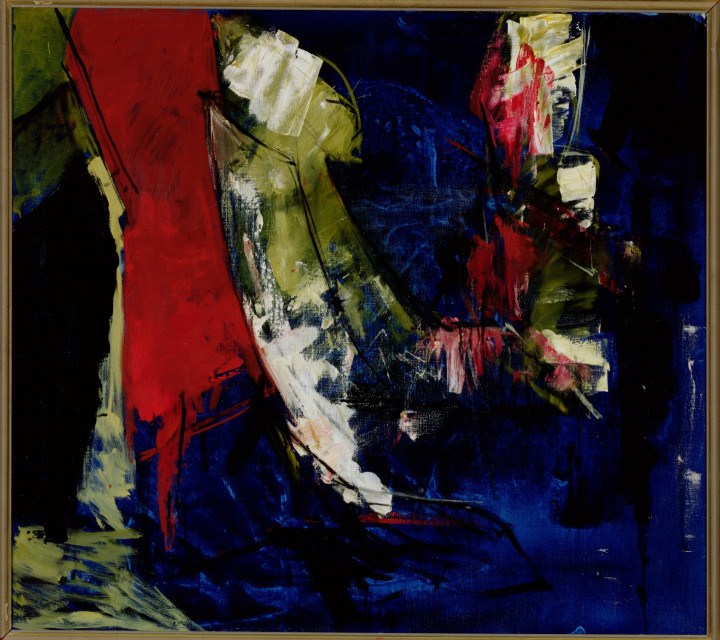 William Johnston, ‘Entombment (1972). © the artist's estate. Image credit: The Fleming Collection
How, then, might we better understand Johnstone and his approach to making, teaching and learning? While training for his Diploma at ECA (1919–23), with additional drawing classes at ECA and the Royal Scottish Academy, Johnstone was attracted to the writings of William Richard Lethaby (1857–1931) on the Arts and Crafts movements, while the ideas of Patrick Geddes (1854–1932) and D'Arcy Wentworth Thompson (1860–1948) were important points of reference in the Edinburgh cultural scene. Arthur Pillans Laurie (1861–1949), the Director of Heriot-Watt College from 1900 to 1928, was another significant thinker, this time in relation to craft education and a holistic education more broadly. It was in Edinburgh too that Johnstone first met the poet Hugh MacDiarmid (1892–1978) and composer Francis George Scott (1880–1958). Together, they were key protagonists for a new Scottish Renaissance. The plurality of Johnstone's painting lent it an internationalism that did not eschew its Scottish origins, but fully enlarged upon them. It was this foundational period that set the scene for Johnstone's interest in an open and outward-looking perspective on making and teaching.
When Johnstone travelled to Paris, he studied at the studio of André Lhote where drawing was vital. Meanwhile, A.P. Laurie’s ‘The Painter’s Methods and Materials’ (1926), bought by Johnstone in Paris upon its publication, was fundamental grounding for his intuitive approach to making. This was also where he established a life-long friendship with American lawyer turned artist Max Bernd-Cohen (1899–1987) and married his first wife, the American sculptor Flora Macdonald (1904–76). Following a brief return to Scotland, the couple travelled to America where Johnstone taught for a period at the California School of Arts and Crafts under Xavier Martinez.
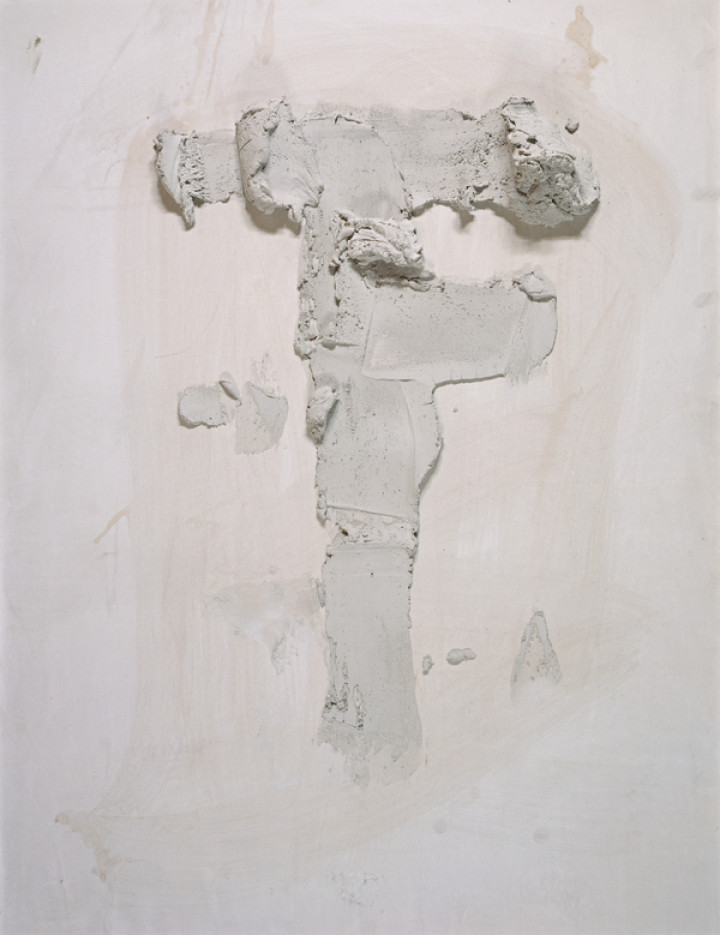 William Johnstone ‘Embryonic’ (1972 – 1973). © the artist's estate. Image credit: The National Galleries of Scotland
Later, in London, and following numerous short teaching positions, first in boys' schools, then in evening institutes and polytechnics, Johnstone became Principal first of Camberwell School of Arts and Crafts (1938–46) and then the Central School of Arts and Crafts (1947– 60). He married his second wife Mary Bonning in 1944. In London, Johnstone moved in theosophical circles, particularly through the publisher Stanley Nott, and developed an unconventional understanding of time, both things that fed into his painting. He admired the writings of Ananda K Coomaraswamy whose famous essay 'Why Exhibit Works of Art?' (1942) may help us to understand Johnstone's reluctance, at times, to exhibit. It was at Camberwell that he first developed Basic Design training with the help of Albert Edward Halliwell (1905–86) and Peter Norman Dawson (1902–60). At the Central School, these ideas were developed further and he recruited a number of fellow Scots to his staff - Eduardo Paolozzi (1924–2005), Alan Davie (1920–2014) and William Turnbull (1922–2012) - all of whom would have experience similar pedagogical sensibilities to Johnstone in their own art education.
Upon his retirement from the Central School in 1960, Johnstone returned to the Borders. Freed up from the responsibilities of principalship, encouraged by the support of a new patron, Hope Montagu Douglas Scott, and championed by the founding Keeper of the Scottish National Gallery of Modern Art, Douglas Hall, Johnstone entered a more prolific period of painting than ever before. Late in life he developed new modes of working. Two livre d'artiste were made in last decade of his life. One, a collaboration with Hugh MacDiarmid (1977) and the other a dialogue with the work of Orcadian poet Edwin Muir (1981). It was in the early 1970s too that Johnstone made plaster works such as Genesis (1972–3), a material shift but similar in conception to many of his tachist works on paper. Later, in his retrospective exhibition at the Hayward Gallery (11 February to 29 March 1981) the elderly artist showed a series of new found works mounted on plinths of stone or wood.
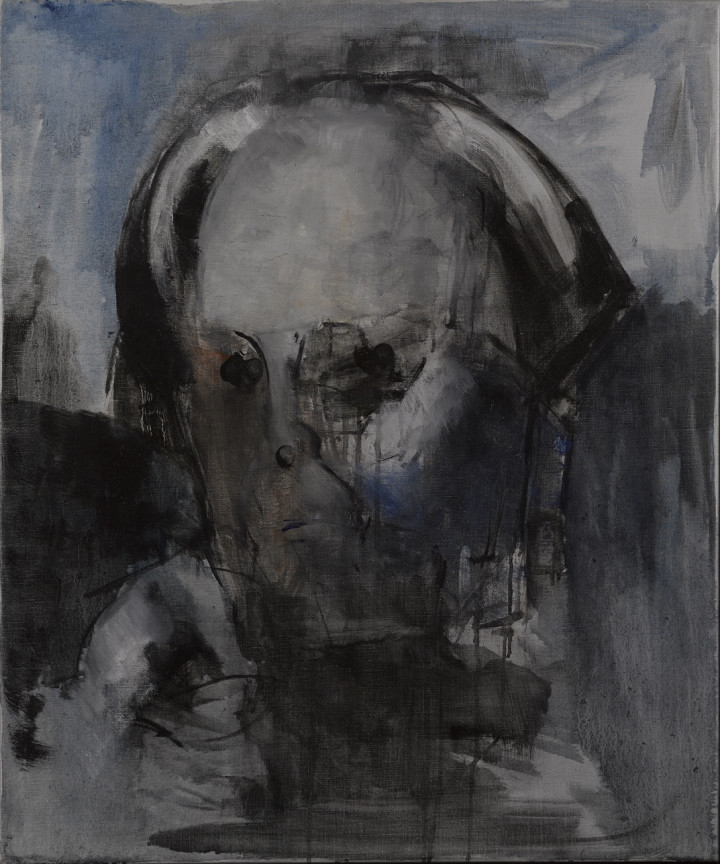 William Johnston, ‘Self Portrait’ (1978). © the artist's estate. Image credit: The Fleming Collection
It was perhaps Johnstone's reluctance to exhibit, along with decades of arduous educational duties, that helps to explain why he has been overlooked, until now. Another contributing factor may be his reputation not only as a Scottish painter, but as a Borderer specifically when his interests and appeal were, and are, more capacious than that. For Johnstone, the flourishing of work and ideas was perpetual, and his enigmatic relationship with time and place made him one of the most beguiling artists of his time and ours. It is Johnstone's outward looking openness that must be acknowledged, so too his creative and intellectual acumen, if his work and its significance is to be fully understood. Ultimately, Johnstone's work recognised a traditional and national legacy which supported, rather than denied, Scottish histories, while preserving its, and his, international modernist credentials. Although some of his paintings delve into the depths and despair of war, others are joyous meditations on the natural world. It is at these edges of experience that Johnstone’s work retains relevance in contemporary times.


