
Scottish Art News
Latest news
Magazine
News & Press
Publications
Thread Memory: Embroidery from Palestine at the V&A Dundee
By Shalmali Shetty, 23.04.2026
It is not often that you walk into an exhibition of a culture’s history while witnessing, in real time, its ongoing destruction and the genocide of its people. At V&A Dundee, Thread Memory: Embroidery from Palestine makes that dissonance unavoidable, reframing what would otherwise be a historical display into something inseparable from the present.
Curated by Rachel Dedman, the exhibition builds on its earlier iteration at Hayy Jameel in Jeddah. Drawing on archives and collections from the Palestinian Museum in the West Bank, the V&A in Dundee and South Kensington, and Art Jameel, the display spans the 19th century to the present, bringing together hand-embroidered material culture - including more than thirty traditional dresses, jewellery and accessories, as well as protest posters, riso-prints, archival photographs, short video interviews, and contemporary interventions. Each object bears witness to everyday life, identity, resilience, and to economic and political shifts, while also carrying the risk of being reduced to mere objects in display cases.
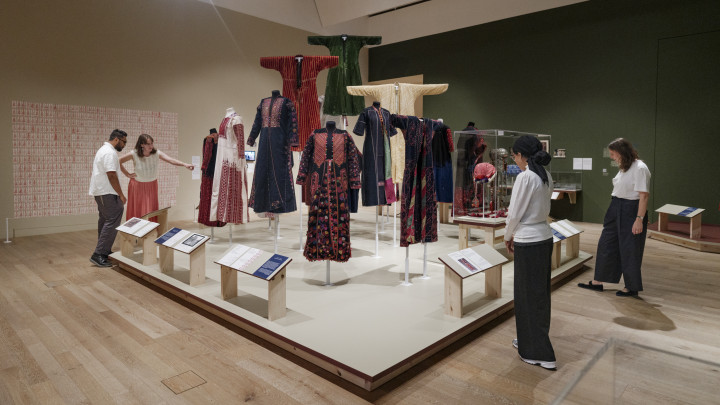 Thread Memory - Full Selection - June 2025 - Grant Anderson
Traditional Palestinian cross-stitch hand-embroidery, known as tatreez in Arabic, is used in making intricately embellished thobes - long robe-like dresses worn by women across the ethnically diverse communities of Palestine. Each stitch, design, and style of these dresses is tied to specific regions, carrying stories and cultural memory while functioning as a visual identifier of the wearer’s community and place of origin: whether from trading centres like Gaza, agricultural villages in Galilee that used lighter embroideries, or affluent cities in the West Bank where gold and silver threads were incorporated. Colour also carries meaning; for instance, in Bedouin communities, blue is associated with grief, with blue-dyed thread gradually fading back to its original colour marking the end of a mourning period.
Tatreez also extends into everyday objects and material culture, from embroidered pillow covers and doll dresses to jewellery and accessories, as well as the headdress known as the waqa’a al-darahem, worn by brides and made with coins, beads, glass, shells, and metals - some of which are on display here. The exhibition also traces wider international trade relations and structures of economic control. Garments such as the Bethlehem taqsireh, a short embroidered jacket often made with velvet, appear here lined with tartan, revealing the influence of British textiles exported into Palestine during the British Mandate. The use of cotton, linen, and wool further situates these objects within trade exchange with neighbouring regions.
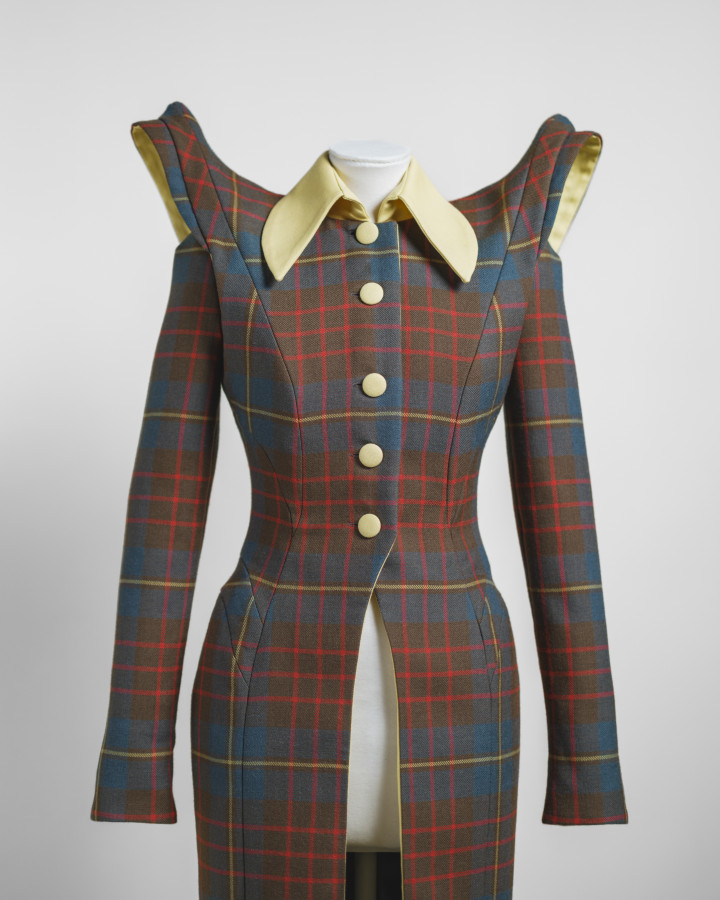 Look from the KALT collection 2025 Zeid Hijazi - front
In 1917, Arthur Balfour, a Scottish-born British statesman, issued the Balfour Declaration, supporting the establishment of a “national home for the Jewish people” in Palestine and shaping the conflict that followed within the broader context of the British Mandate. With increasing Jewish immigration in the 1930s, particularly amid persecution in Europe, the Nakba, or “catastrophe” of 1948, marks the mass displacement of Palestinian people. Around this time, a shift in the symbolic language of tatreez begins to emerge, moving into an urgent act of assertion, defiance, and solidarity, centring the labour of women in preserving and shaping Palestinian national identity. During the First Intifada (1987-93) - the Palestinian uprising against Israeli occupation in the West Bank and Gaza - traditional motifs were reworked into new embroidered forms, including “Intifada dresses” that incorporated banned symbols and the colours of the Palestinian flag as expressions of resistance. Photographs from this period show women embroidering during curfews and by candlelight, while also confronting the Israeli military forces in public acts of dissent, shifting embroidery beyond domestic spaces into public demonstration and political struggle. Each piece functions as a lived record that is meant to be carried through generations.
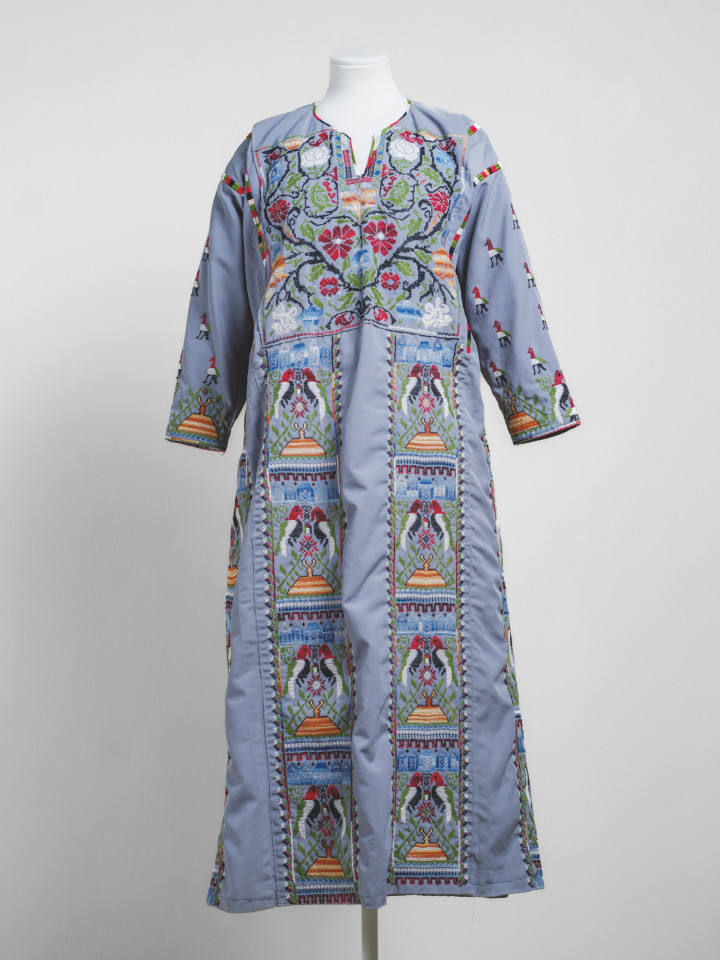 Intifada dress 1987-1993 The Palestinian Museum Collection
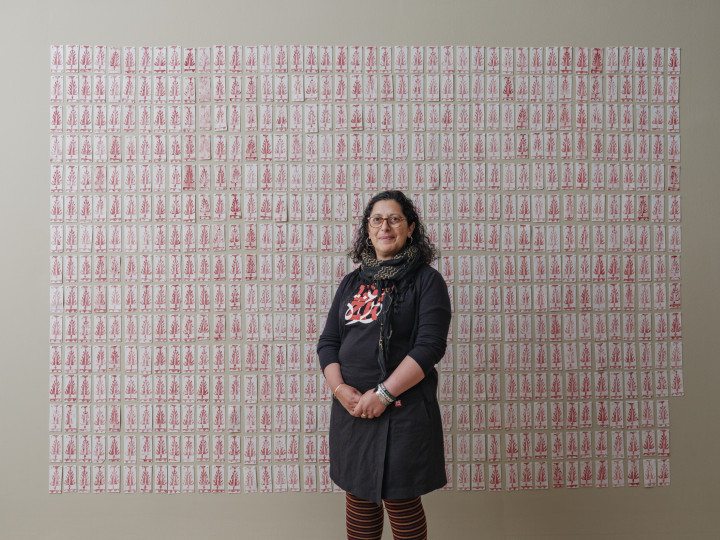
One of the most aching moments comes with the display of a dress from the Rafah Museum, damaged during a 2023 bombing and marked by holes, tears, and long strips of discolouration, caught between history and its present condition, and serving as a reminder of the pain, loss, grief, and struggle of survival carried through generations. Alongside this are contemporary artistic responses, including a section presenting an evolving language in fashion informed by traditional design, with Arab futurist work by Zeid Hijazi combining tartan and tatreez into punk-like forms, speaking to ongoing efforts to preserve stories and heritage for future generations. Also included is an installation of 626 clay tablets by Leena Nammari, each representing a destroyed Palestinian town or village, and works by Aya Haider, whose floating embroidered plastic bags reflect what Palestinian families have carried with them through displacement and dispossession.
The exhibition marks 45 years of Dundee’s twin-city relationship with Nablus in Palestine, established in 1980 when Dundee became the first city in the UK to fly the Palestinian flag as a political act. The flag has remained at the City Chambers in Dundee ever since.
Thread Memory: Embroidery from Palestine is exhibited at Dundee V&A until 26th April


