
Scottish Art News
Latest news
Magazine
News & Press
Publications
The Secrets of Painting: Interview with writer and artist Lachlan Goudie
By Susan Mansfield, 30.03.2026
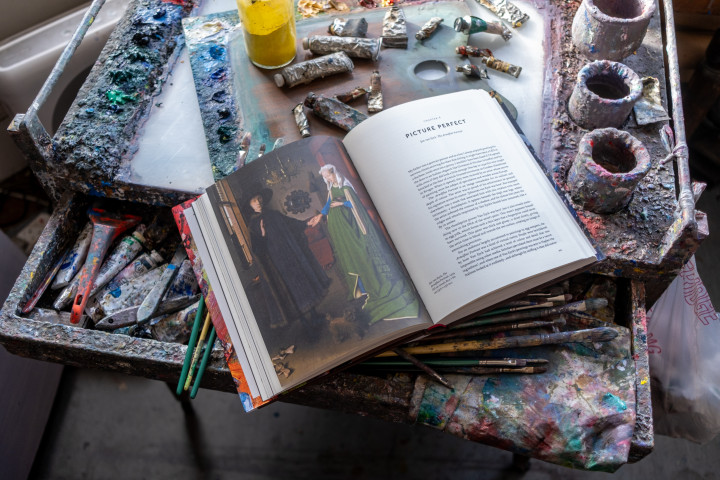
Lachlan Goudie and I take just under an hour to go through the history of art, beginning with horses painted on a cave wall in Chauvet, France, some 36,000 years ago, and ending in a studio in California where digital artist Refik Anadol is making art with AI. This is the epic journey Goudie undertakes in his new book, The Secrets of Painting.
“Ignorance is bliss, and when I walked into this project I didn’t ever anticipate it being quite as epic as it became,” he says, with a wry smile. “I’ve spent a lifetime thinking about the kinds of things that are in the book: what did Rembrandt put in his paint? how did Duccio mix egg tempera? I wanted to find these things out. I just didn’t realise it would end up with me writing the history of art.”
Goudie is best known for presenting The Story of Scottish Art, a four-part series for BBC Two in 2015, and for the book of the same name which came out in 2020, as well as exhibiting his own work. He has carved out a niche as a writer and presenter on art history who is also a painter, interested in materials and techniques, the ‘how’ of art-making.
The Secrets of Painting goes deeper in this vein. The task: to discuss 20 masterpieces of world art - from China, India, Japan and Aboriginal Australia as well as from the Western canon - tell the story of how they were made and try some of the techniques himself. It’s hardly surprising it took five years, including two in which he had to stop painting to concentrate on writing.
.jpg) Lachlan Goudie. Photo: Alistair McCormick
Lachlan Goudie. Photo: Alistair McCormick
The first six months were spent “rooting through the whole of art history” to identify the works he would focus on. “It quickly became apparent this was about more than picking the most famous paintings from different eras. Each work had to allow me to discuss a milestone, a technical shift, a springboard towards a new way of painting.”
The book describes “big bang” moments in the evolution of art which are often less to do with genius (although that’s there as well) than technical, practical developments such as painting on canvas, or the making of a flat-headed paintbrush. Goudie says: “In the medieval studio, someone would have been responsible for threading together the squirrel tails and stoat hairs and putting them into the goose quills. Those brushes would only ever have afforded you one particular kind of brushstroke. It took until the 19th century when a simple device like a metal bracket meant that brush heads could be flat as well as just round. That was a eureka moment.”
Through the stories of masterworks such as Giotto’s ‘Scrovegni Chapel’, Jan van Eyck’s ‘The Arnolfini Portrait’ and Titian’s ‘Diana and Actaeon’, he describes how a fusion of talent and technical innovation push art forward. “It’s not entirely led by the artistic genius, it’s a sensibility in the creative person to the materials at their disposal, how they respect the materials but also challenge themselves to push the materials further.”
His research involved not only conversations with curators and conservators, but trying traditional painting methods hands-on, such as fresco (“a nightmare”) and encaustic, a painting technique involving melted bee’s wax which was used in Roman Egypt in the first century BC.
“Being taught about how to use encaustic, particularly in the way we think it was employed in Roman Egypt, was bonkers in the level of complexity, new implements and ingredients. And risks! My tutor told me not to let the temperature rise above 90 degrees because at that point the fumes from the beeswax become toxic. I gained a lot of respect for the people centuries ago who were completely acquainted with these techniques and used them with speed and agility and grace every day.”
He says that every chapter brought “an eye-opener”, a nugget he could take back and apply to his own painting practice, and he hopes the book will open doors of understanding for readers about how masterpieces were made, whether or not they are artists themselves. It’s how art has been taught for hundreds of years: in the studio of the master.
His own formative, technical training happened not at art school (Camberwell, where he went after a degree in English at Cambridge) but in the studio of his father, Scottish artist Alexander Goudie. “He never sat me down and taught me, he was a reluctant teacher, but every so often he would give me a little bit of an insight, and if I was drawing or painting next to him he would always make a point of commenting on what I was doing.
“Now, my six-year-old son will come into my studio and just stand and stare at what I’m painting, and I’m seeing myself walk in, watching my dad paint. My son’s thing is to say ‘I just can’t draw as well as you’, and I think to myself ‘Bloody hell, I remember saying that to my dad’. We’re always trying to meet the bar set by our ancestor, either in our family or, in the case of the book, century upon century of other painters. Each one of them represents a painting challenge I want to imagine I could rise to. Of course, I can’t in 99 per cent of cases, but what can they teach me? I’m going to try to find that out.”
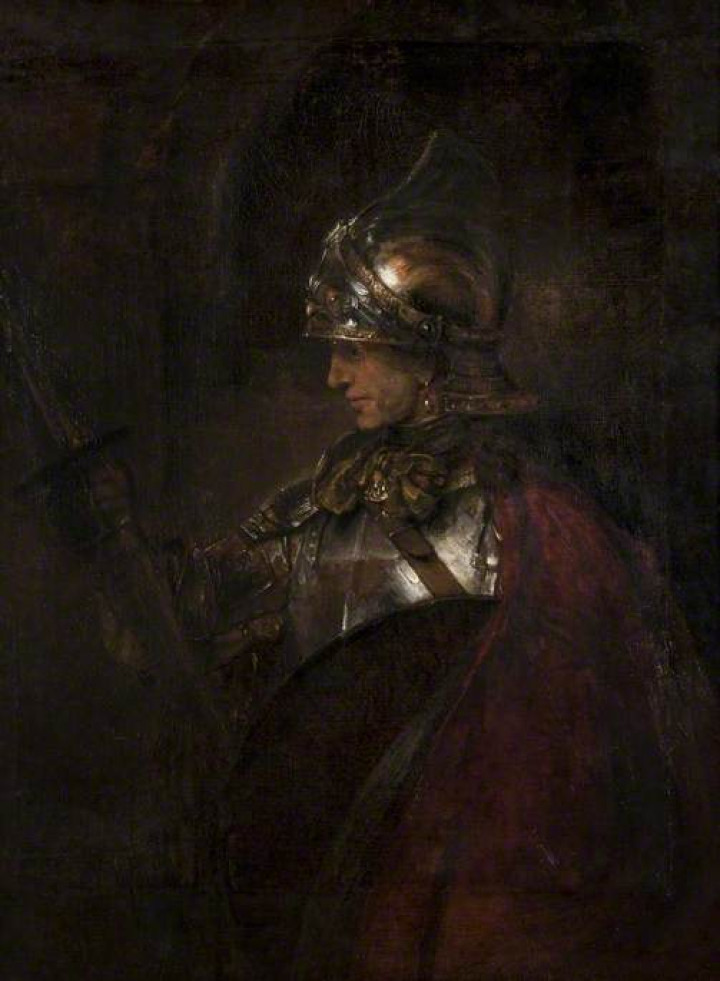 Rembrandt van Rijn (1606–1669), A Man in Armour (c. 1655). Kelvingrove Art Gallery and Museum.
He was able to include in the book one painting he has loved since childhood, Rembrandt’s ‘A Man in Armour’, from Kelvingrove Art Gallery, the techniques of which are still a mystery to art historians. “It was wonderful to get really close up and examine the brushstoke-by-brushstroke wonder of how Rembrandt did it, and then to start learning about the background: what is the subject? Who is the subject? Could it have been his son?”
More than this, he found himself imagining the everyday life happening in and around the artist’s studio. “My dad’s studio in my childhood home is part of my sensory memory, so I was thinking about that and asking questions like: How was Duccio’s studio looking at 10 in the morning? Would he have been in there first thing, or was he a bit more like my dad who liked to take his time? Did Giotto ever had to take the bins out? We admire these pictures in museums but we sometimes don’t think about the human story, about day- to-day life and struggles and bills, the creative chaos that they were born into.”
His acts of imaginative speculation helps to bring the stories of the work alive: Artemisia Gentileschi, painting her personal anger towards the man who raped her into ‘Judith Beheading Holofernes’, the worlds of Berthe Morisot, Jackson Pollock, or African American abstract painter Alma Thomas.
In the final chapters, Goudie asks what the “big bang” moments are in the evolution of painting today. Might one be David Hockney painting on his ipad, or Refik Anadol, making his commission ‘Unsupervised - Machine Hallucinations’ for the Museum of Modern Art in New York by using AI to process data and turn it into visual material?
In the spirit of hands-on exploration, Goudie tried the ipad and found it better for drawing than painting. He says AI leaves him both “terrified” and intrigued. “Reading, researching, looking at the work that Anadol creates, I was thinking about how great technological innovation in the past has brought the end of certain ways of making things but unleashed certain opportunities. I think it’s helpful to think back to Giotto’s workshop, a studio set-up of 40 or 50 collaborators, some of whom were as capable as Giotto was. The way I hope to think about AI is as a studio assistant, someone with real skills, and if you use them correctly maybe they can enhance how you go about what you do, if it’s relevant to your process.”
What emerges most powerfully across the book is the sense of continuity: the ochre clay used at Chauvet is similar to the colours used by Aboriginal artists Clifford Possum Tjapaltjarri and Tim Leura Tjapaltjarri in the 20th century. How the painters of 11th century China, 16th century Mughal India and 18th century Japan were wrestling with similar issues as Titian in Venice. Even Refik Anadol describes data as “pigment” which he “crushes” and “manipulates” to make pictures. Different worlds but the same struggle: the messy, glorious process of making art.
The Secrets of Painting by Lachlan Goudie is published by Thames & Hudson. For more information about publication events see www.lachlangoudie.com


