
Scottish Art News
Latest news
Magazine
News & Press
Publications
The Scandal of John Bulloch Souter
By Graham Fitzpatrick, 21.06.2026
The Aberdeen born artist John Bulloch Souter (1890–1972) is best known for the scandal surrounding his painting, ‘The Breakdown’. A public outcry ensued after its hanging at The Royal Academy’s Summer Show in 1926. The image had a naked white woman dancing to a black jazz saxophonist who was sat on a broken statue of the goddess Minerva. The British Colonial Office had the RA remove it after just a few days, ‘in the interest of the Empire’. Under the pressure of public opinion, Souter went as far as to destroy it.
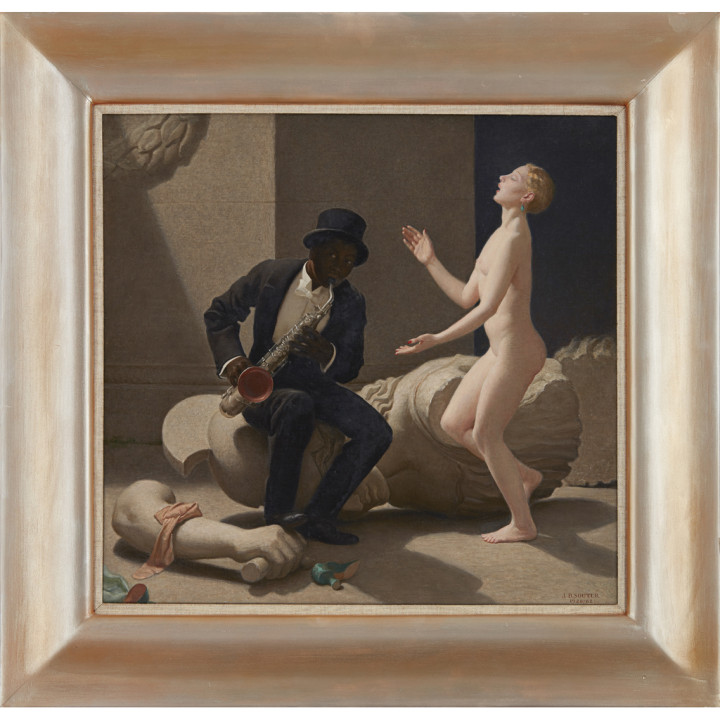 John Bulloch Souter. The Breakdown (1961). Courtesy of Aberdeen Archives, Gallery & Museums.
However, the story didn’t end there. Souter had kept his preparatory drawings, some of which are now held by Aberdeen Art Gallery and, in 1962, by which time attitudes had changed, he recreated the same image. In 2018 this new version was sold to a private collector by Lyon and Turnbull for £75,000.
Perhaps the real scandal here is that by focusing on Souter’s infamy the art world has overlooked his talent as an artist. As well as being a painter, he also worked as a sculptor, illustrator and a caricaturist. But it is his original prints, especially the portraits, that have never been fully appreciated. This is an opinion shared by Kenneth Guichard, the art connoisseur and author of what many see as the “bible” of early 20th century etchers - “British Etchers, 1850-1940”. He described Souter’s etchings as displaying, “a monumental and classic beauty combined with great refinement”, suggesting that they needed, “to be recorded more fully”. A situation yet to be rectified.
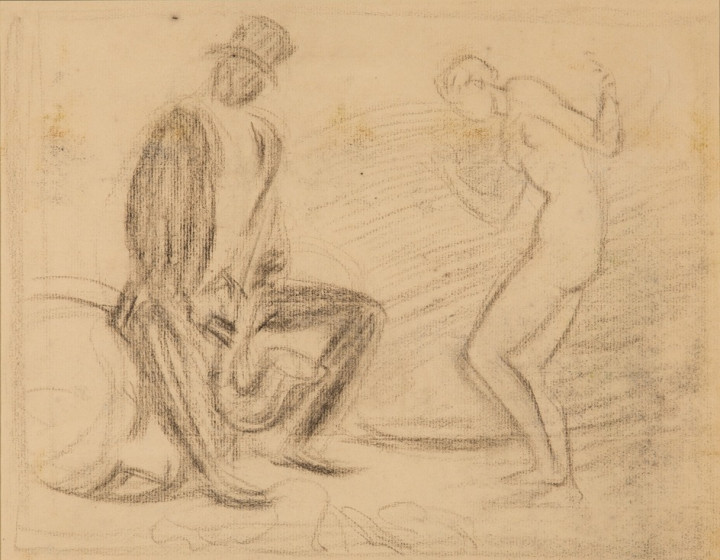 John Bulloch Souter, Study for the Breakdown 1920 © the artists estate. Image credit- Aberdeen Archives, Gallery & Museums
Souter’s development as an artist began early in life. The youngest of 7 children, his father Alexander, was a clothier but his mother, Elsie, was a talented amateur artist and it was she who encouraged his interest in art. After showing potential at Ferryhill School, he enrolled at Grey’s School of Art in Aberdeen. Various scholarships followed, allowing a further 4 years at The Allen Fraser School in Arbroath and, starting in 1912, the opportunity to study in Spain and travel around Europe painting. He was influenced by the work of Valezques, Vermeer, Baptiste and Chardin.
During WW1 he served in the Gordon Highlanders and later the Army Medical Corps. After the war he moved to London where commissioned portraits became an important source of income, with famous sitters including Ivor Novello, Fay Compton and Gladys Cooper. In 1926 he married a Scottish girl called Christian Reid who acted as the subject in many of his pictures.
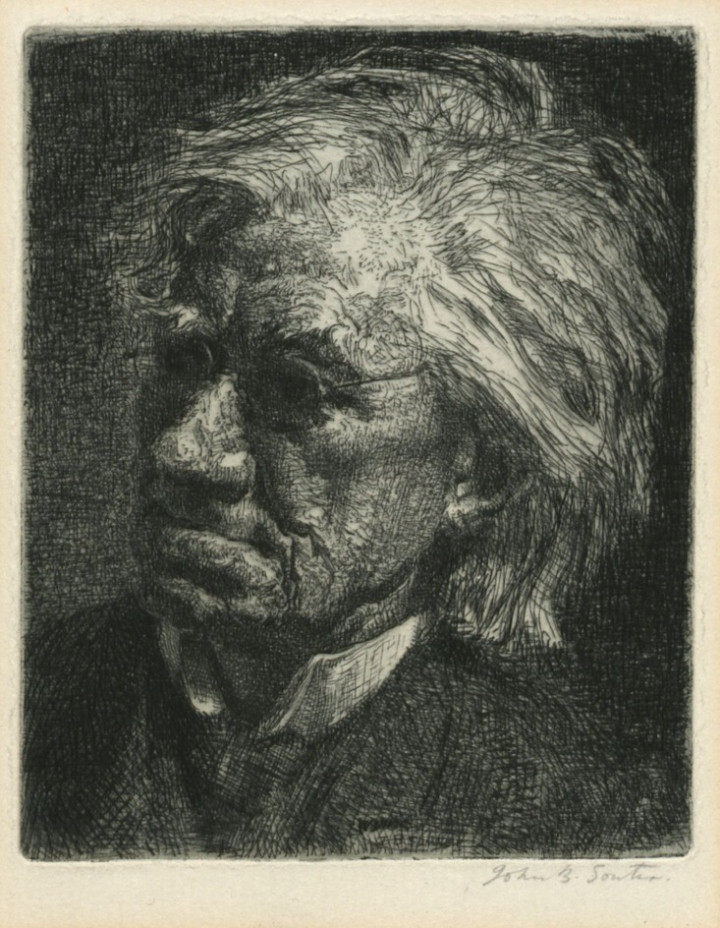 John Bulloch Souter. Portrait of Keith Leisk. Courtesy of Aberdeen Archives, Gallery & Museums.
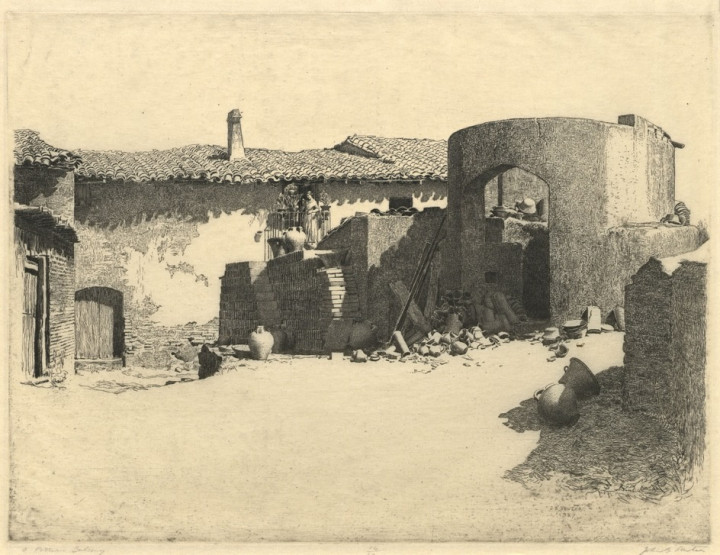
It was during the 1920s and 30s, that most of his print making seems to have taken place. These were predominantly etchings and drypoints, in a style reflecting the trends of the time. As such he was clearly part of the Etching Revival, along side his better known fellow Scots, Bone and McBay. The Revival was an attempt to restore etching as an artistic medium in its own right rather than simply a method of reproducing paintings. Reacting to the shocking experiences of WW1, British printmakers looked backward for their inspiration, rather than the shift to modernism that was taking place in Europe. This connection with the past is reflected in a sense of history, carefully printed limited editions, a relatively small scale, tonal richness, expressive line work and surface treatments, a leaning towards realistic, pastoral images in monochrome and artist involvement in the printing process itself. Such images were fetching huge prices during the 1920s, the bubble bursting with the Wall Street Crash of 1929.
Although Souter wasn’t a major figure, his work displays the movement’s core values and helped keep the style alive during the interwar period both in Scotland and London. His draftsmanship, technical assuredness, and subtle, expressive and, at times, experimental use of line, tone and texture, allowed him to achieve a real sense of atmosphere that well suits his figurative subjects. He was said to be, “gentle and unpretentious”, and able to create an easy rapport with his sitters, ideal attributes when trying to capture someone’s essence. Between 1923 and 1938 he had 27 of his prints reproduced in, “Fine Prints of the Year”, an annual publication reviewing each year’s best prints.
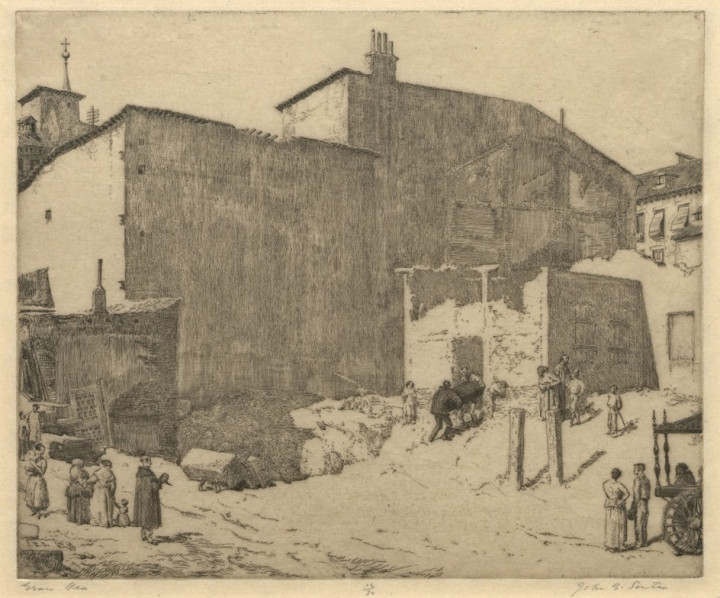 John Bulloch Souter. Madrid Burial Scene. Courtesy of Aberdeen Archives, Gallery & Museums.
WW2 saw him working in the Post Office Censorship Dept. as a translator, whilst also restoring paintings at Windsor Castle and acting as an Air Raid Warden at night. After the war, with a decrease in the demand for portraiture, he switched his focus to landscape and still life. He returned to Aberdeen in 1952, continuing to paint until his death in 1972.
During his lifetime Souter exhibited at the Redfern Gallery, the Fine Art Society, the Royal Scottish Academy and regularly at the Royal Academy. His paintings, often his portraits, can be found in collections around the country, with Aberdeen Art Gallery having the largest group. His etchings are rarer and more difficult to find. Aberdeen has several and the British Museum has one. Dealers Campbell Fine Art in London and Fidra Fine Art in Scotland have handled some fine examples, and both have some in stock currently.
Souter is every inch a Scottish artist and his prints are worthy of greater recognition.


