
Scottish Art News
Latest news
Magazine
News & Press
Publications
The Newhaven Fishwives at the forefront of social documentary photography
By Sara Stevenson, 13.07.2026
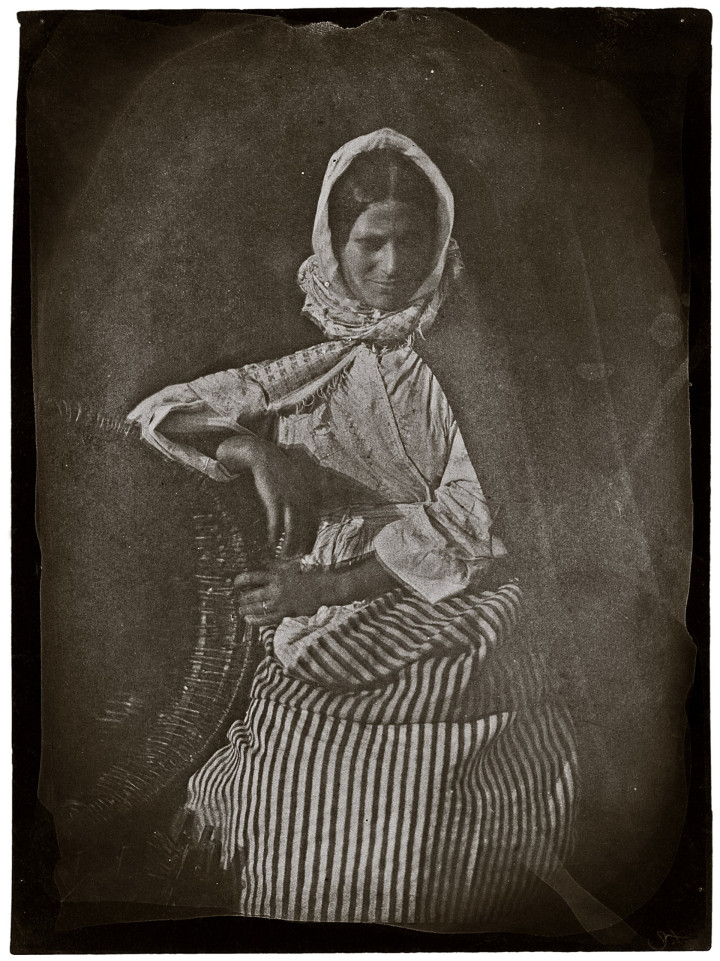
In the 1930s, when the Royal Scottish Academy was 100 years old, the German philosopher and polymath Walter Benjamin wrote an extended piece on the work of Scottish academician, David Octavius Hill. Benjamin singled out a photograph taken in the 1840s, which he knew as ‘A Newhaven Beauty’. His text focused on two things: the woman herself and the way such a picture may express the essence of photography. Benjamin wrote of the image: ‘Her eyes cast down with such indolent, seductive modesty, there remains something that goes beyond testimony to the photographer’s art, something that cannot be silenced, that fills you with an unruly desire to know what her name was, the woman who was alive there, who even now is still real and will never consent to be wholly absorbed into art. And I ask, “how did the beauty of that hair, those eyes, beguile our forebears: how did that mouth kiss, to which desire curls up senseless as smoke without fire”.’
Benjamin presented the world with a secular icon – an object, not a subject. However, ‘A Newhaven Beauty’ was just one of 130 images, involving 200 figures (women, men and children). They were taken between 1843 and 1847 by the partners, David Octavius Hill and Robert Adamson, assisted by Jessie Mann, working with Henry Fox Talbot’s calotype photography. This was the first negative/positive process made on good drawing paper, capable of printing hundreds of images from one negative, and able to disseminate the same picture across the world: publication and communication.
In 1844, Hill and Adamson advertised six albums, starting with ‘The Fishermen and Women of the Firth of Forth’. They carried their equipment down from their Calton Hill studio to Newhaven to take the photographs. This gives the pictures their natural setting and light. We do know the name of ‘The Beauty’. She is Elizabeth Johnston Hall, who married in 1842, and the ring on her finger is prominently displayed. She was not a passive or generalised model. She was one of the Newhaven fisherwomen, known at the time for their hard work, confidence and beauty, their fine singing voices and their distinctive dress. The photograph was not a single image – she appears in other photographs and, magically, among the discarded negatives, in which her hand has moved, and she has turned her head to look at us and smile.
The whole work is the first ever social documentary series of photography, with no effective parallel until the end of the century. Photographers, fisherwomen and men worked together to give us the visual account of an admirable, hard-working community thriving in circumstances of great economic and social difficulty. We know from contemporary records who they were and what they did. The character of the images stems from the sympathy established between them and the artists, and it is this that gives them their powerful strength, communicating today as it did at the time.


