
Scottish Art News
Latest news
Magazine
News & Press
Publications
The Fleming Collection acquires significant post-war work by Scottish avant-garde artist William Gear (1915-1997)
By Theodore Albano, 12.07.2026
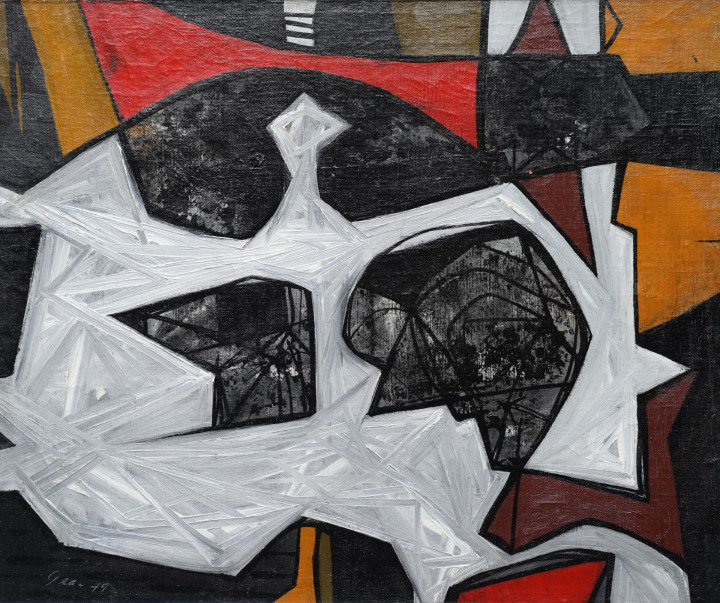
William Gear held a long and productive artistic career that spanned the better part of six decades. The Fleming Collection’s newly acquired work, ‘Interieur Forme Blanche’ (1949) was made at an important turning point in European history, a time of flux and change which is worth exploring through an understanding of Gear, his life and his influences.
Born to a coal miner in Methil, Fife, Gear was a talented artist from a young age, and his work was accepted into the Annual Exhibition of the Royal Scottish Academy at just 18. In 1937, shortly after finishing his studies at the Edinburgh College of Art, Gear received a scholarship to spend a year studying abroad. He started in Paris, where he studied under the ground-breaking French artist Fernand Léger, and continued to Italy, the Balkans, Greece, and Istanbul. This year would become one of the major formative experiences of his life and would inform Gear’s thinking, broad-mindedness and interest in global trends in art for the rest of his life.
In early 1940, shortly after the start of World War Two, Gear was called up for service with the British Army’s Royal Corp of Signals where he served in North Africa and the Middle East. After V-E day in 1945, Gear joined the Monuments, Fine Arts and Archives (MFAA) Branch of the Control Commission for Germany, or as they were more widely known ‘The Monuments Men’. As a Monuments officer in Hanover Gear oversaw the return of artworks from the Berlin state art collections, some of which had been stored for safekeeping at Marienburg Castle. Gear’s duties also included promoting the work of avant-garde German artists, which he accomplished by arranging a series of contemporary art exhibitions. Upon viewing the contents of one of the ‘degenerate art’ portfolios stored at the castle, Gear organized the popular public exhibition Modern Prints, containing these works along with other woodcuts by the German Expressionists. Gear was also a member of the international committee commissioned to design a memorial at the Bergen-Belsen concentration camp. Gear visited the camp and was so deeply moved by the experience that it affected his later work.
After being de-mobilised from the MFAA in 1947 Gear moved back to Paris to begin what would be one of the most productive and important periods of his artistic career. It was here that Gear met the avant-garde artists of the CoBrA group, named after their respective Northern European cities Copenhagen, Brussels, Amsterdam, The three cities were formerly under Nazi occupation and emerged from World War Two surrounded by devastation and tragedy. For the artists associated with CoBrA, the styles of art that had existed before the war, particularly geometric abstraction, were a dead language that failed to communicate the realities of post-war life. Instead, the group produced spontaneous, rebellious artworks inspired by a range of ideas, including the work of children and Outsider Art. Gear exhibited with them in Amsterdam and Paris in 1949. In the same year his work was shown in New York alongside paintings by Jackson Pollock. He eventually returned to live in the UK in 1950, and continued to exhibit both at home and internationally until his death in 1997. ‘Interieur Forme Blanche’ is a wonderful legacy of this period of mutual creativity and international influence. Gear, whose work ranged from different forms of abstraction, felt at his heart he was a landscape painter. This intriguing painting combines different influences; it has an almost organic cubist form spreading out of solid blocks of colour, reminiscent of stained glass windows which the CoBrA artists were very interested in. A strange amalgamation of a landscape painting, pure abstraction and a still life painting, ‘Interieur Forme Blanche’s’ white form appearing as a piece of bone or mask or fossil.
Gear had come out of the war, had absorbed continental modernism, and was close to CoBrA’s interest in instinct, myth, children’s art, raw mark-making, and anti-academic energy, however Gear is always more structured than some of the CoBrA painters which can be seen in this painting.
Gear’s work from this period is testament to his international sensibility, while he remained throughout his whole life and travels a proud Scotsman. Gear acted as a serious player in the growing modernist scene in Paris, and ‘Interieur Forme Blanche’ gives us a window into that exciting time.


