
Scottish Art News
Latest news
Magazine
News & Press
Publications
Tate St Ives’ exhibition affirms Wilhemina Barns-Graham’s place as one of the most innovative figures in British modernism
By Beth Williamson, 26.11.2026
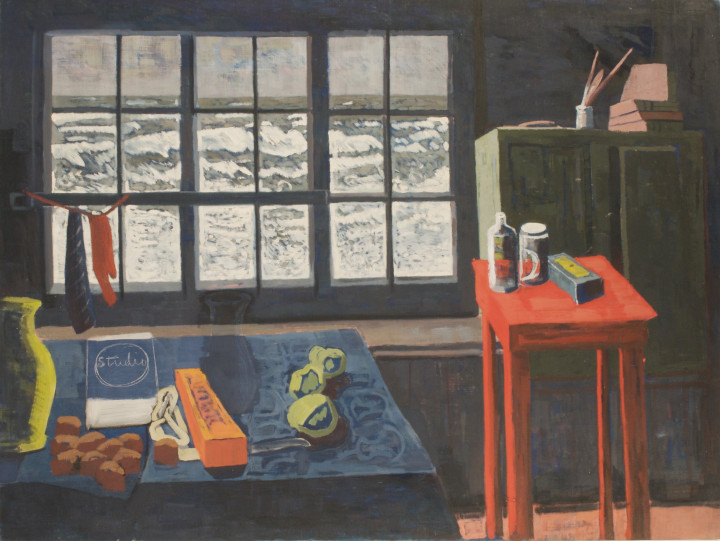
In this exhibition, over 150 paintings, drawings and prints convey the story of Wilhelmina Barns-Graham (1912–2004), not only as an artist but as an explorer, experimentalist and renegade of her time.
The presentation of Barns-Graham’s work at Tate St Ives brings many of the works back to where they were created. The exhibition begins with the studio, an anchor for her practice and a space for experimentation. The Blue Studio c. 1947-8, loaned from the Fleming Collection, is particularly apt: we see through the studio window the rolling waves of Porthmeor Beach; the same beach the gallery now looks onto, lapped by similarly urgent autumn waves on the day the show opens.
The exhibition continues to unfold through a series of thematic rooms that follow a loose chronology. Born in St Andrew's, Barns-Graham entered Edinburgh College of Art (ECA) in 1931 where she received a rigorous training from artist-tutors including William Gillies and Adam Bruce Thompson. It was during this time she first encountered mathematician and biologist D'Arcy Wentworth Thompson's book On Growth and Form (1917), an important point of reference for Edinburgh’s cultural scene. Paintings such as ‘The Episcopal Church, Aviemore’ (1938) demonstrate the beginning of its impact on Barns-Graham’s practice, which would become more pronounced in later works. The bold use of colour and simple structuring of space in the painting suggests the early influence of the Scottish Colourists and the French Impressionists.
Moving to St Ives in 1940 was a decisive moment for Barns-Graham; here she entered a growing community of modern artists including Barbara Hepworth, Naum Gabo and Ben Nicholson. It was in this context that she developed her own distinctive visual vocabulary. ‘Box Factory Fire’ (1948), for example, demonstrates her attentiveness to the relationship between interior and exterior spaces; a consideration she developed further in her glacier paintings.
In 1949, Barns-Graham visited Grindelwald in Switzerland and was captivated by the crystalline glacial structures she experienced there. Between 1949 and 1952 she made over sixty paintings, drawings and prints as a major exploration of that "total experience". The works – and audience - are granted exceptional space within the exhibition, creating a tangible feeling of movement across the glacial surfaces.
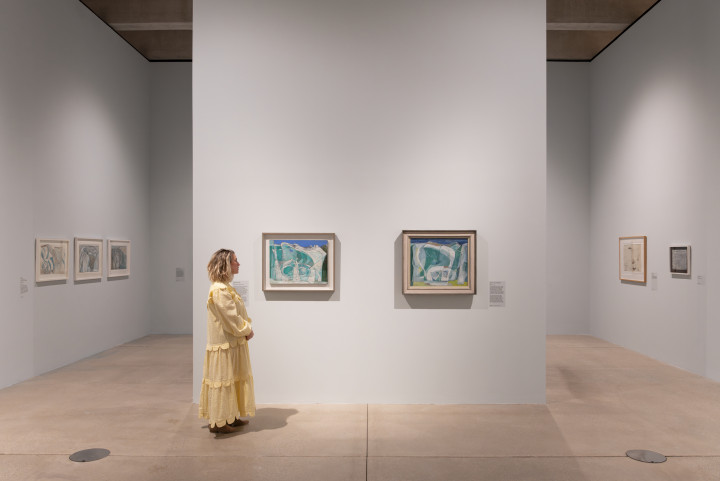 Tate St Ives. Installation of Wilhelmina Barns-Graham.
Between 1956–7 Barns-Graham briefly taught at Leeds College of Art on Harry Thubron's Basic Design Foundation course. This is when she restructured scenes of Yorkshire fields into geometric systems. The semi-abstract grids of ‘Snow at Wharfedale 1’ (1957), for instance, also hark back to her time at ECA and Wentworth Thompson's ideas in On Growth and Form; ideas that artists in England did not generally encounter until its republication in 1942. Barns-Graham also completed her first fully abstract compositions in 1957, with ‘Red Painting’ and ‘White, Black and Yellow (Composition February)’.
From the 1960s until the 1980s Barns-Graham developed a different kind of order: Between 1960 and 1963 she lived in London and it was then, as well as a period in the United States in 1965, that she was exposed to geometric abstraction including op art and kinetic art. She initiated a more active approach to composition deploying a systems-based approach that enabled her to consider how natural processes could be understood through abstraction. ‘Assembly of Nine’ (1964) explores her interest in the Bahá'í Faith through a tight arrangement of squares while ‘Ascending Squares of Equal Amount’ (1970) displays a much freer arrangement of forms. Further, Barns-Graham's synaesthesia meant colour choices in her paintings were often deeply personal. After the hard-edged abstraction of the ‘Touch Point Series’ of the 1980s she returned to drawing from nature.
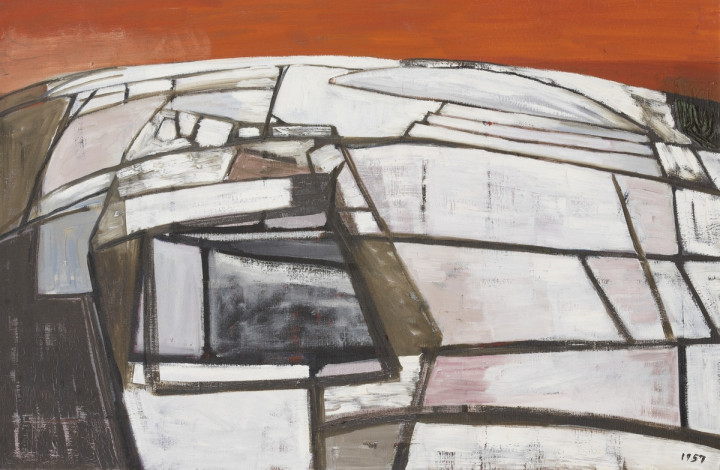 Wilhelmina Barns-Graham. Snow at Wharfedale. © Wilhelmina Barns-Graham Trust.
Barns-Graham's observational drawings of the 1980s and 1990s are exquisite. The ‘Small Energy’ drawings of fine line wave patterns or wind eddies were inspired by the landscape surrounding her homes on Cornwall and Fife, or memories of Grindelwald. This period also saw her spend time in the Orkney Isles, and Lanzarote in the Canary Islands. She explained she was "collecting shapes that become my shapes".
The layering of colour on paper or card upon hardboard in the ‘Warbeth’ works of 1985 bring a material understanding of the colour and surface of rock formations in Orkney. Drawings of St Ives became parred back so that ‘Eight Lines, Porthmeor’ (1986) expresses movement in nature through a radical economy of means.
In the midst of the restless energy of the 1990s and 2000s Barns-Graham described living "in the most appalling time of abuse of living things” referring, for instance, to war in Afghanistan. She hoped her lively paintings would, "stimulate and excite people, give them an enthusiasm for looking”. Her exuberant ‘Scorpio’ paintings of the 1990s were a deliberate counterpoint to the disorder and destruction she observed in the world around her in these later years. Like the artist, this exhibition celebrates "joy through colour, form and texture". It is a joy that can be carried beyond the gallery and into the world.
Wilhelmina Barns-Graham is exhibited at Tate St Ives until 3rd May 2027


