
Scottish Art News
Latest news
Magazine
News & Press
Publications
Still Glasgow: Photo Exhibition Captures Life in the City
By Lena Kammerer, 24.01.2026
With over eighty photographs on display, Still Glasgow presents the city through the lenses of visitors and residents throughout the decades. Lena Kammerer selects five works not to miss.
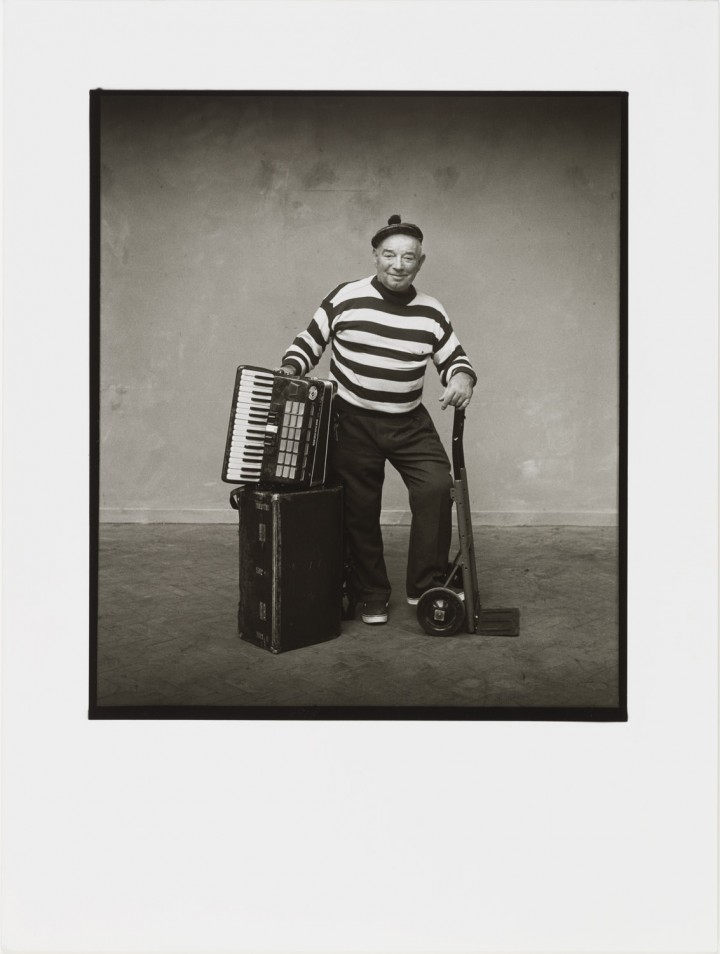
David Eustace, The Buskers Series, 1993
Displayed across the full length of one gallery wall is a series of photographs titled The Buskers by Scottish photographer David Eustace. Since graduating from Napier University in 1991, Eustace has gained international acclaim through his work in fashion, celebrity, and fine art photography. The striking images, which portray buskers Eustace encountered daily along the Clyde in the early 1990s, took inspiration from the work of twentieth-century photographers Martín Chambi and August Sander. The hand-printed series constitutes one of the photographer’s first portfolios. GoMA’s curator Katie Bruce explains: “These are when [Eustace] didn’t have much money, had to manage to black a studio in the Clyde, manage to persuade buskers he saw in and around him every day to come and get their photographs and they’re handprinted by him. There are only two sets like that. These photographs, done in dark rooms and hand-printed by the photographers themselves, have a real depth.”
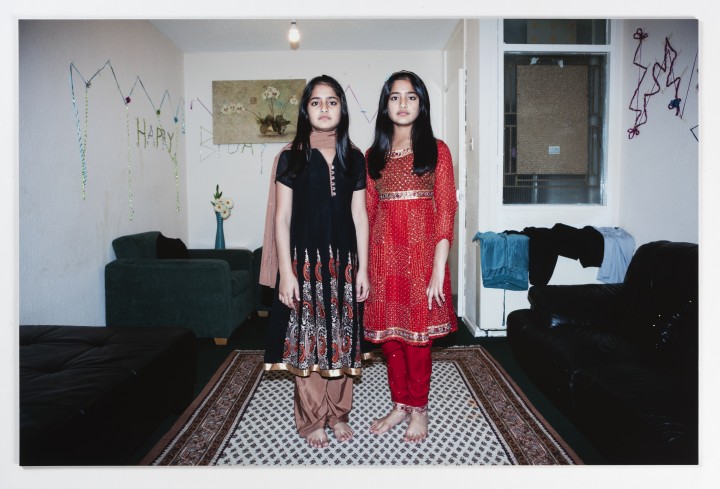 Iseult Timmermans, 10 Red Road Court (2012) © the artist.
Iseult Timmermans, 10 Red Road Court, 2012
Iseult Timmermans’ 10 Red Road Court opens the door into the homes of the people who lived in the iconic Red Road Flats in North Glasgow. The flats were built as part of the city’s social housing policy in the 1960s, and from the early 2000s onwards became increasingly inhabited by asylum seekers and refugees. The flats constituted an integral part of Glasgow’s skyline throughout their existence until their eventual demolition between
2010 and 2015. Timmermans, a Glasgow-based photographer, organised a creative programme and community studio for the Red Road Court residents between 2010 and 2012. 10 Red Road Court, a collage of over three hundred photographs, capturing window views, empty and adorned walls, hallways and rooms, as well as the people who had made these spaces their home, arose out of a collaboration with remaining residents in the weeks leading up to the demolition, providing an intricate and intimate sense of place and identity.
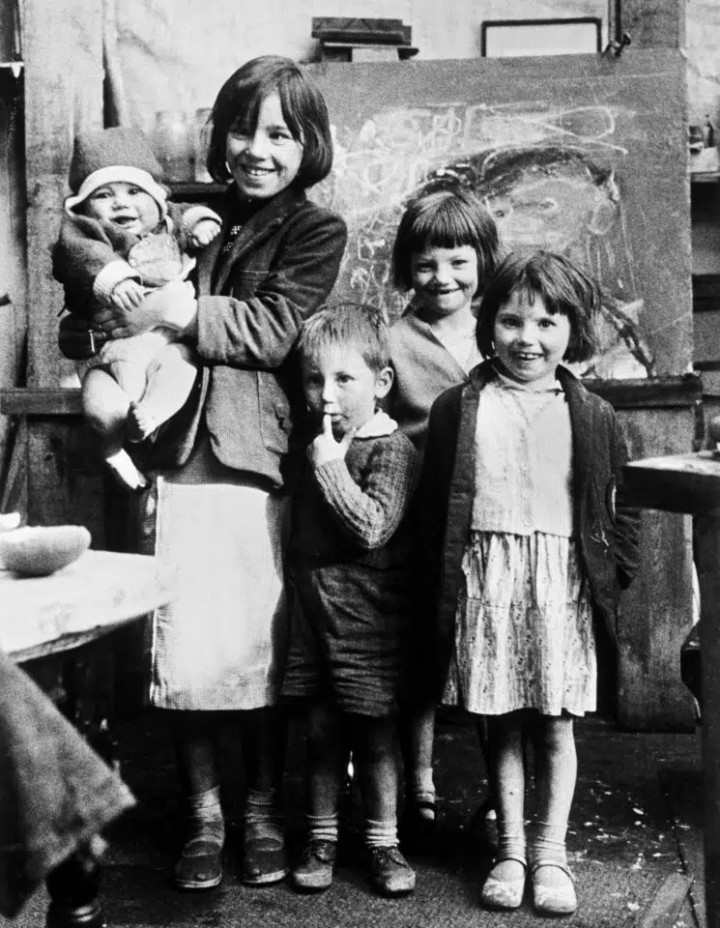 Oscar Marzaroli, The Samson Children in Joan Eardley’s Studio, Townhead (1962). © The Oscar Marzaroli Collection. Courtesy of Street Level Photoworks.
Oscar Marzaroli, The Samson Children in Joan Eardley’s Studio, Townhead, 1962
Oscar Marzaroli’s photograph of the Samson children in Joan Eardley’s studio shows them posing before one of the artist’s paintings, through which the Scottish-Italian photographer skilfully intertwines Glasgow’s social history with its artistic heritage. Marzaroli, the son of Italian immigrants who moved to Scotland when he was two, became renowned for documenting Glasgow during a period of profound change, as the Gorbals were cleared for new social housing. In this image, Marzaroli captures more than a moment in the studio; he reveals the conditions of creation behind Eardley’s work. The Samson children, who lived near the studio in Townhead, appear not merely as sitters but as participants in the artistic process. Their presence reflects Eardley’s engagement with working-class life and underscores Marzaroli’s ability to document the intersection of everyday life and artistic expression.
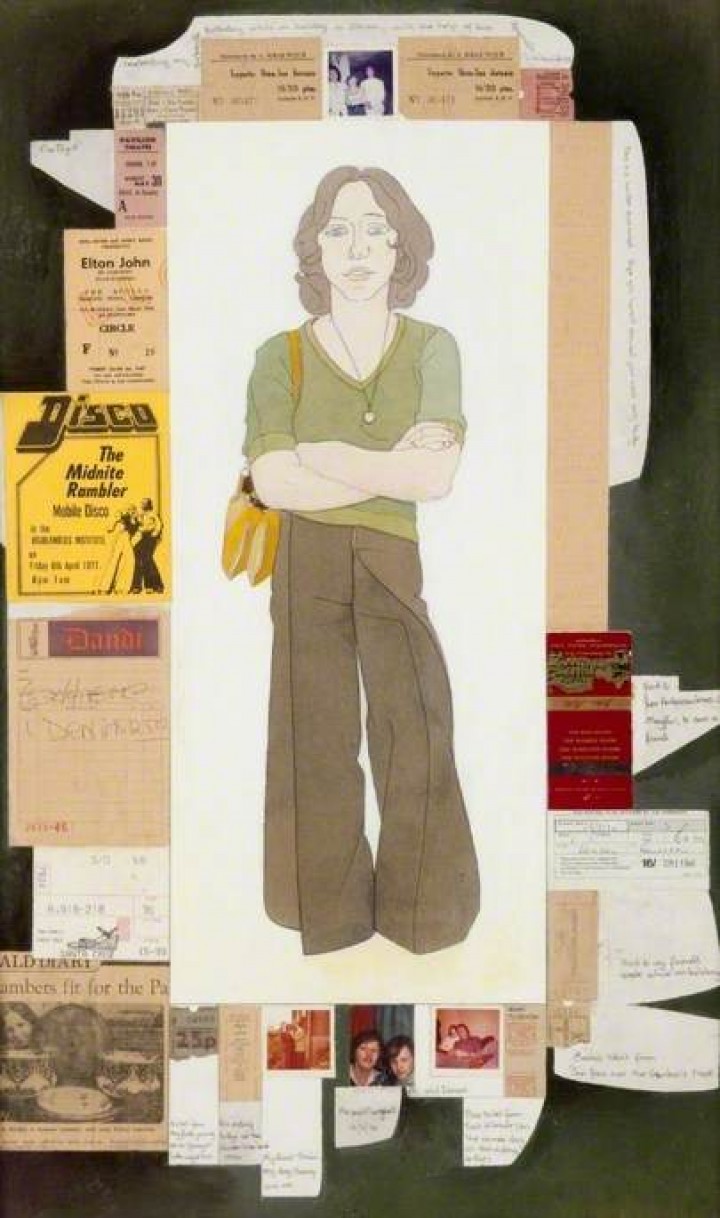 Alasdair Gray, Frances Gordon, Glasgow Teenager (1977). © the artist's estate. Courtesy of Glasgow Life Museums.
Alasdair Gray, Frances Gordon, Glasgow Teenager, 1977
While centring on photography, the exhibition also explores how artists have used the medium in inventive and varied ways. A striking example is Alasdair Gray’s portrayal of the Glaswegian teenager Frances Gordon, who worked as an admin assistant at the People’s Palace while Gray was creating a series of paintings for the museum. At the centre is a large-scale drawing of Gordon, surrounded by the contents of her handbag at the time: bus and concert tickets, receipts, photographs of friends and family, and other personal items. This arrangement offers a richly intimate snapshot of life for a teenager in 1970s Glasgow, revealing how photography inhabited their everyday world. Bruce observes: “It’s the idea of a Glasgow teenager and the way that you’d have, if you’d empty out your handbag, you’ve got snapshots and photographs in there.” Through this work, Gray transforms ordinary objects into a vivid, layered portrait of youth, memory, and place.
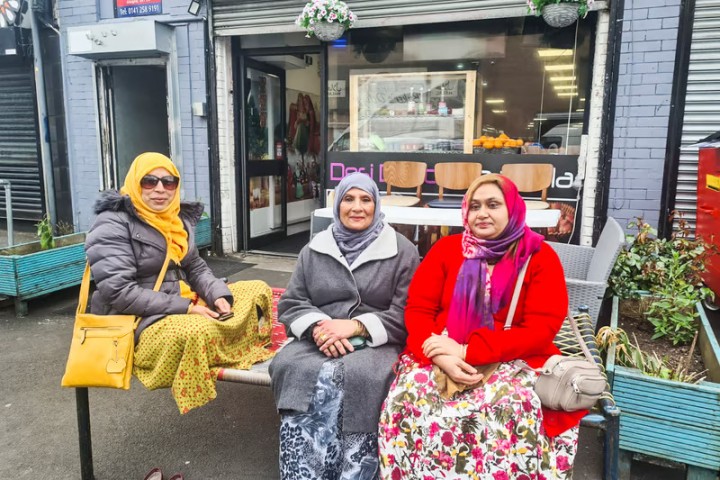 Zubaidah Azad, Friends Getting Together (2023). © the artist.
Zubaidah Azad, Friends Getting Together, 2023
Zubaidah Azad’s Friends Getting Together visualises how Glasgow’s residents view themselves and their surroundings today through the lens of a camera. Azad, a member of the Glendale Women’s Café in Pollokshields, a space founded to bring local women together to learn, create, enjoy, and support one another, took part in a project capturing everyday life in their part of the city. Working alongside photographer Robin Mitchell, Azad and other participants helped shape images that reflect lived experience. Her photograph shows three women seated on a bench outside a shop. Their relaxed posture and open gazes convey an intimacy that feels familiar and quietly confident. Around this image, eleven additional photographs by Azad and fellow participants depict people, streets, shops, and communal spaces. Together, the series forms a layered portrait of contemporary Glasgow, celebrating community, connection, and diversity while highlighting how photography can reveal both the personal and the collective.
Still Glasgow is exhibited at Gallery of Modern Art, Glasgow until 13th June 2027.


