
Scottish Art News
Latest news
Magazine
News & Press
Publications
Spirit Animals: Michael Visocchi’s Monument to the Lost Whales of South Georgia
By Greg Thomas, 23.07.2026
The artist Michael Visocchi RSA lives in a converted schoolhouse in the Angus countryside. The old teaching room, with its high gabled and windowed roof, now serves as his studio, the walls filled with neatly arranged rows of hanging tools, a large table saw sitting on the concrete floor poured by the artist himself. He’s just added a front step, too, a chunky cement slab with a lip created using a converted piece of guttering as a mould. The evidence of the artist as maker, an old-fashioned and appealing notion, is everywhere in evidence around the old red sandstone residence.
Inside, the shelves and walls are covered in artworks, many of them Visocchi’s own: graphically precise arrangements of signs, shapes, letters, and numbers, in painted wood, telling sensitive stories about the relationship between humanity and nature. Sitting in the kitchen, looking out across rolling June hills dotted with rusting farm machinery, Visocchi remarks: "I often sit here and look at the colours in the land and the skies and think: I could be on South Georgia”.
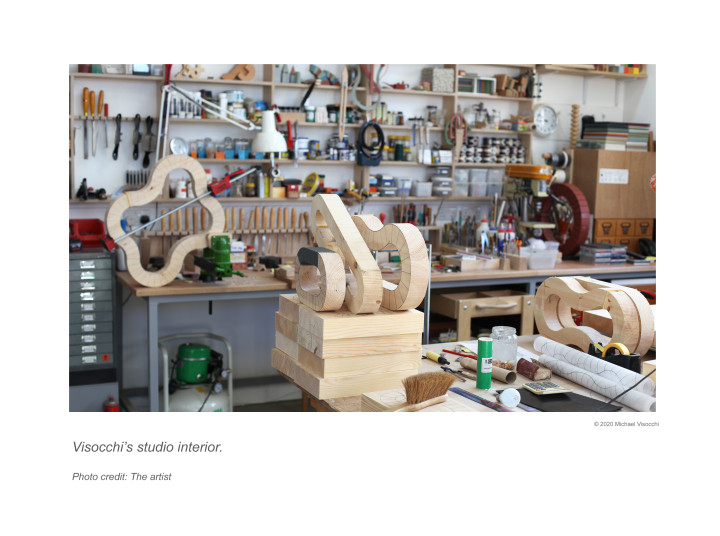 Michael Visocchi's Studio Interior III. Courtesy of the Artist.
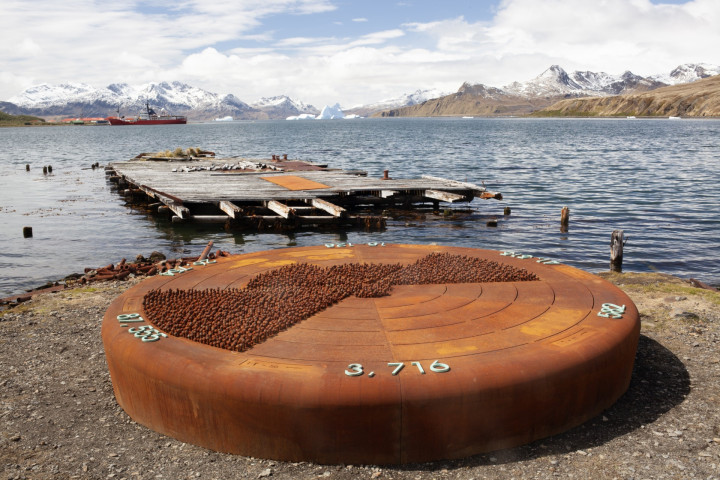
Over the last few years, the Angus-born sculptor, who became the youngest ever electee to the RSA in 2005, has had cause to visit that far more remote location on three occasions, catching a four-day boat ride east from the Falklands to the little sub-Antarctic island in the South Atlantic. It’s all to do with an ongoing commission from the South Georgia Heritage Trust to create a major public artwork at Grytviken, one of the former whaling stations that dot the island. Seven huge Corten steel discs sited on the “flensing plan” – a large patch of scrubland where the animals were disembowelled and processed – will memorialise the thousands of cetacean lives lost across the twentieth century, before the bloody industry was wrapped up in the early 1960s.
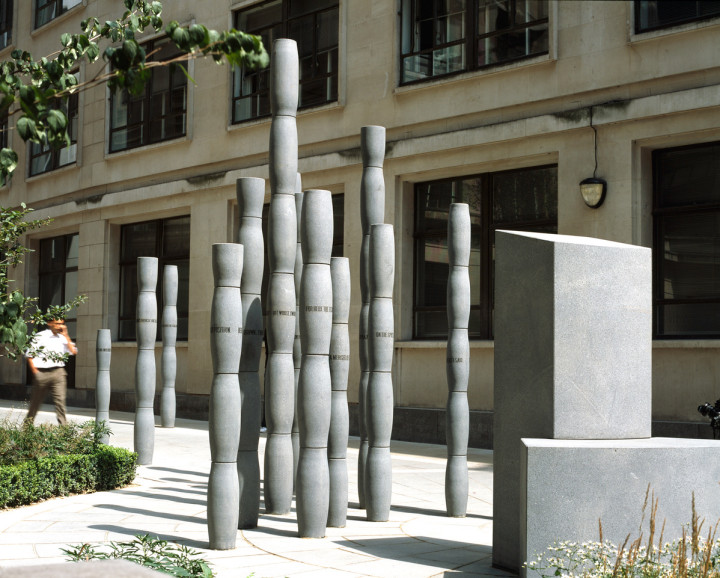 Michael Visocchi. Gilt Of Cain. Courtesy of the Artist.
This is the latest in a line of significant site-specific commissions which, Visocchi tells me, have become something of a stock-in-trade since his graduation from Glasgow School of Art in 2001. They include 2007’s ‘Gilt of Cain’, a collaboration with the poet Lemn Sissay in the City of London, unveiled by Archbishop Desmond Tutu to mark the bicentenary of the abolition of the British slave trade. A gathering of sugar-cane- like columns around a stone pulpit with Sissay’s verse cut into it, it could represent a group of reformers at the speech stump or human chattel herded for auction. A more recent and local example is a huge frieze-like wall construction for St. Rollox Church in Sighthill, north Glasgow. Crosses representing Christian traditions from around the world wrap one exterior corner of the site. The piece, called ‘Assembly’ (2021), pays homage to the ethnically diverse congregation, including many refugees.
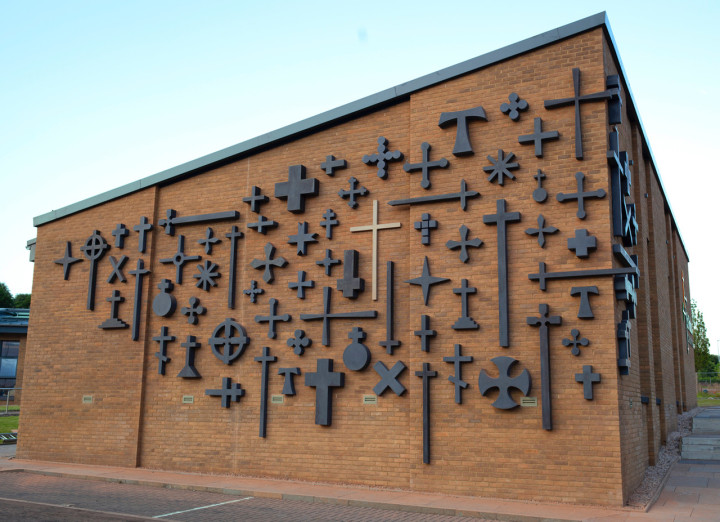 Michael Visocchi. St Rollox Artwork - Assembly. Courtesy of the Artist.
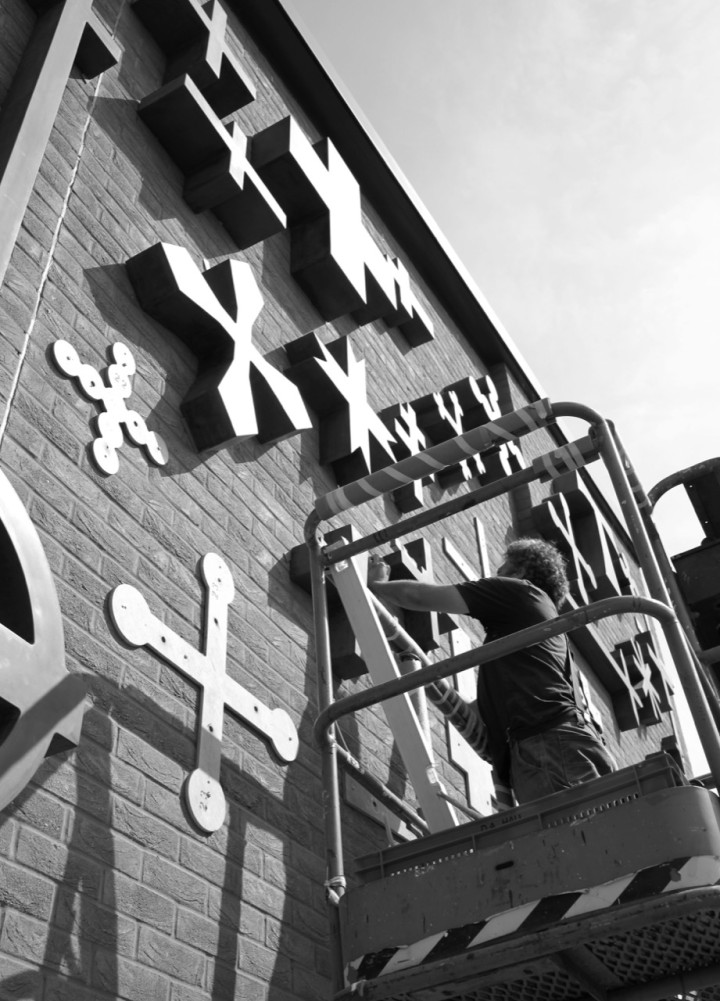 Michael Visocchi. St Rollox Artwork Install. Courtesy of the Artist.
In amongst it all, Visocchi tells me, he has kept up a studio practice as his primary passion, influenced by the connections between sculpture and environmental art at GSA. “I’ve always been interested in traces of culture in the landscape, whether that be traces of our spirituality or of economic power structures, or the architectural footprint we leave behind.”
At the Meffan Museum in Forfar, a group of Visocchi’s early 2000s works feature in a small show celebrating RSA members with connections to Angus. They include ‘Suburban Curve’ (2002), a sculptural relief of little house-shaped blocks on undulating wooden shelving, a whimsical response to the uniformity of neo-liberal town planning. There is also ‘Metaphysical Landscape’ (2003), a photograph showing card drawings of towers and spires stretching into the distance against a monotone blue sky—like a model village designed by Giorgio de Chirico.
Although Visocchi now speaks with some detachment about these early pieces – “almost technical exercises, like I’m practicing my scales” – they are related to projects for which he has more enduring affection. These include the ‘Calvinist Implement’ sequence (2001 onwards), which involved constructing temporary sculptural installations in the landscape, photographed then swiftly removed: a sketch of a tree, a huge protractor, a little corrugated iron campanile with cross atop it. “It’s an alternative to the idea of siting sculptures permanently in the landscape, less time-consuming and environmentally impactful.”
More recently, there has been a palpable shift towards ideas of data mapping and visualisation in his work, particularly as a way of tracing the damage caused by climate change. A good example is ‘Cumulonimbus Flammagenitus’ (2024), a sculptural grid of arrows representing the movement of air through the cloud formations that gather around wildfires.
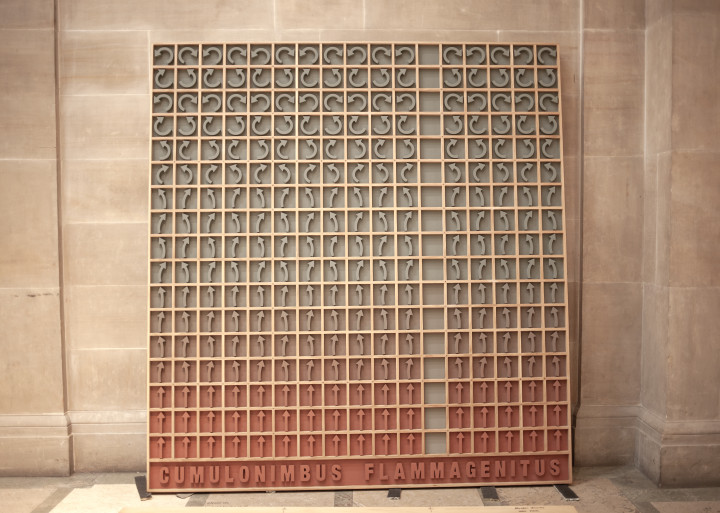 Michael Visocchi. Cumulonimbus Flammengenitus. RSA Sculpture Court. Courtesy of the Artist.
This brings us back to ‘Commensalis: The Spirit Tables of South Georgia’. Visocchi was awarded the commission for the work in 2020, but five years later, the scale and cost of the project means it remains unfinished, with only the so-called “key table” sited on island. Visocchi’s beautiful scale models made in rust-coloured birch plywood give a sense of the final spectacle. “All the whaling stations had these stores, which included everything you needed to repair a ship or an oil tank. They’re full of the most amazing things, including boxes of radars, and piles and piles of rusted rivets.” The proliferation of rivets, and their likeness to the “whale barnacles” that grow on the backs of the giant, sea-grazing mammals, gave Visocchi the idea of using them as a form of counter. “I thought, this is a numerical story, you need a unit of measurement.” (Incidentally, the work takes its name from the non- harmful, “commensalic” dependence of barnacle on whale.)
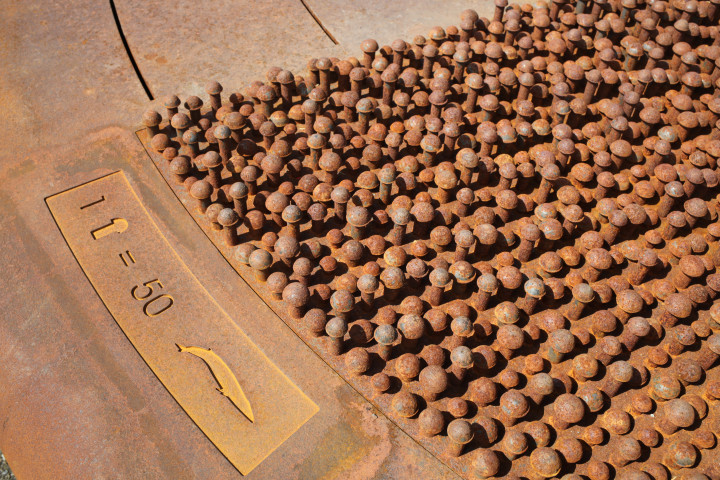 Michael Visocchi. Key Table SG (2025). Courtesy of the Artist.
Using a system of one rivet for every fifty whales killed, Visocchi devised a pie chart- type arrangement of fin-shaped wedges for his key table, each triangle of rivets representing deaths amongst a particular species. In total, 3505 rivets were sourced from the nearby station of Stromness (whose name gives a sense of the hunters’ geographical origins). The six remaining, still larger “spirit tables” – the phrase suggests Ouija boards and seances, the ghostly human presence on South Georgia – will have the same-sized wedges cut out from their surfaces. The remainder will be covered in shimmering new stainless steel rivets, reflecting the resurgence of each species since it was saved from the flensing knife. Patterns have been devised for each based on associative connections with the animal: the humpback table, for example, will bear a spiral design emulating the spiral bubble nets which humpbacks use to catch krill. “I’ve been lucky enough to see one in the water,” Visocchi tells me, “the most beautiful thing.”
At present, plans are being hatched to tour each of the tables, once constructed, to a different location with connections to the whaling industry, including north Norway, California, and Dundee. This will lead, it is hoped, to new interest and funding for the project, and ultimately, to the realisation of this extraordinary and moving sculptural elegy: a monument to a rare story of nature in recovery from human damage.
You can find out more about Commensalis: The Spirit Tables of South Georgia by Michael Visocchi and support the project here: https://whalememorial.org/ and here: https://www.bbc.co.uk/programmes/w3ct5tlw


