
Scottish Art News
Latest news
Magazine
News & Press
Publications
Scottish Art in Argentina
By Sebastian Pasquet, 23.06.2026
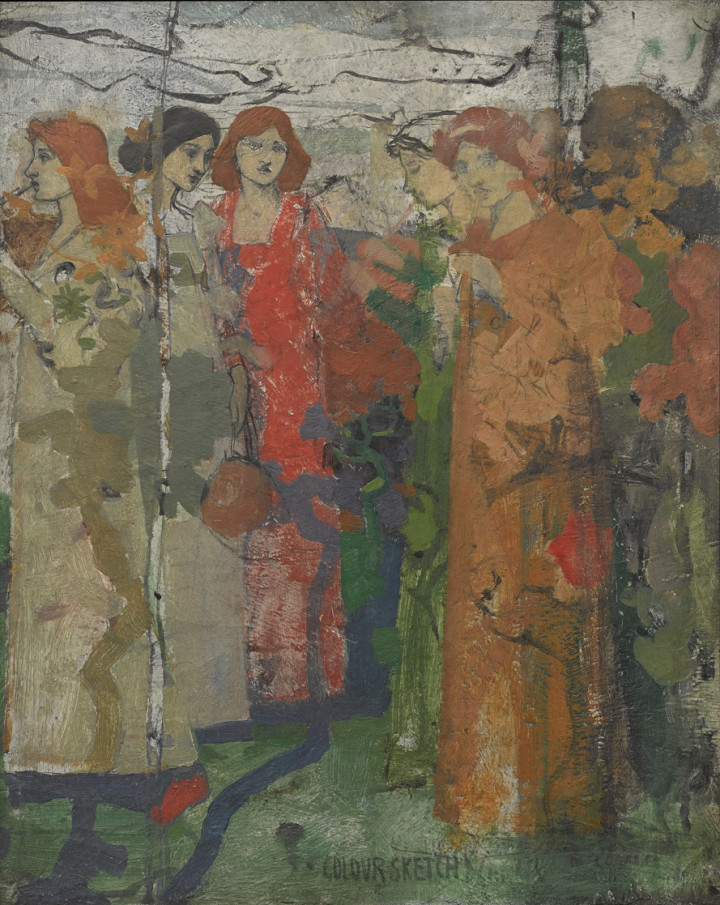
There is a painting in the Fleming Collection by the Glasgow Boy David Gauld—a sketch from around the 1890s that may not immediately stand out among the other works. And yet it is the piece that came to matter most to me. The description on the Fleming Collection website notes that the ‘sketch, St Agnes, relates to a finished painting (Scottish National Galleries) and to windows for St Andrew’s Church in Buenos Aires.’ Whenever Gauld’s name appears online, there is usually some passing reference to these stained-glass windows, often accompanied by the claim that they represented his most important commission.
For more than a decade, I have led projects related to Scottish heritage in Argentina, including research, archives, cultural programming, conservation, and restoration. Much of that work has taken place inside St Andrew’s Church in Buenos Aires. For that reason, I believe those brief references to Gauld’s windows do not fully capture the extraordinary scale of the project.
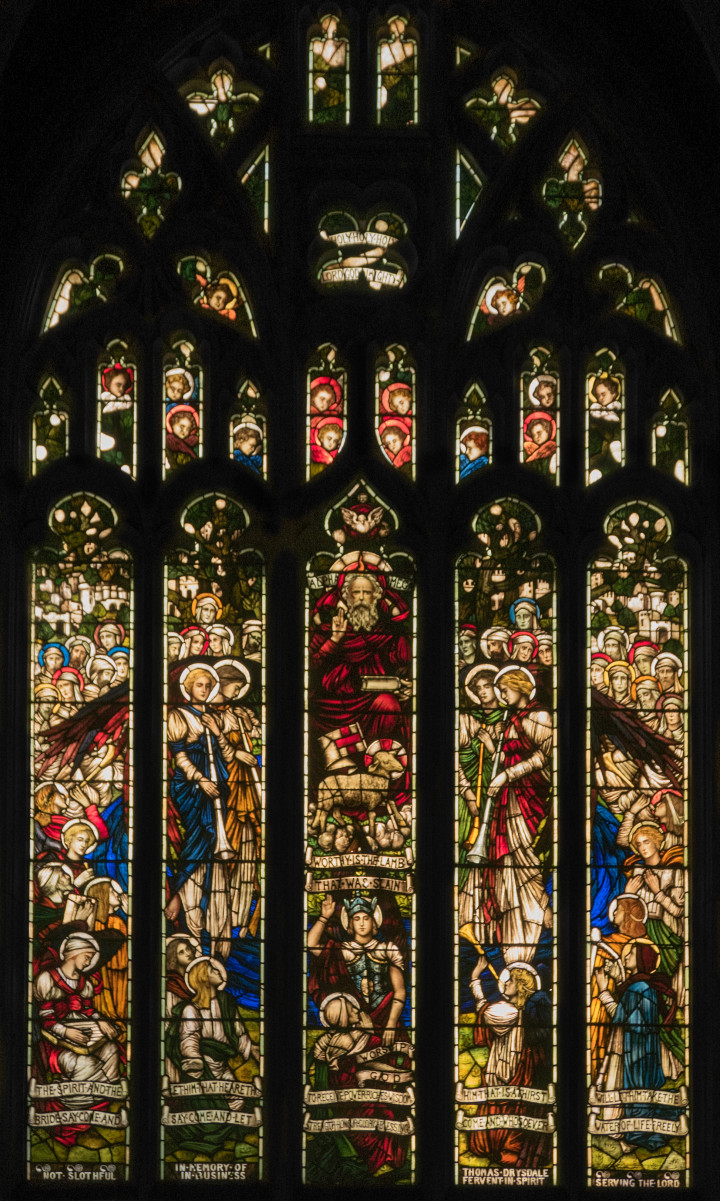 The central window at St Andrew's Buenos Aires. The Argentine art historian Dr Francisco Corti described this central window as ‘the most beautiful and technically important stained-glass window in the country’. Photo by Sebastian Pasquet
The commission was not for a modest suburban church, but for a monumental Neo-Gothic building located only three blocks from Plaza de Mayo, the historic and political centre of the city. At the time, Argentina was among the fastest-growing economies in the world. The scheme comprised more than thirty windows, ranging from relatively simple lancets to an immense multi-panel composition rising to roughly ten metres. The Argentine art historian Dr Francisco Corti described this central window as ‘the most beautiful and technically important stained-glass window in the country’. Guthrie & Wells, the Glasgow firm responsible for producing the windows, later used it prominently in their own advertising material.
The historical context surrounding this commission forms an often overlooked chapter of Scottish diaspora history. Argentina was home to one of the most significant Scottish communities outside the formal British Empire, and this community has had a lasting impact on the country’s development through education, sport, healthcare, infrastructure, transport, religious freedom, and many other areas. Last year, in fact, Argentina celebrated the 200th anniversary of the Scottish community in the country.
Beyond Gauld, windows by other important Scottish artists have been identified, including Harrington Mann and, most notably, Marjorie Kemp, whose contribution would deserve an article of its own. Dozens of windows still remain unidentified.
Gauld himself is also elusive within the Buenos Aires commission. His name appears neither on the windows nor in surviving church documents. This is perhaps unsurprising, as stained-glass art is collaborative by nature. Architects determine the spaces, ministers and committees select subjects, studios coordinate production, and craftsmen translate cartoons into glass and lead. And yet, artists leave traces of themselves even within collective projects.
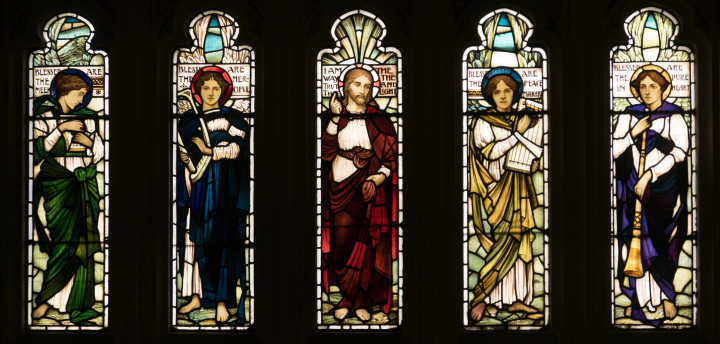 David Gauld, 'The Beatitudes' St Andrew's Church, Buenos Aires. Photo by Sebastian Pasquet.
The collection of windows attributed to Gauld in St Andrew’s forms a sort of curatorial experience. Together, they produce a coherent, immersive, and deeply affecting atmosphere that I have rarely encountered in other Gothic Revival churches. But one group in particular seems to carry something distinctly personal. Set within the church is a modest five-window composition: four winged female figures arranged around a central image of Christ bearing the words ‘I am the way, the truth and the light.’ Each woman represents a Beatitude.
They are quieter than some of the larger narrative windows nearby—less monumental, perhaps. The composition, while humble, occupies a central position just beneath the largest window and stands at almost human height. As a result, it is unusually accessible and engaging compared to most of the other windows.
The figures stand lightly, almost weightlessly. Looking at them, one begins to recognise imagery that recurs throughout Gauld’s paintings, including the Fleming Collection sketch: women standing in the open air, surrounded by nature, with musical instruments, colourful garments, bare feet, and a sense of stillness and freedom. These are images that feel somewhere between symbolism and everyday presence.
At times, one has the impression of encountering the same women across Gauld’s different paintings and designs. Perhaps that is why these windows feel so compelling. It is not only because of their scale or technical accomplishment, nor because of the story they tell about a much broader Scottish history and the internationalisation of art and industry, but because they express a deep and moving artistic personality.
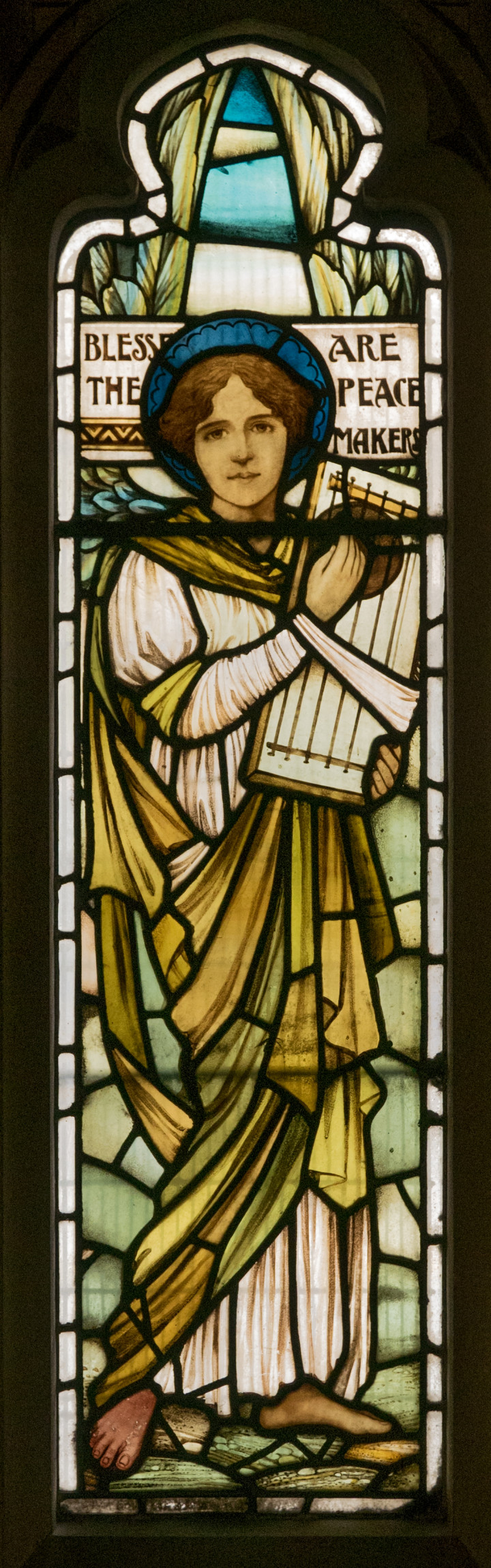 David Gauld, 'Blessed are the Peacemakers' detail of stained glass window in St Andrew's Church, Buenos Aires. Photo by Sebastian Pasquet.
There is still a great deal that remains unknown. After years spent researching and disseminating Scottish art and heritage in Argentina, it still feels more like an archaeological site only recently uncovered than a fully known chapter of history.
It becomes difficult not to consider how Gauld’s sketch in the Fleming Collection, his cartoons in the Glasgow City Archives, his paintings in Scottish museums, and his stained-glass windows in churches across the globe ‘relate’ to one another as an essential part of their meaning. Just as the age of a work can shape our perception of it, I believe the invisible relationships that connect these works across continents, histories, and people can also shape how we experience them.


