
Scottish Art News
Latest news
Magazine
News & Press
Publications
My Dear Black Sheep: Alistair Peebles’s ‘Rousay Mending’ and Ian Hamilton Finlay on Orkney
By Greg Thomas, 16.11.2026
. image courtesy of the artist.jpg)
Alistair Peeble’s ‘Rousay Mending’ is a poem-object consisting of eight thread cards, each bound with three strands of yarn knotted neatly at the back, whose colours correspond to a trio of words printed on the front: “HOME/ DREAM/ ISLAND”, for example, or “NET/ YOLE/ SAIL”. The little octet of ‘floss bobbins’ – as they are also, divertingly, called – arrives in a snug metal tin, of the kind that might seem to contain a miniature first aid kit or fishing flies, itself housed in a brown card box alongside a beautifully designed fold-out sheet. This sheet contains seven “footnotes” to the paired trios of word and wool, constructed with Peebles’s characteristically close attention to the particulars of Finlay’s life on Orkney, diverting precisely in its focus on a narrow sliver of scenes, sights, and sounds.
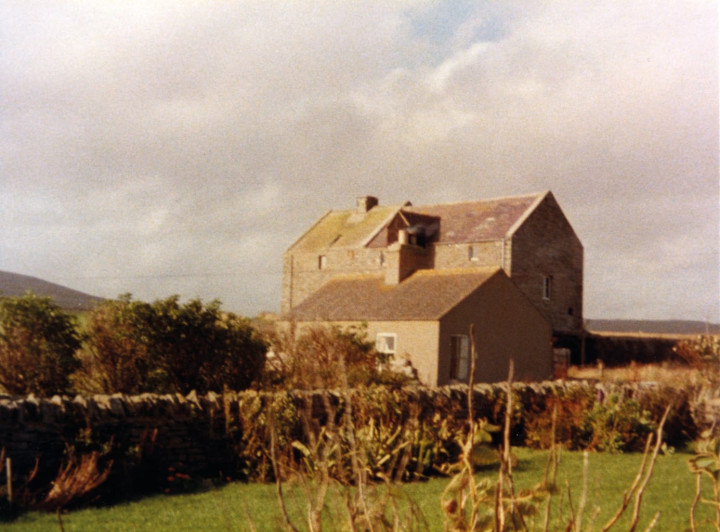 Millburn, Sourin, Rousay, with the Mill behind. It was in Millburn that Finlay lived in Spring 1959. Courtesy of Hugh Gibson.
For the last decade or so, Peebles has been working on a biography of Finlay’s early life, including the mere 11 or so weeks that he spent on the Orkney island of Rousay from March 1959 onwards. Though his early career is steeped in myth – a topic which Peebles also touches on, in a separate section of his “footnote” supplement – there is no doubt that this period was of immense emotional succour and creative inspiration to then struggling writer. ‘Rousay Mending’ is both testament to and visual-linguistic evocation of this fact. Having lived with his first wife Marion in rural Perthshire for the late 1940s and much of the 1950s, Finlay’s separation from her coincided with the onset of an increasingly acute agoraphobia that made many aspects of daily life near impossible.
Arriving at Rousay in springtime, with its “sooty-black” hills, mill, and 230 odd inhabitants, Finlay was part of a council team sent to repair the island’s one, circular road. But aside from his duties he was, Peebles notes, “free to spend his time writing and reading, and fishing, including in the burn and at Kirsty Pabbie’s Pow [pool in Orkney dialect]”. A letter to the Austrian poet Ernst Jandl from 1965, recalling this brief Orcadian sojourn, excerpted by Peebles, indicates how formative the experience was in establishing Finlay’s sense of the possibility of a rural idyll in which to live and create:
I wish you could have seen the little house I had in Orkney: the window was full of the sea, almost to the top; and I had one table, an oil-drum as a chair...dried fish hanging on a string...sometimes boats came to shelter between the islands, and I could lie in bed looking at their little lights, through the rain...I have poems about it in my first book.
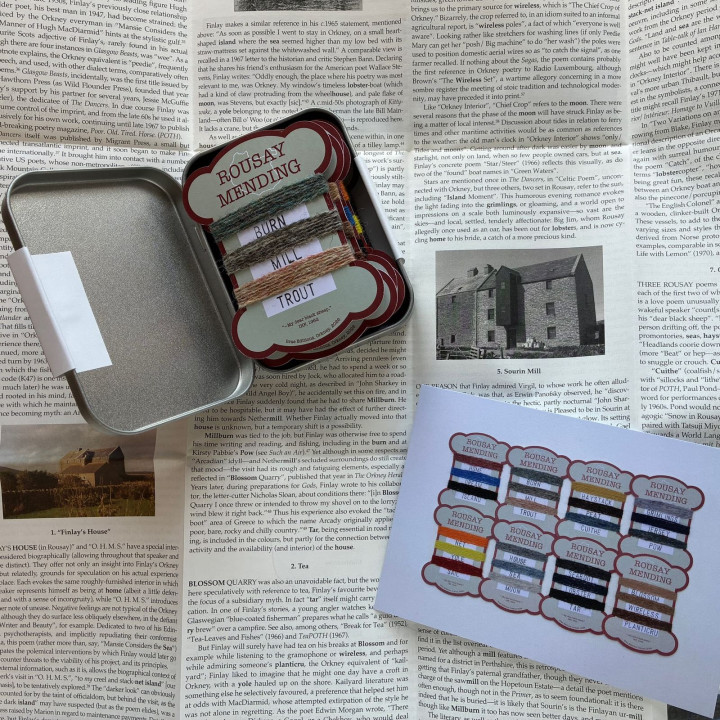 Rousay Mending. Courtesy of the Artist.
Words placed in bold by Peebles correspond to those featuring on the poem-thread- cards, indicating how the footnotes function in indexical terms. As for Finlay, the “first book” (of poetry, though he had previously published plays and stories) did indeed return restlessly and continuously to Rousay, in search of an emotional centredness that seemed elusive in Edinburgh, where he had moved: “At night, when I cannot sleep,/ I count the islands/ And I sigh when I come to Rousay/ – My dear black sheep.” (“Poet”, from The Dancers...)
The pleasure of ‘Rousay Mending’ is in the precise attention paid to a formative period in the career of an epochally significant Scottish writer and artist. Indeed, such is the influence of Finlay’s later material poetics and “poem-objects” that their compositional grammar seems less like an individual style than a collectively accessible idiom within Scottish and modernist aesthetics, one replete with the atmospherics of Peebles’s word-triads: HAYSTACK, PEAT, CUITHE; HOUSE, SEA MOON. In this sense, the significance of Peebles’s work is in furnishing a poetic origin myth for such important work, suggesting some of its formative visual stimuli, from the blue of jersey and lobster to the dear black of island and tar, to the rich brown of peat and planticru.
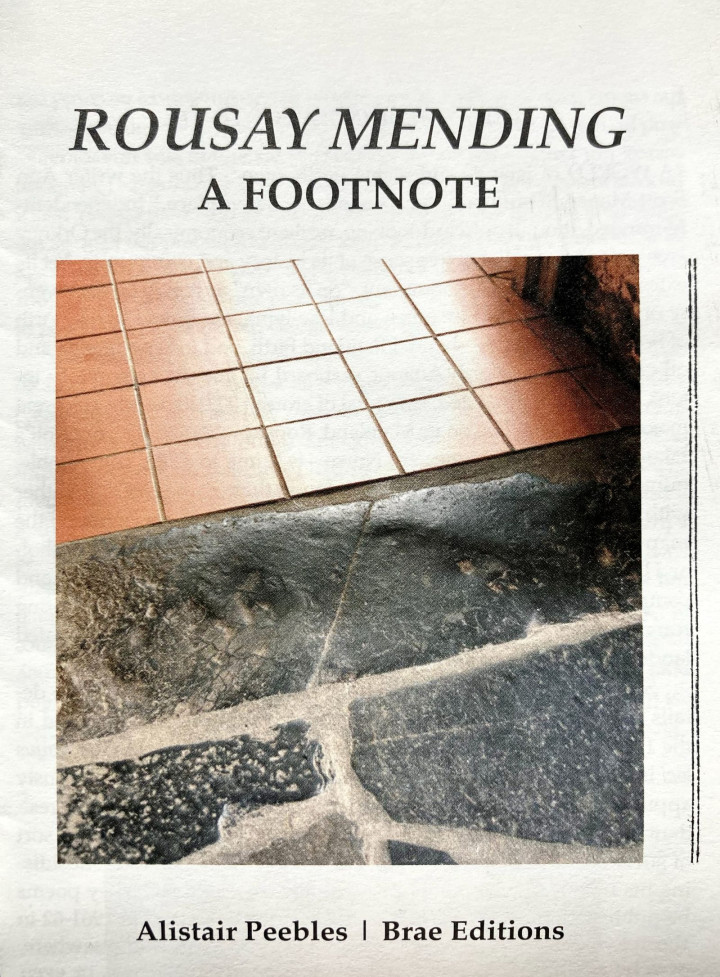 Alistair Peebles. Rousay Mending, A Footnote. Courtesy of the Artist.
Rousay Mending by Alistair Peebles is published by Brae Editions, Orkney, in an edition signed and limited to 60 copies (£125). It can be purchased at Pier Arts Centre:
https://www.pierartscentre.com/publications-print/rousay-mending-by-alistair-peebles-is-published-by-his-brae-editions


