
Scottish Art News
Latest news
Magazine
News & Press
Publications
Making art through the constraints of a structurally ableist world
By Shalmali Shetty, 02.05.2026
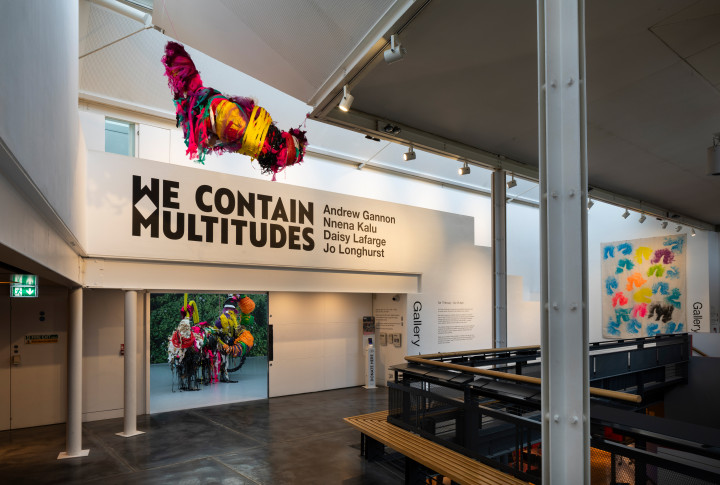
We Contain Multitudes at Dundee Contemporary Arts brings together four artists working from positions of disability, tracing their bodies through the constraints of a structurally ableist world. Across sculpture, painting, installation, photography and film, materials and gestures begin to accumulate through binding, repetition, restriction, multiplication; alongside quieter acts of survival, inflected by both anger, and a dry, disarming sense of humour. Moving through it asks us to look again at the spaces we inhabit and the conditions that shape them.
Within this, Andrew Gannon’s sculptures assert a presence in the space. Working with techniques drawn from prosthesis, he produces multiple plaster casts in response to his congenital limb difference. Installed across the gallery on plinths, walls, and suspended from the ceiling, the works move from what first appears decorative into something more critical, questioning the assumption that prosthetics should restore a body to a “cosmetically normal” state. Neon-sprayed and painted, they resemble musical instruments, weaver bird nests, or stethoscopes. Some appear wired into sockets suggesting functionality, yet remain deliberately inactive, introducing a hint of humour. In conjunction with this, Gannon’s stencilled paintings and neon-blue screenprints make use of his body as both subject and object, as well as a presence within an absence. This extends into performance, one of which involved the playful decoration of his limb with icing and sprinkles, suggestive of constructing something beautiful that keeps melting.
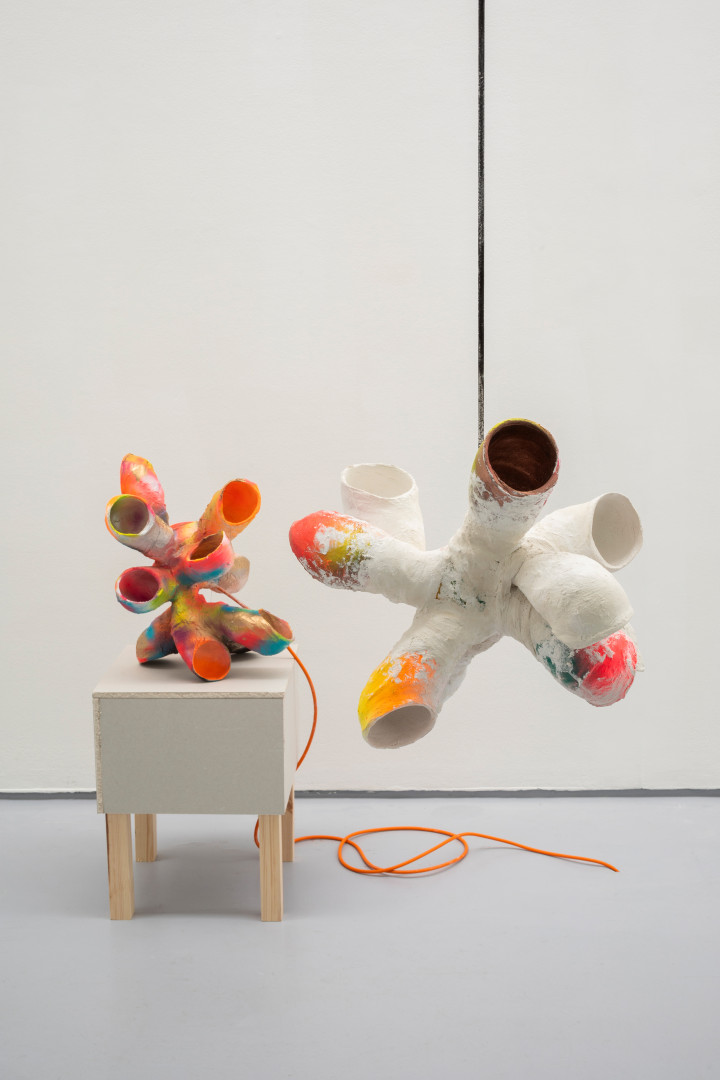 Sculptures by Andrew Gannon. Photo Credit: Ruth Clark, courtesy of Dundee Contemporary Arts (DCA).
Daisy Lafarge’s work transforms the space into a ‘Sick Garden’, reminding us to pause and rest, to sit at the table, lie on the futon, watch the clouds through the skylight, or read her poetry pamphlet ‘The Romance of the Sick Rose’, inspired by William Blake’s 1794 poem ‘The Sick Rose’. Here, drawing on ideas of the enclosed garden and the tradition of the rose as a love object, it is refigured instead as an eroticised motif of pain, beauty and fragility. Lafarge, a poet and painter living with Ehlers-Danlos syndrome, often works from periods of enforced rest, when chronic pain, alongside the strain of navigating long calls with healthcare systems and applications for medical and financial support, limits movement. Lying down becomes a way into her painting practice, defined by sensual hues of pink and red that form abstract shapes which slowly begin to change into familiar forms the longer you look. These works are held to the mount with cut-up leftover kinesiology tape, otherwise used to support her unstable joints.
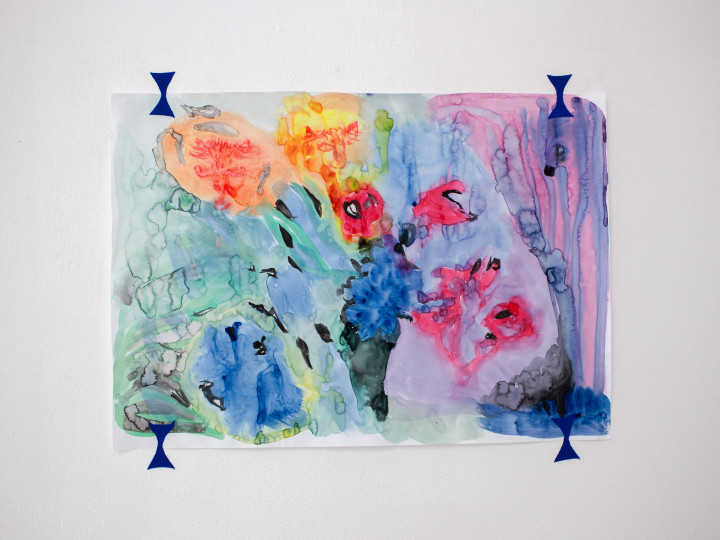 Daisy Lafarge’s work transforms the space into a ‘Sick Garden’. Photo Credit: Ruth Clark, courtesy of Dundee Contemporary Arts (DCA).
Alongside the clinical materials, organic forms and references to growth continue in Jo Longhurst’s photographs, prints, and film. Using the concept of “crip-time”, Longhurst explores how cultural ideas of perfection shape identity, and how bodies are seen or how they choose to be seen. Drawing on invasive bindweed (known for its anti-clockwise growth), she forms an analogy between what is considered an unwanted plant and the disabled body. In ‘Crip’, a photographic installation of 143 overlaid collaged prints of the same image, bindweed spirals outward in dense, repeating patterns across the contained structures of frames. The frames themselves climb the wall like the weed they reference. This contrasts with ‘Pinnacle’, where a group of images of a gymnast’s legs reveal the markings and bindings involved before reaching a state of “perfection.” Further, ‘Silent Fury’ responds to a traumatic legal case involving discriminatory treatment, and the frustration of navigating ableist systems through court processes, NDAs, and paperwork. A photograph shows these documents being burned in a bonfire on a hill, the ashes of which are later used as pigment in her silkscreen print series presented here.
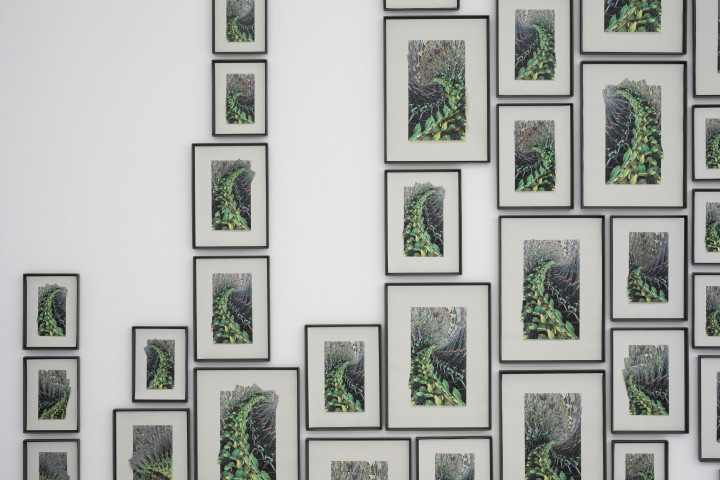 Jo Longhurst’s 'Crip’. Photo Credit: Ruth Clark, courtesy of Dundee Contemporary Arts (DCA).
Nnena Kalu, recently named the 2026 Turner Prize winner, creates myriad sculptures that appear to emerge from discarded packaging materials. Vividly coloured, they hover in mid-air like densely layered clouds or soft, cocooned beasts. Working with limited verbal communication, she draws on bodily movement to construct these works from fabric, paper, rope, clingfilm, tape and VHS tape, building through repeated acts of binding, wrapping, and knotting, with loose ends left to cascade and gather on the floor. These sculptures are built over time, where the act of making is a continuous process until she decides it is finished. This process extends into her meditative drawings, made at the scale of her hand’s reach. Often presented as diptychs and triptychs, they are developed through continuous, symmetrical patterns and mark-making. When placed together, the drawings appear almost identical, despite being individually produced, showing variation within repetition and the limits and possibilities of the body.
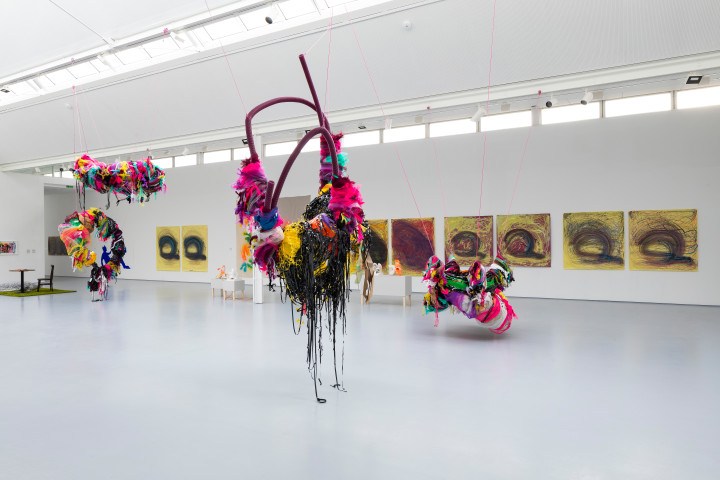 Sculptures and drawings by Nnena Kalu. Photo Credit: Ruth Clark, courtesy of Dundee Contemporary Arts (DCA).
Instead of treating disability as something separate, the exhibition complicates fixed labels, showing how bodies are shaped and constrained in different ways by the same structures. In this sense, the exhibition reflects on what contemporary art institutions still need to address within an ableist cultural landscape. It points to the systems that continue to be replicated without being questioned, where change is often seen as inconveniencing dominant norms, allowing the status quo to remain.
Attention to access runs throughout the exhibition, with seating and a box of material samples from the works available to touch, something DCA has consistently included across its programming - encouraging a reconsideration of who the gallery is for and how it can be used. The exhibition has been developed from the collaborative project also titled We Contain Multitudes, funded by the Paul Hamlyn Foundation and led in partnership between DCA, Collective, and LUX Scotland. It works towards systemic change in the Scottish arts sector by supporting disabled artists, arts professionals, and audiences through training, research, and commissioning, and by addressing ableism within institutional structures to create greater access, visibility, and recognition of disabled expertise.
We Contain Multitudes was exhibited at Dundee Contemporary Arts between 7th February – 26th April


