
Scottish Art News
Latest news
Magazine
News & Press
Publications
Labours of Language and Love: Hannah Ellul’s Sound Art
By Greg Thomas, 03.03.2026
In the front room of Hannah Ellul’s Glasgow flat, four speakers have been positioned in a square around a comfy armchair, on which I’m sitting listening to the multi- channel work that will form the core of her upcoming exhibition, Days and Years, at Glasgow Project Room. The domestic setting is a necessity, the sound-sources positioned to mimic the gallery set-up. But it feels oddly appropriate to the content of the work.
The seven-minute long, four-channel piece consists of intricately spliced snippets of audio featuring the artist talking to her Egyptian-British mother, uncle, and aunt about their relationship to Arabic. The bird sounds and fridge-hum in the background indicate an intimate, domestic environment. In the foreground, the ums and ahs that pepper the dialogues have been extracted and stitched together to form a kind of granular sound poetry, at once aesthetically intriguing and an index of those moments in human conversation where speech disintegrates into vocal noise. As a characteristic of dialogues about the participants’ bilingual heritage, these moments feel especially loaded, at once markers of confusion and frustration, and expressions of some ineffable plenitude or fullness of feeling that can’t carry over into words.
Hannah Ellul (b.1982) is a sound artist and experimental musician based in Glasgow whose work has long been concerned with what she calls, at one point in our discussion, “laboured language”. Trained at Brighton and Glasgow, her practice is steeped in the DIY noise and free improv performance scenes of those cities as well as – perhaps more than – any formal canon of sound art. Ellul herself plays in the bands Human Heads and Rotter Otter with other musician-artists based in Scotland, including Rebecca Wilcox, a frequent collaborator; their most recent joint show was Knot at Glasgow’s Broadside Gallery, 2024.
Like any creative practice that occupies the interstices between disciplines, Ellul’s can be hard to present, display, or describe in ways that convey its subtleties. Suffice it to say, a primary medium is sound; the artist’s website contains a selection of audio and video-works spanning the last fifteen years. Key past exhibitions and performances include ‘Hocket’ (2011) at Market Gallery, an audio-visual piece which explored traditions of collective singing, in particular Inuit katajjaq throat-singing, a form of call-and-response in which the singing-partner’s mouth is used as voice box. This establishes another key aspect of Ellul’s practice. That is, the idea that vocal sound depends on a listener to bear any meaning, and that this listener is almost always an interlocutor. Therefore, linguistic sense is a product of collective rather than individual thought, a concept with roots in feminist and structuralist theory.
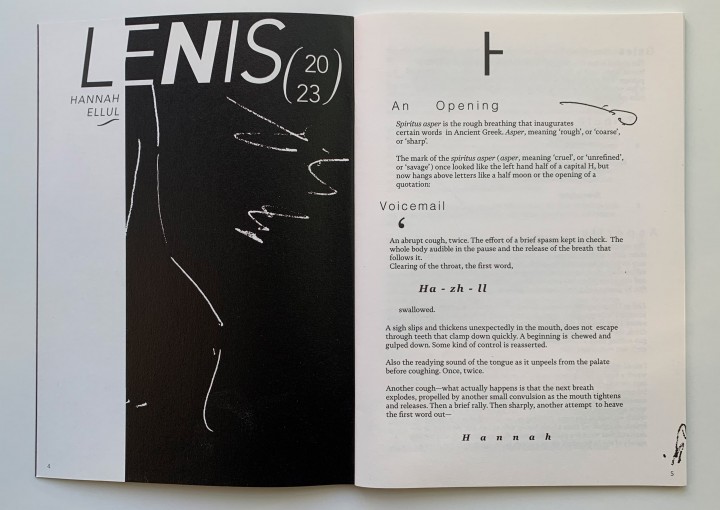
.jpg) Hannah Ellul, Lenis, video, 2021
Hannah Ellul, Lenis, video, 2021
A key turning point in Ellul’s work, though one which she now professes “mixed feelings” about, was the 2019-20 radio-piece ‘Breathless’, commissioned by the Scottish experimental music festival and station Radiophrenia and Kunstradio Radiokunst for Ö1, Austria. For the first time, Ellul used documents of family life as the primary basis for her sound art, specifically a series of breathless, stumbling voice-recordings sent to her by her father Len towards the end of his life, his voice affected by alcoholism and respiratory illness. (The same recordings informed the written piece ‘Lenis’, published in the journal 2HB in 2023, and ‘Lenition drawings’ of 2021-23, based on scrawled notes.)
The ‘Breathless’ sequence used spliced-together fragments of disintegrating or ruptured speech in a way that predicted subsequent works such as the video-work ‘Pommel’ (2021, Nottingham Contemporary) and the pieces in Days and Years. “I’m interested in that moment when the voice falls apart”, Ellul tells me. More significantly, perhaps, the choice of source material allowed Ellul to focus not just on the socio-political connotations of the voice – the way accent and grain of voice are impacted by class and related things like lifestyle and air-quality, say – but on how these factors had played out in her own immediate family. Indeed, though she is admirably wary of the reductive interpretation that such labels can invite, it is undeniably core to Ellul’s work that she is a working-class artist of mixed heritage.
All of which brings us back to Days and Years. Were the conversations which informed this piece – talking to an older generation about their mixed-race identity, as manifested through bilingualism – to some extent prompted by the emboldened racism of British politics over the last decade? Certainly, at several points, her family-members can be heard discussing the racism they have encountered in relation to their ‘grasp of English’. “I don’t want that to be too on the nose,’ says Ellul. “As an artist I’m drawn to the unresolved spaces, even if it’s not the most politically expedient thing to do. And a lot of my work is about breaking down an easy, fixed sense of identity. But it felt important to leave those passages in.”
Ellul also notes that, having gone into the discussions expecting her relatives to talk about their estrangement from Arabic, she found they were more likely to speak of that language as a refuge, and of English as a potential source of alienation. Two of the three siblings were born in Alexandria, the other, Ellul’s mother, after the move to the UK. Yet memories of childhood lessons and songs, or of speaking with older generations, seem to form a wellspring of feelings and thoughts that are somehow untranslatable.
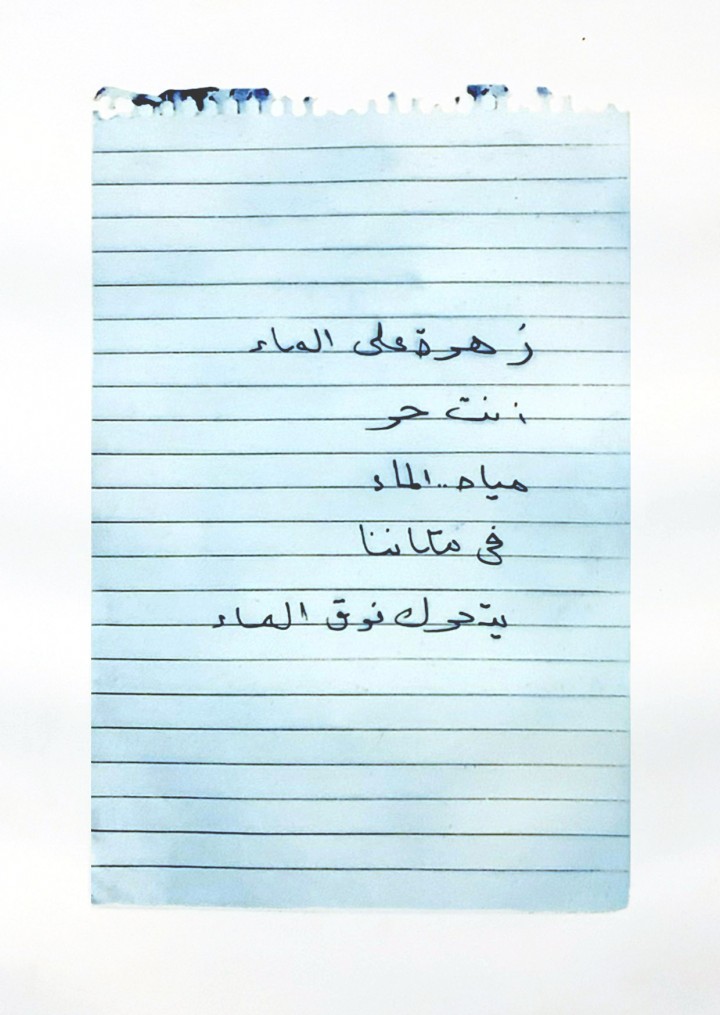 Hannah Ellul, Ya Mayla (1), photopolymer etching on paper, 2025.
This is borne out in several ways in the upcoming show. Uncle France spent some time during their recordings discussing the song “Ya Mayla Al Gousoune”, by the Lebanese singer Fairuz, ubiquitous in the pan-Arab world. His rough translation of the lyrics – “A flower in water/ oh you free one/ Waters of the water/ In our place/ Moves over the water” – has an abstract poetry to it that prompted the artist to create two photo-polymer etchings for the exhibition, one bearing a cursive transcription of the lines in English, another the same lines translated back into Arabic by a friend. The name of the show, too, is based on a phrase of France’s, “ayaam wa saneen”, which he says can be translated as “days and years” but which bears much greater richness to him in the original, indicating “aeons of time”.
A final element of the show is a stereo sound-piece more akin to Ellul’s work with noise and improv bands, combining synthesiser, voice recordings, and distorted sections of the same Fairuz song. Taken together, the pieces in Days and Years pay typically thoughtful homage to an aspect of the artist’s family history not previously broached in her practice, representing both continuity and breakthrough within an important body of contemporary sound art.


