
Scottish Art News
Latest news
Magazine
News & Press
Publications
Joan Eardley: The Sea at Catterline
By Keava McMillan, 11.06.2026
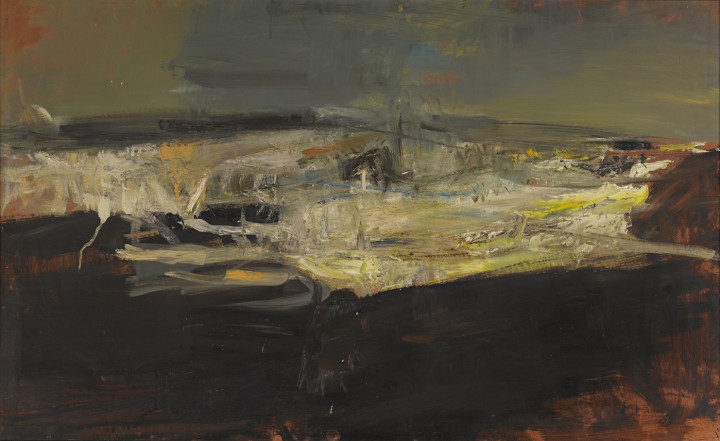
The artist Joan Eardley RSA (1921–1963) first visited the north-east coast of Scotland in 1951. She wrote to her mother: ‘I have quite fallen for it, both the sea and the country behind.’ She spent an increasing amount of time in the fishing village of Catterline over the next decade, painting the small cottages, the windswept fields and the vast coastline. The vivid seascapes she produced in these final years defined her short life and career.
In ‘Wild Sea’ (1958) she transports the viewer to a clifftop overlooking the horseshoe bay which offers little protection to the village she made her home. She sculpted muted tones onto her board, capturing the brutality of the storms she waited for and her fishermen neighbours dreaded. She shows us many of the places in the village that she repeatedly returned to paint: the shingle beach, the rocks, and the exposed salmon bothy. Vivid hints of cool blue beneath the sea menace the chalky warmth of the cottages. including her first studio, the Watchie, a barnacle on the clifftop directly across from her easel.
..jpg) Joan Eardley. Wild Sea (c. 1958). © Estate of Joan Eardley. All Rights Reserved, DACS 2020
Joan Eardley. Wild Sea (c. 1958). © Estate of Joan Eardley. All Rights Reserved, DACS 2020
She painted this view not far from her first home in Catterline, 1 South Row. The cottage was basic, lacking running water, plumbing, flooring and a watertight roof. This proved no obstacle to Eardley. With her friend and fellow artist Angus Neil (1924–1992), she waterproofed the roof with abandoned canvases and adopted the mice that lived in the space before her. In many ways, her living conditions mirrored those of the cottage’s inhabitants in the previous century. However, the life she created for herself as a single, working woman was distinctly modern.
Many of the most striking portraits of Eardley herself were taken by her companion, the photographer Audrey Walker. Through Walker’s lens we see Eardley at home as an artist and as a villager. Combined with the letters Eardley wrote daily, some of which are archived at the National Library of Scotland, Walker gifts us a glimpse into the artist’s working life. Sometimes she is a formidable figure, facing off against the sea in front of her easel. At other times, she writes about village gossip or is pictured sitting with friends outside her cottage.
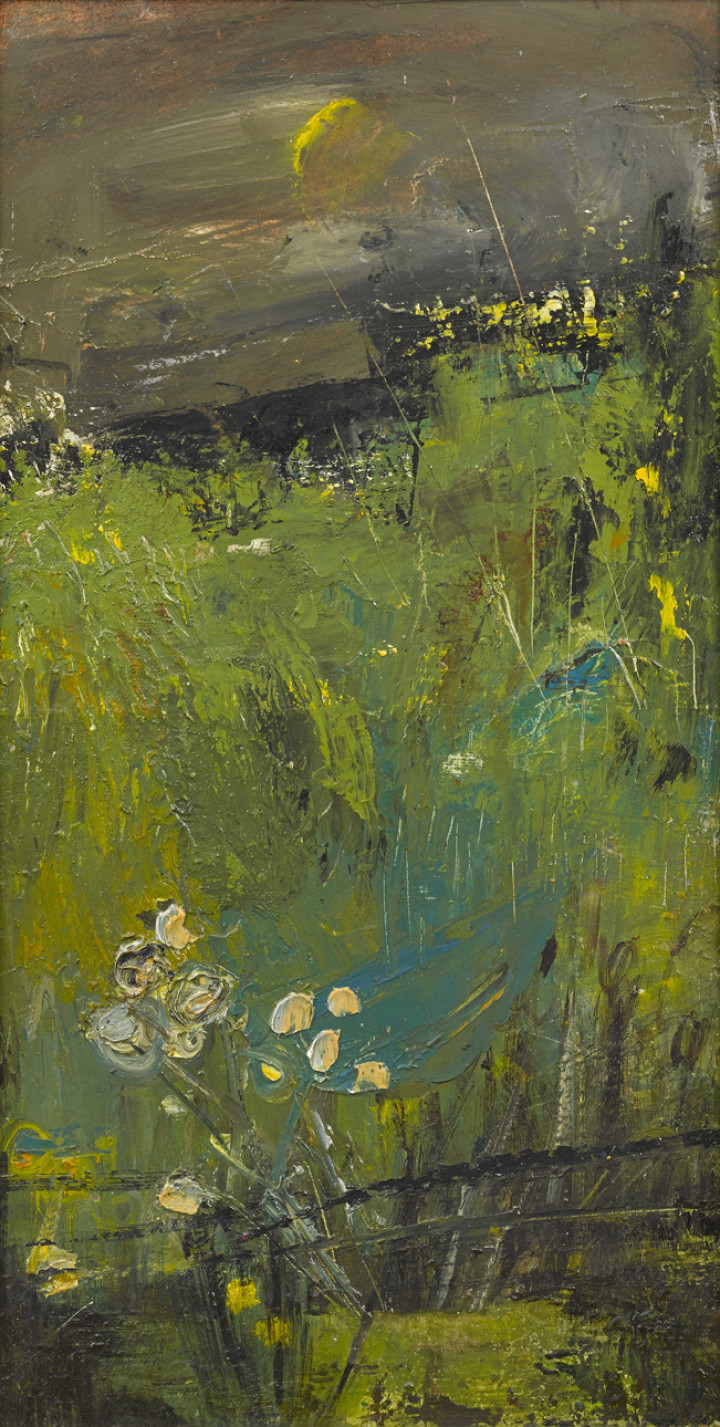 Joan Eardley, Summer Storm © Estate of Joan Eardley. All Rights Reserved, DACS 2020
Painting outdoors on the scale and intensity at which Eardley worked was manual labour and she dressed accordingly. While post-war urban fashions for women circled back to femininity, she sported cropped hair, corduroy trousers, thick boots, and shirts or smocks. Eardley’s approach was equal parts practical and non-conformist, a combination that upset her mother when she saw her daughter pictured in the newspaper in trousers and on a motorcycle. Regardless, she forged her own path which reflected her work and life.
Eardley was, in contrast to her early biographers, unperturbed by her sexuality and frank when speaking to close friends. ‘Well, being a lesbian in itself isn't a thing to worry me,’ she wrote to her friend Francis Stephens. Relationships between women were not criminalised in the same way as those between men, meaning that lesbian lives often slipped between the cracks of societal scrutiny. However, mid-century attempts to decriminalise homosexuality resulted in a heightened, and generally hostile, awareness of queer lives from the public and media. Despite this pressure, queer women continued to find and support each other. Many, like Eardley’s openly lesbian aunt Sybil Morrison, found community in cities like London. Others, like Eardley, made a home for themselves in a small place.
..jpg) Joan Eardley. Field of Barley by the Sea (c. 1962). © Estate of Joan Eardley. All Rights Reserved, DACS 2020
Joan Eardley. Field of Barley by the Sea (c. 1962). © Estate of Joan Eardley. All Rights Reserved, DACS 2020
Catterline was a little, rural community. In the 19th century, the village’s isolation was a cause of concern for state and church authorities who were anxious about smuggling and unmarried couples thriving away from their watchful eye. Eardley’s appearance, motorcycle, cohabitation with Neil (an unmarried man) and work as a painter were already a curiosity. Some of her neighbours were aware of her relationships with other women but this did not appear to impact her participation in village life.
What bothered Eardley was not being a lesbian but being alone. Her most intimate companion, Walker, was happily married, previous romantic relationships had interfered with her painting, and her cohabitation with Neil was complicated by his illness and intensity. She regarded her happiness and artistic success as interlinked and had no interest in cultivating misery in either sphere. Walker remembers that ‘she so longed for a right wee home, and was so happy when there was a wee person there’ which allowed her to ‘do some of her best work.’ Eardley was highly aware that her contemporaries’ artistic practices were sustained by their partnerships; by a partner who took on the cleaning, cooking and care work that underpins the work of a married painter. A ‘wee person’ was for her painting as much as for herself.
.jpg) Lil Neilson, Salmon Nets Drying
Lil Neilson, Salmon Nets Drying
Eardley may have written to Walker about her desire for a relationship but a vibrant lesbian dating pool was not among Catterline’s many charms. A tutoring gig at Hospitalfield in Arbroath was initially a maddening interruption to her Catterline painting life in 1960. The talents of a couple of the students were some consolation, and she reported to Walker ‘there is a girl who is really rather good’. The painter Lilian ‘Lil’ Neilson (1938–1998) was at the very beginning of her career when she met Eardley at Hospitalfield. Eardley was approaching the peak of her career, preparing for her second solo show in Edinburgh and with her first in London on the horizon. It was 1962 before Neilson gained and accepted an invitation to stay in Eardley’s new (furnished, plumbed and electrified) cottage at No. 18: ‘If you find the place stimulating you could stay a bit.’
Their relationship spanned the final year of Eardley’s life though. As Eardley was only 42, neither of them were aware that their time together was limited. However, there was an urgency to the seascapes she produced in the early 1960s in the lead-up to her London show. Many of these pictures were painted outside, working side-by-side with Neilson. Eardley, who captured the likenesses of Glasgow children in her Townhead studio with vivacity, chose not to include people in her paintings of north-east Scotland. The lack of figures fixes an image of her as a solitary being, working alone in dialogue with the ocean and the grasses. This image, while romantic, is not entirely accurate. Eardley had a rich community of neighbours and artists in the village. Lovers, friends and family visited and she also acquired Mrs Cat, who was . . . a cat. In the final months of her life, she was cared for by Neilson and her friends. Amid the chaos of grief, artworks and politics after Eardley’s death, Neilson stayed in the village. She spent the next decade painting outdoors in Catterline without Eardley. There are affinities between their work from the 1960s, in the shared fascination with the sea and the interest in texture. Neilson’s unique grasp of light and excellent draughtsmanship was obscured by a critical reception more interested in her connection to Eardley.
..jpg) Joan Eardley. Rag and Bone Shop (Unknown). © Estate of Joan Eardley. All Rights Reserved, DACS 2020
Joan Eardley. Rag and Bone Shop (Unknown). © Estate of Joan Eardley. All Rights Reserved, DACS 2020
Histories of queer artists often focus on an escape from a provincial family home, with the artist finding personal and professional fulfilment in an exciting larger city. This is an alluring, and often accurate, narrative but one which elides the potential freedoms contained within a small place. Eardley gravitated to rural Scotland, spending time with Walker in the Scottish Borders and working alongside Margot Sandeman on Arran. Even her studio in Townhead was in a tight-knit community, far from the suffocating orbit of the Glasgow art world. The anonymity of the city offered protection to some, but others flourished in isolated areas free from the surveillance of society and the pressures of the market. Some, like Eardley, settled on the periphery, occupying the role of the artist who was both an insider and an outsider.
Catterline was not only a home, workplace and source of material for Eardley’s paintings but almost a creative collaborator. Elements of the shore, sea and grasses cling to her works from this period. The same views are repeated, each with renewed curiosity. Eardley did not see her subjects as finite: ‘I hardly ever move from one spot. I do feel the more you know something, the more you can get out of it.’ Her Catterline works hold a power and urgency that still captivate contemporary viewers. Their planes of colour and wild strokes are laid open to future generations to draw from. Like Catterline itself, they are an inexhaustible source.


