
Scottish Art News
Latest news
Magazine
News & Press
Publications
Interview: Bugarin + Castle on bringing Shame Parade to Venice
By Lena Kammerer, 14.05.2026
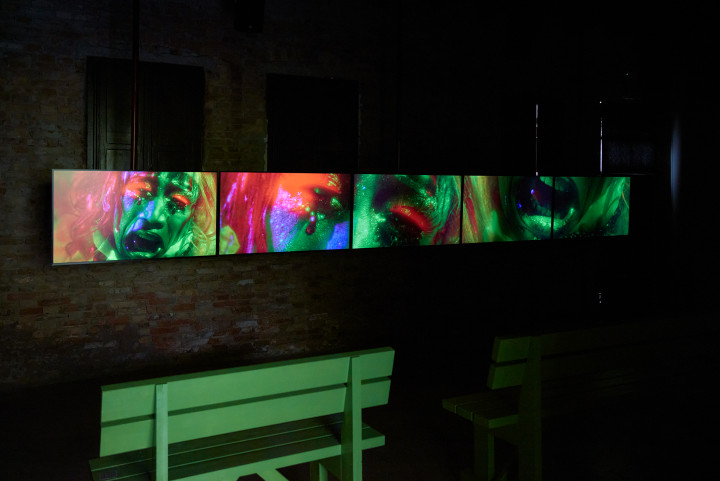
Representing Scotland at the 61st International Art Exhibition – La Biennale di Venezia – is Bugarin + Castle, composed of the two Glasgow-based artists Davide Bugarin and Angel Cohn Castle. Their creative partnership first began a decade ago as Bugarin explains. “We started as an artist duo ten years ago, performing together with Pollyanna, which is the production cabaret company that Angel founded. I was introduced to the magical world of drag cabaret. At the beginning, we started doing performances, and then, our realms, our research started to intertwine. I come from architecture. I still practice as an architect. Angel comes from fine art and filmmaking.”
“A key project that summarises how that intertwines was ‘Sore Throat’,” says Castle, an interactive film exploring how sound is overheard through walls and its impact on queer people and queer spaces in the Philippines, where sounds are often interpreted through referencing monstrous mythology and distorted through colonisation and gentrification. “We were thinking about how can we think about architecture, think about cabaret, also think about visual arts? We worked with Studio Autonomic to develop the new software, with the question of how can we bring the interactive nature of cabaret into film installation?”
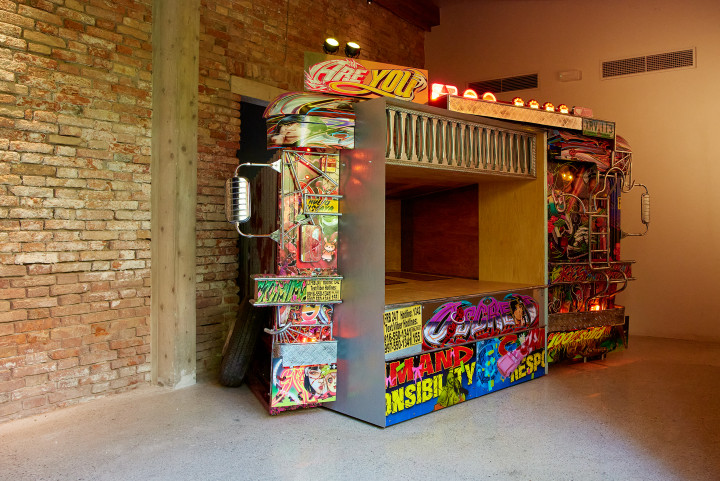 Bugarin + Castle, Nocturnal Amusements, part of the exhibition Shame Parade curated by Mount Stuart Trust for Scotland + Venice at La Biennale di Venezia in 2026. Image by Dimitri D’Ippolito. Courtesy of the artists and Scotland + Venice.
Bugarin + Castle’s multi-layered project for Venice, curated by Mount Stuart Trust and commissioned by Scotland + Venice, began far away from the Italian city, Castle says. “Davide was doing a sound mapping in Manila, and it's a really noisy, bustling city. Just a certain borough was strangely quiet at night. It was really quiet after 10pm and he wondered why that was, and it turned out to be this site called Manila North Cemetery. There is a particular space where people live amongst and above mausoleums and tombs. We looked into what this sound restriction was about, and actually, it was due to Article 155 in the penal code, and specifically, within that, there's this word called charivari.”
“This began this question, what is charivari? And it brought us to European history, Scottish history, English history. These, starting in medieval times era, shaming parades, where intriguingly, sound was used amongst people, and that was interesting to us, because we had made this work about sound. But also cross dressing was used as a form of mockery, including to shame others. So, as artists that have thought about drag, cabaret, and sound, this was intriguing for us. Not to think about, ‘oh, let's find this liberatory history around queerness in the past’ but let's think about the complex, the sticky history of crossdressing that could be something that is about patriarchy or about shaming others.”
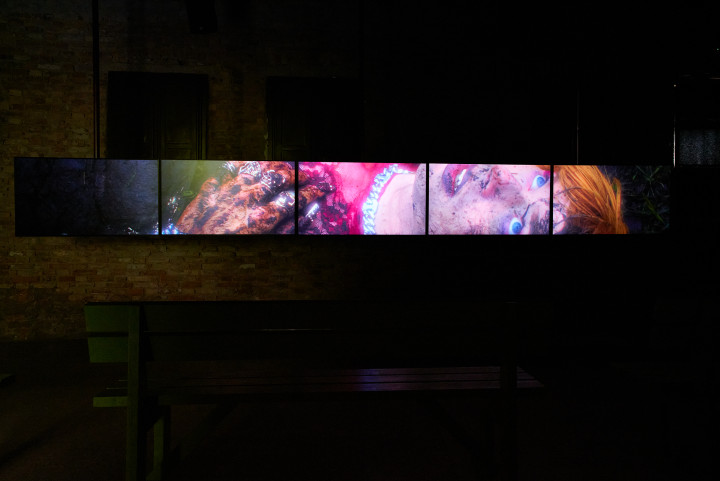 Bugarin + Castle, Submit to Sound, part of the exhibition Shame Parade curated by Mount Stuart Trust for Scotland + Venice at La Biennale di Venezia in 2026. Film curated by Mount Stuart and produced by Forma. Image by Dimitri D’Ippolito. Courtesy of the artists and Scotland + Venice.
Castle elaborates on what Scotland’s pavilion, with this historical concept of the shame parade at its core, is composed of. “The exhibition expands out on those themes, so we have film work, which does recreate some of those elements of the shaming parades and also intertwines that with a trans perspective and a Filipino perspective. Bringing us to Manila North Cemetery, but also bringing us to a trans voice feminisation session. We also have the other artworks in exhibition that think about sound, voice, and shame, through a number of different lenses.”
“We would want audiences to come away with an exhibition that is proudly trans, proudly Filipino. It's not taken in a simplistic or expected sense of how are we going to get to celebration and joy? It's called Shame Parade. We're thinking around the forces that cause shame, inner or outer. We are also thinking about the, as I said, complex histories. We're thinking about the two things can be opposite and exist at once, such as maybe feelings of - another artwork, talks about the ideas of clocking or passing, like whether being clocked as a trans person, or passing as a trans person is something to strive for, or something to avoid.”
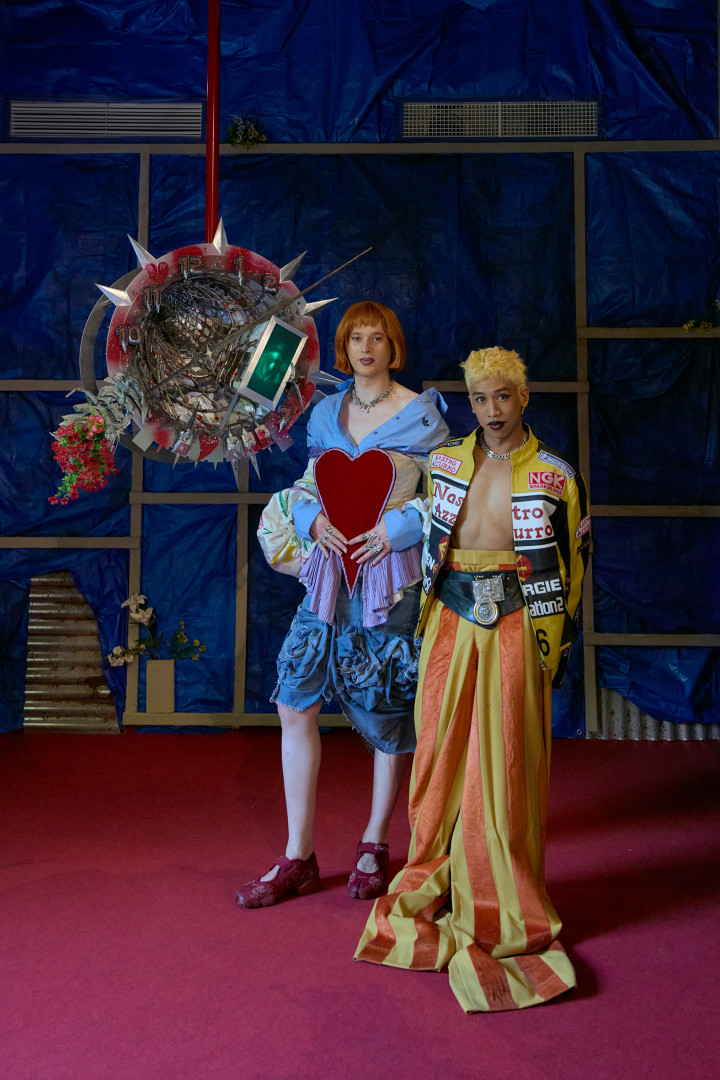 Bugarin + Castle on the occasion of Shame Parade opening at Scotland + Venice during the 61st International Art Exhibition - La Biennale di Venezia. Image by Dimitri D’Ippolito. Courtesy of the Artists and Scotland + Venice.
Drawing on the diverse source material of queer histories, Scottish archives, and Filipino cultural heritage while simultaneously incorporating wide-ranging practices like cabaret and architectural methodologies characterises Bugarin + Castle’s work and way of working. “Someone has said something about the way that we combine not only histories and beings, but also materials is reflective of actually how the world works. It's not distinctly put into boxes. We receive a lot of information, we research lots of information, and the keyword for us was collision. It's also about the mention of what does it mean for two people to make work together? Crossing over experiences, but differing experiences.”
“We're really excited that this project has been about celebrating the work that we are excited to do, and in particular, that's about positioning Scotland as part of the world. This is about Scotland. It's about the Philippines, it's about transness, and Scottish experience. This is not about something that's disconnected from the world. It's very much about being part of the world.”


