
Scottish Art News
Latest news
Magazine
News & Press
Publications
Inference to the Veil
By Shalmali Shetty, 10.06.2026
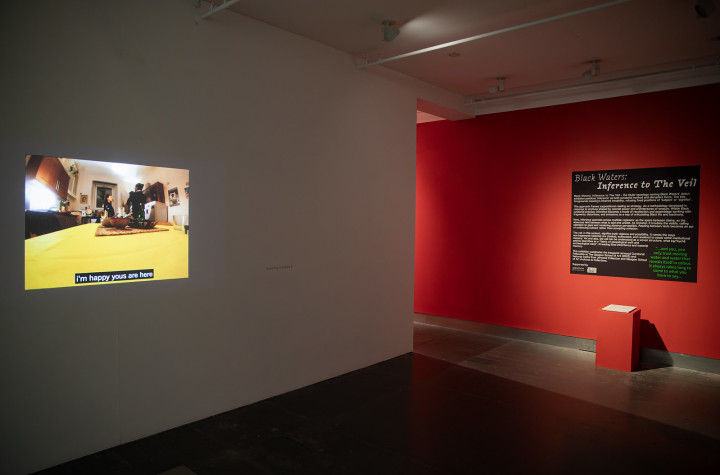
Inference to the Veil marks the inaugural Jerwood Curatorial Fellowship at Glasgow School of Art. Presented by Black Waters, a collaborative curatorial research incubator led by Zoë Zo, Zoë Tumika & Zoë Guthrie and Żżo Charlery, it brings together works from the Jerwood Collection and Glasgow School of Art Archives & Collections alongside invited artists and spanned painting, sculpture, printmaking, archival material and moving image.
Framing Glasgow as a site shaped through colonial trade, maritime circulation and the afterlives of empire, the exhibition traces how Black histories remain embedded yet obscured within the structures of the modern city. Here, “inference” operates as a curatorial method tracing how histories persist through fragments, opacity and archival absence, while also approaching Black abstraction as both structural condition and aesthetic practice. Across the gallery’s three rooms, “sites of tidal contact” function as a relational link to explore each work.
 (2020).jpg) Barbara Walker - Vanishing Point 13 (Veronese) (2020) © Matthew Arthur Williams
Barbara Walker - Vanishing Point 13 (Veronese) (2020) © Matthew Arthur Williams
Drawing from works in the Jerwood Collection, Barbara Walker’s ‘Vanishing Point 13 (Veronese)’ (2020) re- engages with Old Master paintings through a reading shaped by the “archive of the shipped,” situating a graphite-rendered Black female figure against another figure who persists only as trace and near absence. Presented alongside Walker’s work is Lubaina Himid’s ‘A Rake’s Progress: Hole in Her Stocking 4’ (2022), which reworks, through screenprint and acrylic, William Hogarth’s 18th-century moralising narrative imagery to expose Enlightenment “progress” as structured through colonial extraction and enslaved labour. This extends through Yinka Shonibare’s ‘Mayflower, All Flowers’ (2020), where a maritime vessel is composed through woodblock print and collaged batik fabric, a textile originating in Java and circulating through Dutch colonial trade into West African markets. Michael Armitage’s ‘Dream and Refuge’ (2020), depicts a sleeping or dreaming figure and situates migration within longer maritime and ancestral histories that contemporary border regimes and anti-immigration narratives violate.
 (2022).jpg) Lubaina Himid CBE, RA - A Rake’s Progress Hole in her Stocking (4) (2022) © Matthew Arthur Williams
Lubaina Himid CBE, RA - A Rake’s Progress Hole in her Stocking (4) (2022) © Matthew Arthur Williams
.jpg) Michael Armitage - Dream and Refuge (2020) © Matthew Arthur Williams
Michael Armitage - Dream and Refuge (2020) © Matthew Arthur Williams
From the GSA Archives, Kialy Tihngang’s ‘Useless Machines’ (2021) sits on a central plinth, critiquing capitalist regimes of utility through non-functional assemblages of discarded materials and uneven waste economies. Emmanuel Addo-Osafo’s four small wood engravings from 1961 registers entanglements with colonial education systems, tracing pedagogical circuits between the Glasgow School of Art and the Kumasi College of Art through the African Community Schools Curriculum. An artist of Chinese-Malaysian heritage trained at GSA, Hock Aun Teh’s ‘Painting of Jamaica Street Bridge’ (1971) reframes the Clyde’s industrial setting as a fluid pictorial space, revealing the river as a conduit of colonial trade and extraction. Anna Tawungwa’s ‘Dirty Hoops’ (2025) explores these ideas further, through a textile-based abstraction of stitched circular grids and layered pigments across a quilted gingham ground producing unstable, shifting surfaces.
.jpg) Hock Aun Teh - Painting of Jamaica Street Bridge (1971) © Matthew Arthur Williams
Hock Aun Teh - Painting of Jamaica Street Bridge (1971) © Matthew Arthur Williams
Invited artist Adebusola Ramsay’s two brightly painted canvases using acrylic paints and techniques of mark-making, draws on grief, memory, and Black and African visual and textile traditions. Across the moving-image works by Camara Taylor, Grace Browne, Rebecca Bellantoni, and Zoë Zo, Zoë Guthrie & Zoë Tumika, the archive is refigured as a constructed and contested system, where narrative is produced through image, instruction and silent subtitles, and voice is circulated collectively through forms of gathering, testimony and exchange. Three vitrines extend this inquiry through an archival presentation of the single 1990 Glasgow-based exhibition invitation In Search of Oshun: An Exhibition of Contemporary Nigerian Art, alongside books and research materials relevant to the making of this exhibition, framing the archive as a site of reading and reassembly.
The Jerwood Curatorial Fellowship is established in partnership between GSA Exhibitions and the Jerwood Foundation. This paid programme seeks to address the gap between academic training and access to curatorial production, particularly for those working outside permanent or formal institutional roles. Through the Fellowship, emerging curators in Scotland are supported to realise their first institutional exhibition beyond formal education. Within a wider landscape of shrinking arts funding and reduced curatorial opportunities in Scotland, the Fellowship responds to growing sectoral precarity, particularly for practitioners facing structural barriers linked to race, class, gender and disability.
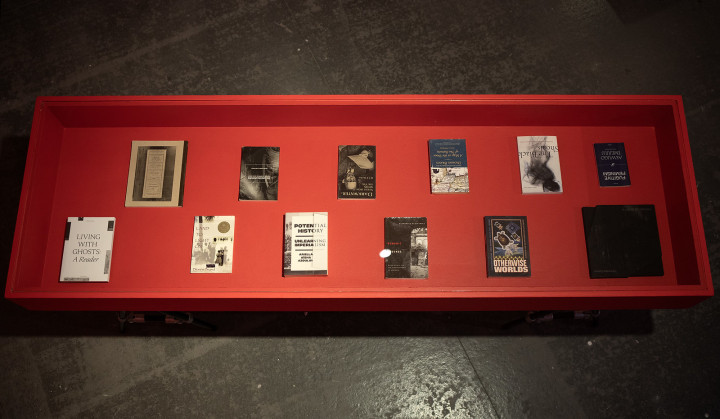 Citation References © Matthew Arthur Williams
As Jenny Brownrigg, Director of GSA Exhibitions, notes: “An aim of the Curatorial Fellowship is to provide a new paid opportunity; to support a new body of curatorial research; to provide new readings to historical works, and in turn through a contemporary response, create an exhibition opportunity for a diverse group of exhibiting artists. In this way it contributes to the curatorial landscape in Scotland.”
The second Jerwood Curatorial Fellowship 2026-27 will be advertised this summer.
The exhibition was on view from 14 March to 25 April 2026, at the Reid Building, Glasgow School of Art


