
Scottish Art News
Latest news
Magazine
News & Press
Publications
Elizabeth Blackadder: A Life in Colour
By Neil Cooper, 11.08.2026
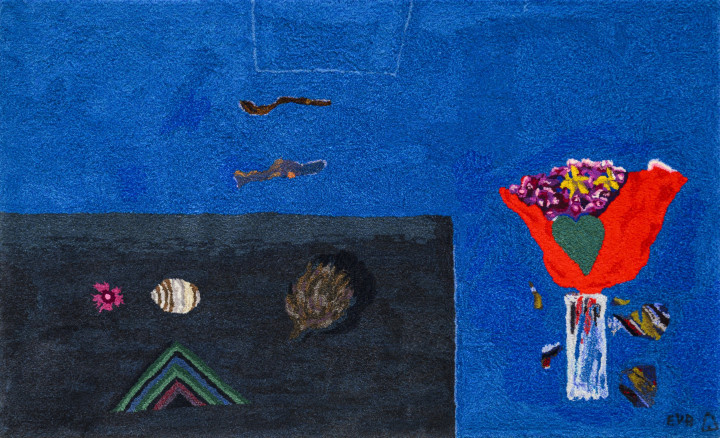
By the time Elizabeth Blackadder RSA (1931–2021) became the first woman elected to the Royal Scottish Academy in 1972, the Falkirk-born painter and printmaker had already carved out a unique oeuvre of vibrant landscapes and still lives focused on flowers and objects. Some of this has been channelled into the tapestries and rugs featured in Elizabeth Blackadder: A Life in Colour, an exhibition of Blackadder’s works that puts these textiles in dialogue with paintings and drawings by the artist from the RSA collection. Marking five years since Blackadder’s death, the exhibition at Dovecot Studios in Edinburgh, where the textile works were made, aims to show off Blackadder’s vivid use of colour in her visual language.
The artist’s relationship with Dovecot dates back to 1966, when ‘Still Life, Tulips’ (1966) was her first tapestry work. Since then, Dovecot has collaborated with Blackadder on a total of 31 tapestries and five rugs. These include ‘Eastern Still Life’ (1980) and ‘Cats at Play’ (1995). Since her death, the relationship has continued with ‘Flowers and Black Cat’ (2023) and ‘Red Still Life – Dragon Fruit and Oysters’ (2023). The newest addition to Blackadder’s canon is ‘The Red Bouquet’ (2026), a hand-tufted rug inspired by the 1975 painting of the same name. Made by Dovecot’s team of weavers, the newly finished work will receive its public premiere at the exhibition.
“It’s very exciting to show a new work,” says Naomi Robertson, Dovecot’s head of Tapestry Studio. “As with all the works on show, ‘The Red Bouquet’ demonstrates the strength of colour in Elizabeth Blackadder’s work. The red flowers in the piece are bold, and the pattern and composition are interesting. Sometimes we’re looking at something that is a bit more abstract rather than purely pictorial.”
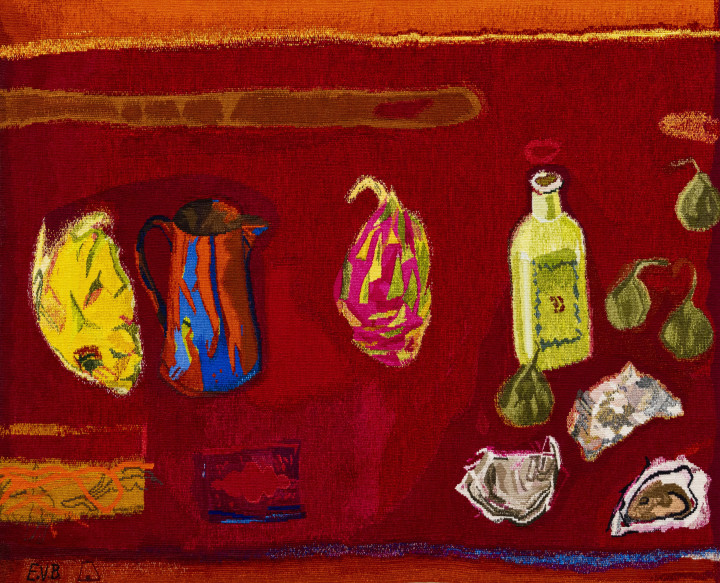 Dovecot Studios after Elizabeth Blackadder, Red Still Life - Dragon Fruit and Oysters, 2023
In Robertson’s time at Dovecot, 23 tapestries of Blackadder’s work have been made. “We worked on some large projects, as well as private commissions,” Robertson says. “Blackadder was a very quiet, unassuming woman, but she knew what she wanted. She would talk us through the designs and was involved throughout the weaving process.”
“As weavers, it is essential to build trust with an artist who is handing their work to us. Often relationships are built over years, and the more that you work with someone, the more comfortable they feel to let their work go, knowing that it is in good hands with the Dovecot weavers.”
When Robertson joined Dovecot Studios in 1990, there was already a long-established relationship between Blackadder and the weaving team. “We have created more tapestries with her than any other artist in Dovecot’s history, which I think speaks volumes about our collaboration,” she says.
The relationship also charted the development of Blackadder’s practice and a recognition of the understated power in her work. “I think sometimes at a first glance, her paintings can appear like delicate still lifes,” Robertson observes. “But actually, once you start to examine the work, you can see her use of colour, detailed composition and the distinct objects she collected during her travels. I was lucky enough to visit her studio once and spot some of the items, like her fans and boxes, that reappear throughout her work.”
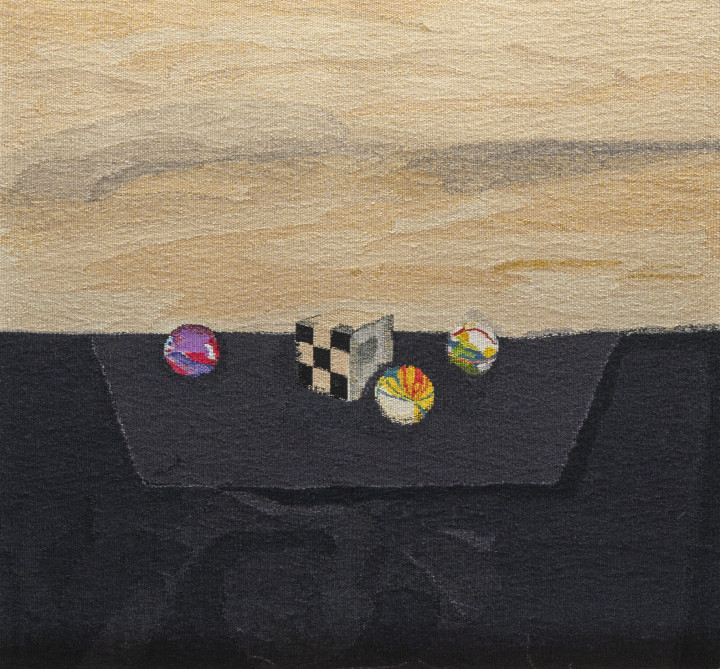 Dovecot Studios after Elizabeth Blackadder, Still Life with Chequered Box, 2023
This is evident throughout the Dovecot exhibition, which features a range of more than 30 paintings, screenprints and etchings by Blackadder alongside several tapestries. The paintings span decades, from ‘Still Life with Mexican Angel’ (1964) and ‘Still Life with Indian Cloth No. 11’ (1967), right through to Japanese inspired works such as ‘Still Life with Kimono, Kyoto’ (2002) and ‘Still Life with Fan’ (2013).
“I think her paintings translate beautifully into tapestry,” says Robertson. “Exploring watercolour offered a different approach, which was an exciting direction for the studio. It’s not a medium that’s traditionally adapted in this way. When translating her work into tapestry, it was about capturing that delicacy of the watercolour without making the work feel too heavy, so you still retain all that movement within the background and the painterly marks.”
Robertson adds: Unfortunately, she never saw the latest pieces we created, which is a real shame. But I believe she would have loved the bold use of colour and our exploration of her work from a different perspective and celebrating another side of her practice.”
As the popularity of Blackadder’s work runs on apace in all forms, A Life in Colour provides a unique opportunity to bask in the spare intricacy and deceptive complexities of her work. “I think it’s the chance to re-examine her work as well as the perceptions that people have of it,” says Robertson. “Blackadder is known for her painted flowers, cats and delicate compositions, some of which will be included in the exhibition. But there was this daring and punchy side to her that people may be less familiar with. She wasn’t afraid of using colour and she could use it well.”
Elizabeth Blackadder: A Life in Colour is exhibited at Dovecot Studios until 14th November


