
Scottish Art News
Latest news
Magazine
News & Press
Publications
Childhood Dreams: An Interview with Wendy McMurdo
By Greg Thomas, 01.06.2026
 (1).jpg)
Wendy McMurdo is showing me around her current studio, high up in a plate-glass office complex in Edinburgh, which is being let out as a meanwhile space. “It’s like having a residency in the Ritz”, she tells me, as we take the elevator up several floors to the vacated premises of global asset-management company BlackRock. An LED-text clock in one of the open-plan work-spaces shows the times in London, New York, and other financial capitals.
Unmoored from context it looks melancholy and whimsical, like a miniature Nathan Coley. Being surrounded by reflective surfaces seems apposite somehow for McMurdo, whose best-known works include photographs of school children gazing into the shiny depths of museum display cases (‘Girl with Bears’ [1999] and others). One of the most innovative photographers of her generation, her work is marked out by its unflinching engagement with the relationship between technology, cognition, and childhood. An upcoming solo show at the National Galleries of Scotland’s Portrait gallery will, as she explains while handing a coffee across her desk – stacks of prints and cardboard busts for a planned installation piece all around us – plot a course through her practice from 1995 to 2018. The exhibition is part of the 200th anniversary celebrations of the Royal Scottish Academy, to which she was the first female photographer to be elected.
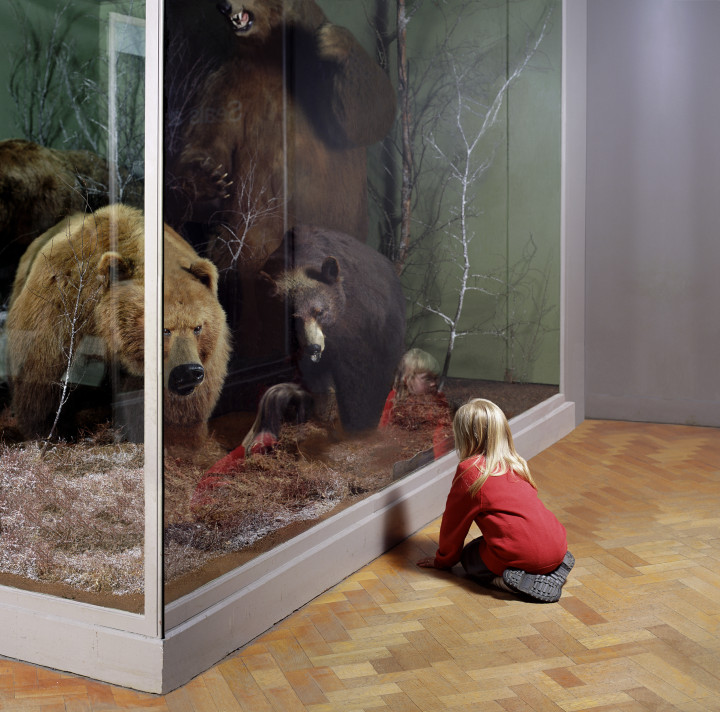 Wendy McMurdo, Girl with Bears, Royal Museum of Scotland, Edinburgh, 1999. National Galleries of Scotland © Wendy McMurdo. All rights reserved, DACS 2026. Courtesy Patricia Fleming Gallery, Glasgow.
Across the time-period marked out, cultural discourse has repeatedly borne out the messages that McMurdo’s photography subtly encodes. Digital technology has opened up strange portals in our hearts and minds, fundamentally changing the way we parse reality, relate to others and form bonds, digest and process information. And young people are particularly exposed to its effects. However, while we might see this process as inherently sinister, McMurdo’s work explores it with cool lucidity, an eye for the marvellous, and a residual human warmth.
Born in Edinburgh in 1962, the groundbreaking photographer had initially hoped to be a painter but switched while studying at New York’s Pratt Institute in the 1980s. Back in the UK in the 1990s, she completed a MA at Goldsmiths and a two-year residency at the Henry Moore Foundation, the latter of which proved critical. “The mid-1990s was a really interesting time for photography”, she tells me. “There was a real anxiety around the introduction of early digital practice into the medium. And parallel to that, computers were being introduced in a standardised way into art schools.” The Foundation asked her “to do a piece of visual research exploring the impact of computation on our lives and creative practices.” The brief was broad. However, reading what she calls “a throwaway line” from Sandy Stone’s prescient 1995 book The War of Desire and Technology at the Close of the Mechanical Age, led her to focus in particular on children.
One result was the remarkable series ‘In A Shaded Place’ (1995), the earliest to be featured in the show, for which analogue and digital techniques were spliced to produce hyperreal images of children – members of a Sheffield drama school – confronting their own doppelgängers. Some of the shots were staged in front of theatre curtains while the children acted out the parts they were rehearsing for. The whole thing has something of the feel of glossy Lynchian surrealism about it, but transposed into the more familiar, humdrum world of British childhood. Indeed, surrealism, and its attendant idea of the fractured subject, is a touchstone for the artist, though it is the female pioneers of surrealist photography – Dora Maar, Lee Miller – that trip off her tongue.
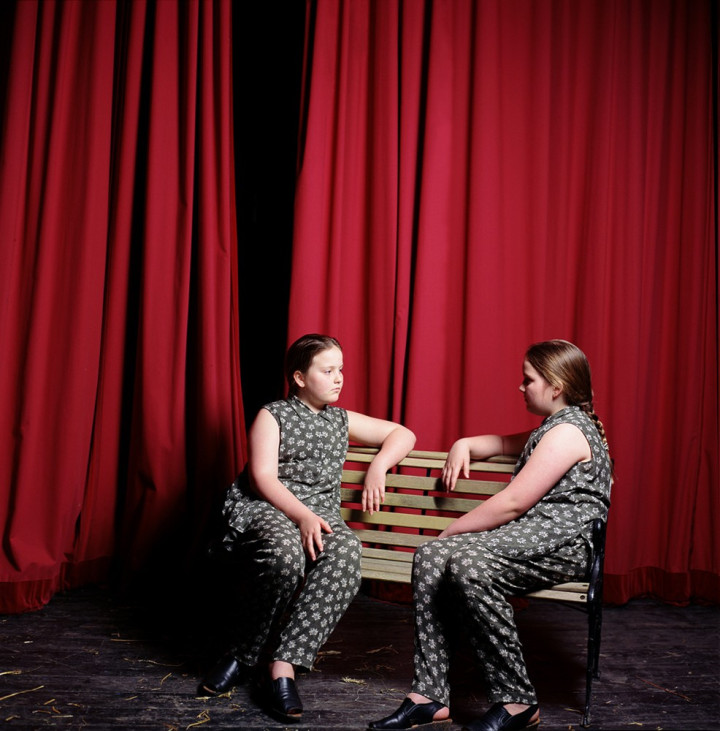 Wendy McMurdo, In A Shaded Place, Catherine Cowan, Merlin Theatre Sheffield 1995. courtesy of Patricia Fleming Gallery, Glasgow.
“Once ‘In A Shaded Place’ had had some success, I thought: there’s a lot to say here”, she recalls, “though I had no idea it would be twenty years’ worth of work.” After moving back to Scotland, McMurdo seized on the school classroom as a setting. “There were two main institutions that characterised childhood at that time, family and school; this was written about endlessly by sociologists. Now, of course, that’s changed.” Educational contexts ultimately proved more fruitful than domestic ones because “the rules are more clearly delineated”. The impacts of changing technology could be mapped more precisely against the prevailing norms.
Photographs called ‘Computer Class (i) and (ii)’ are key products of this new fascination. The “first works that you’ll encounter in the space” (the exhibition is non-chronological), they show children in “very traditional classroom settings”, captured in Edinburgh around the turn of the century, apparently working on invisible desktop computers. In the background are “the familiar accoutrements of play: toys, paper...” The images were a form of magical-realist response to the computer lessons just being introduced to primary-school children in the city, for which the clunky desktop devices would be “wheeled in and out of the room on little trollies. I found the whole scene very touching.”
, 2008. image courtesy of the artist and patricia fleming gallery, glasgow © wendy mcmurdo. all rights reserved, dacs 2026.jpg) Wendy McMurdo, Avatar (i), 2008. Image courtesy of the artist and Patricia Fleming Gallery, Glasgow © Wendy McMurdo. All rights reserved, DACS 2026. Courtesy of Patricia Fleming Gallery, Glasgow.
Wendy McMurdo, Avatar (i), 2008. Image courtesy of the artist and Patricia Fleming Gallery, Glasgow © Wendy McMurdo. All rights reserved, DACS 2026. Courtesy of Patricia Fleming Gallery, Glasgow.
A couple of years later McMurdo returned to the same classrooms for a Channel 4 documentary and found the rooms gutted, replaced with computer labs. When these hardware-filled spaces were superseded in turn by tablets and other handheld gadgets in the 2000s, she thought “the cat’s really out of the bag now”.
The imaginative conceit at the centre of these and other works is, of course, the conspicuous absence of the object which defines the scene. The invisible computer is a neat metaphor for the unpredictability – it then seemed – of the likely effects of this still-young technology on young people’s emotional lives. So too, in later series such as ‘Let’s Go To a Place’ (2016) and ‘Indeterminate Objects (Classrooms)’ (2017) floating 3D visualisations – translucent geometric shapes, refracting the colours behind – are placed infront of children’s faces or hover above school desks. What do these indeterminate digital objects signify? We cannot say, but their presence is unavoidable. It is that quality of uncertainty that gives the works their gently disquieting power, like intimations of the digital sublime.
 2016 courtesy of the artist.jpg) Wendy McMurdo, Lets Go to a Place, Young Girl (iv) 2016. Courtesy of Patricia Fleming Gallery, Glasgow.
Wendy McMurdo, Lets Go to a Place, Young Girl (iv) 2016. Courtesy of Patricia Fleming Gallery, Glasgow.
Towards the end of our discussion the topic shifts, inevitably, to the rise of artificial intelligence, the next phase in the ever-changing relationship between our human minds and bodies and the world of phenomena around us. Various installation-based works at the portrait gallery will respond to this new paradigm, including a digital animation from the ‘Indeterminate Objects’ project displayed on a very large LED screen. “I wanted it to loom, dominate the space. It’s interesting thinking about how AI will become such an important part of our lives, but we’re not quite sure how yet.”
Still, for McMurdo there is no sense of insularity or pessimism about this encroaching reality: an unusual position, perhaps, for any creative in 2026. “The augmentation of the body has been going on since before the industrial revolution, so I don’t have the same worries about AI as some. It’s next phase of that kind of development. As artists, we have to respond honestly to what’s happening.”


