
Scottish Art News
Latest news
Magazine
News & Press
Publications
A Mental and Visual Dapple
By Greg Thomas, 07.09.2026
. reproduced by permission of the edwin morgan trust.jpg)
In a 1980 author statement on a recent publication of poster-sized visual poems, Edwin Morgan noted that the collection, entitled Colour Poems, was concerned with “flickering or dappled effects, protective coloration, colour in living or dead metaphors.” He added that “the actual colours used in the poems function at a remove from imitation and have perhaps something of the effect of metre or rhyme in ordinary poetry”, and that the overall aim was to create “a mental as well as a visual dapple.” It was a typically lithe evocation of a complex poetic concept from Morgan, whose achievements across the fields of concrete, visual, and sound poetry are presented in a new book edited by the poet Julie Johnstone and myself, A Home in Space, published by Reaktion in August 2026. Magnificent works from the sequence such as “Dapple”, in which hand-written phrases like “salmon and smoke”, “brick and flame”, and “donkey and peach” appear in unexpected, vibrant colours, get across something of what he meant.
. reproduced by permission of the edwin morgan trust.jpg) Dapple, from Colour Poems (1978). Reproduced by Permission of the Edwin Morgan Trust.
Dapple, from Colour Poems (1978). Reproduced by Permission of the Edwin Morgan Trust.
Edwin Morgan was born in the west end of Glasgow in 1920, remaining in the city until his death in 2010 at the age of 90. Over the intervening decades he became a much-loved teacher of English Literature at Glasgow University and one of the most distinctive poetic and critical voices of his generation. His work was marked by its range, from lyric to sci-fi poetry, social documentary and cut-up verse; and by its embrace of modernity, in contrast with a Scottish literary-modernist milieu often defined as gruff and backwards-looking. The advent of high- speed travel and communication, TV, radio, and photography, space travel, the reconstruction of Glasgow through high-rise social housing and expanded road networks all make their mark in Morgan’s oeuvre, though clearly some enthusiasms have aged better than others.
Morgan’s interest in the new also extended to a wide-eyed engagement with avant-garde art and literature, and with the ways in which boundaries between media were being overrun during the 1960s, the decade of his emergence as a writer. Morgan had always straddled the visual and the literary in his passions. The surrealist scrapbooks which he compiled since boyhood now stand as one of his most lasting creative achievements. He considered attending art school as a teenager, and almost became an apprentice carpet-designer at 15. His university years were marked by explorations in abstract pen and pencil drawings in the style of contemporary British artists such as Paul Nash.
By the early 1960s, however, Morgan was a lyric poet, broadly in the neo-romantic style associated with Dylan Thomas, though increasingly influenced by North-American beat poetry. Yet his visual and literary interests converged when he discovered the movement of concrete poetry in 1962. Emerging in Latin America and Northern Europe in the mid-1950s, concrete poetry stressed the graphic arrangement of language-forms to appeal to the reader in a new way which combined optical and linguistic sense. There had been a form of visual poetry attached to the Dada and Futurist movements. But in marked contrast, concrete poetry was neat, clean and minimalist, influenced by its namesake movement of Concrete Art as practised by figures such as Theo Van Doesburg, Josef Albers, and Max Bill.
Morgan began experimenting with the style, and within a few years had built up a prodigious body of work composed on the typewriter, whose even character-widths allowed him to arrange words and letters in geometric patterns, very much in the spirit of the original concrete poetry movement. Yet he was a restless experimenter, essentially anti-minimalist in spirit. He had found ways around the semantic constraints of concrete poetry – classic examples of which might include just one or two words – to write protest poems such as “Starryveldt” (1965), which tackles police violence in Apartheid South Africa, and the moving “Message Clear”, which repeats a line attributed to Jesus on the cross, “I am the resurrection and life”. Different letters are removed from each repetition of the line to produce a cut-up meditation on paternity, mortality, and grief. (Fittingly enough, this poem was written on a bus ride home from visiting his terminally ill father).
. reproduced by permission of the edwin morgan trust with thanks to glasgow university library.jpg) Edwin Morgan Typescript for Starryveldt (1964). Reproduced by Permission of the Edwin Morgan Trust with Thanks to Glasgow University Library.
Edwin Morgan Typescript for Starryveldt (1964). Reproduced by Permission of the Edwin Morgan Trust with Thanks to Glasgow University Library.
By the late 1960s, a new development in Morgan’s poetry was the use of coloured, handwritten lines as an integral element of poetic meaning, carried into the final work through the relatively new printing method of photo-lithography; or, in the case of Colour Poems, silk- screen printing by master printer John Taylor at Glasgow Print Studio. Describing his 1966 poetry booklet Sealwear, which pre-empted this approach in its use of handwriting, Morgan acknowledged to the poet Cavan McCarthy that “there is something paradoxical about giving concrete poetry the nervousness of a calligraphic line”. More than that, these new poems, the first of which were written in felt-tip pen and presented as originals – such as his poster poems for a centenary celebration of Apollinaire held at London’s ICA in 1968 – were marked by their use of colour.
. reproduced by permission of the edwin morgan trust with thanks to glasgow university library.jpg) Edwin Morgan, from Bestiary (1968). Reproduced by Permission of the Edwin Morgan Trust with Thanks to Glasgow University Library.
Edwin Morgan, from Bestiary (1968). Reproduced by Permission of the Edwin Morgan Trust with Thanks to Glasgow University Library.
Both gestures were significant. Concrete poetry in the first instance indicated a certain anti- expressionist ascetism, a desire to rid the poem of the polluting influence of the romantic lyric subject. Morgan covertly infused something of that spirit back into the genre with his curvaceous, brightly coloured poem-posters. Somewhat like expressionist painting, Morgan’s colour poems often use what we might call non-mimetic colour, printing a word in a different colour to that which it would normally describe or reference. The poem “Pink Peace-Red War”, for example, consists of a string of word-pairs that make the reader think of one or other colour (“Shocking Pinkshears” and “Bloodred Desertrat,” say), but are printed in blue and black. A gap between linguistic and visual inference is opened up here, which somehow seems to invite the reader-viewer to bring new tones and hues of their own to the poem.
In terms of the biographical reference points which Morgan himself brought to the Colour Poems, one potentially relevant titbit is that he was colourblind, a fact which seems to dovetail nicely with the semantic-optic mix-up of the work. In a 2003 letter to the poet Richard Price, Morgan mused that his flamboyant dress sense might partly reflect this condition. But other possible explanations are in play too, bringing to light a more veiled and potentially tender aspect of his identity. Printing a sequence of multi-coloured poems featuring title-phrases such as “Pink-Peace” just before Scotland finally decriminalised homosexuality in 1980 might well seem a loaded gesture. A later publication of colour poems, Guten Morgan (2000), features a dazzling composition entitled “Rainbow” which is more directly suggestive.
In this sense, it is important to remember that Morgan was set apart from his generation of poets not only by his forward-looking optimism but also by his sexuality. His breakthrough collection The Second Life (1968) was full of love poems whose second-person address carefully disguised the identity (and gender) of the beloved. The “second life” alluded to in the title was partly that of a middle-class university lecturer whose nights and weekends were often spent cruising Glasgow’s streets and parks for love. He only came out as gay in 1990, as a 70th birthday present to himself, he later recalled, and to mark Glasgow’s year as European City of Culture.
Morgan’s colour poems are not only a declaration of an avant-garde credo, but also, perhaps, a way of showing his true colours, and of indicating how they had to be hidden for much of his life—just as colours hide behind words, and words behind colours, in the mental and visual dapple of the poems themselves.
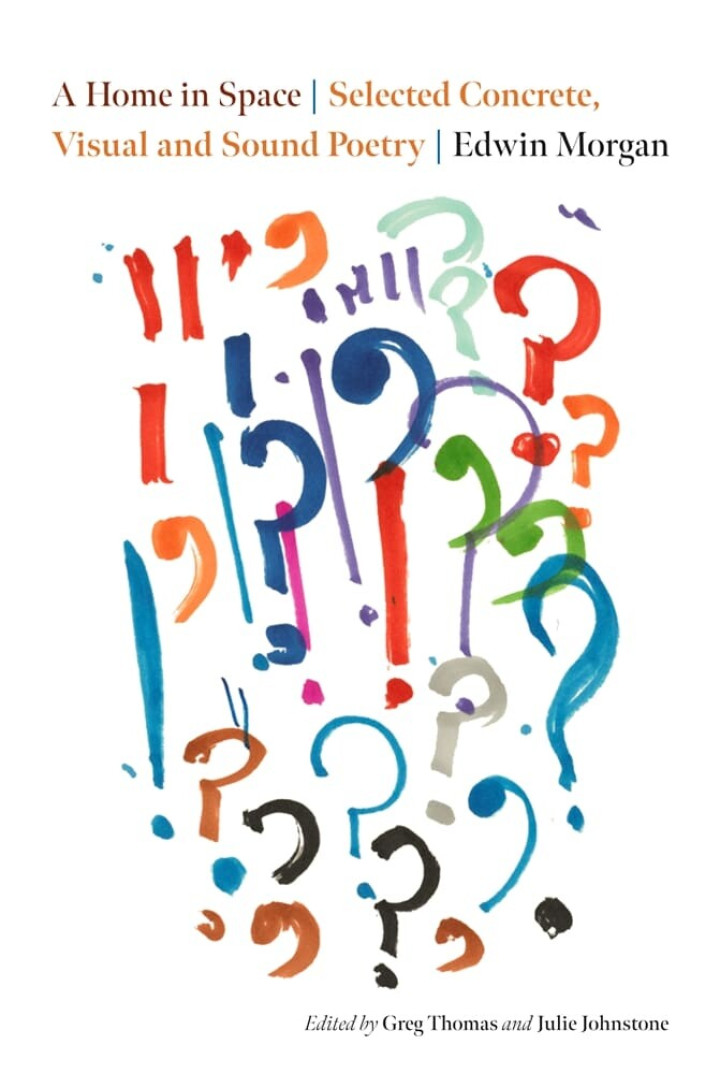 A Home in Space Cover.


