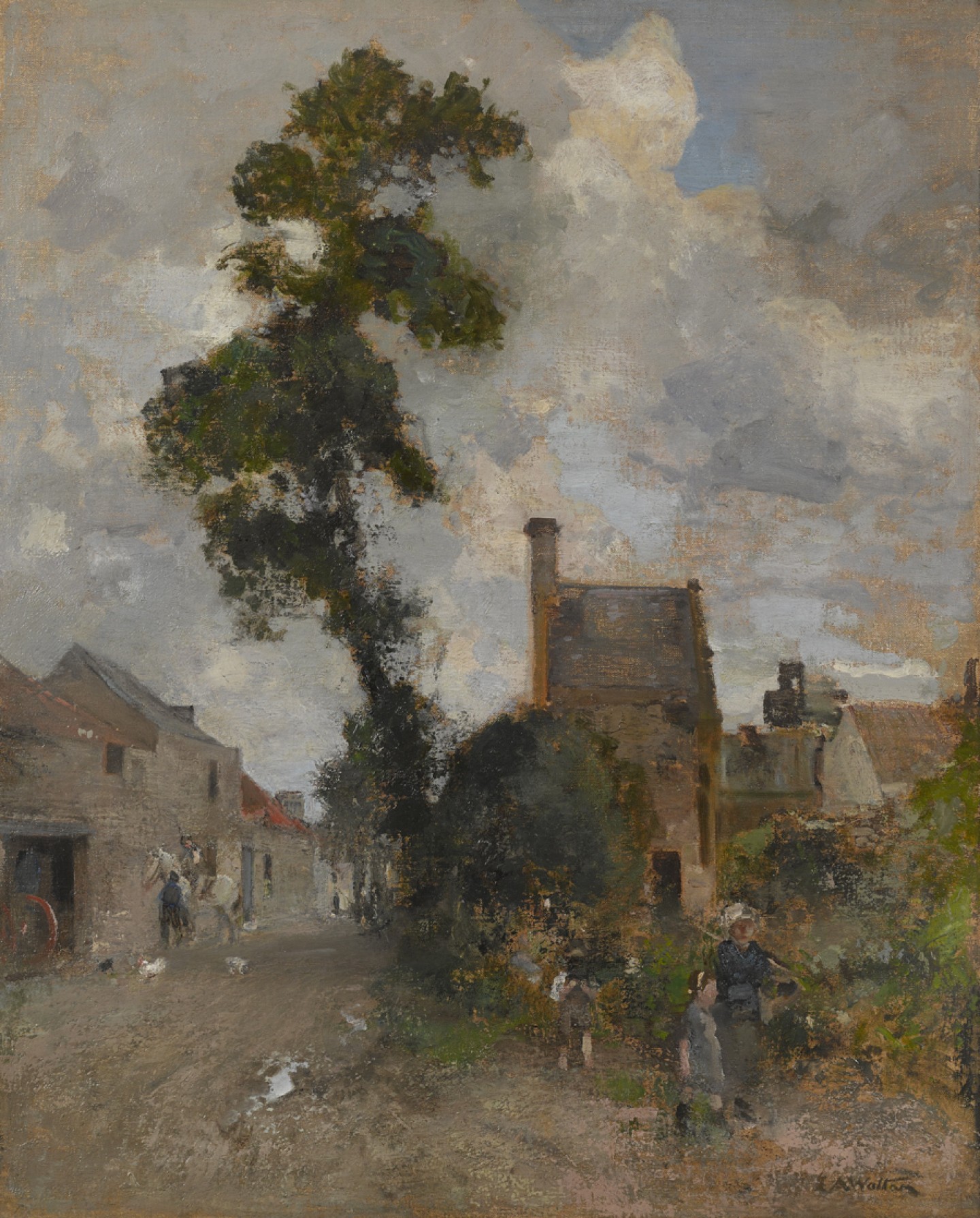
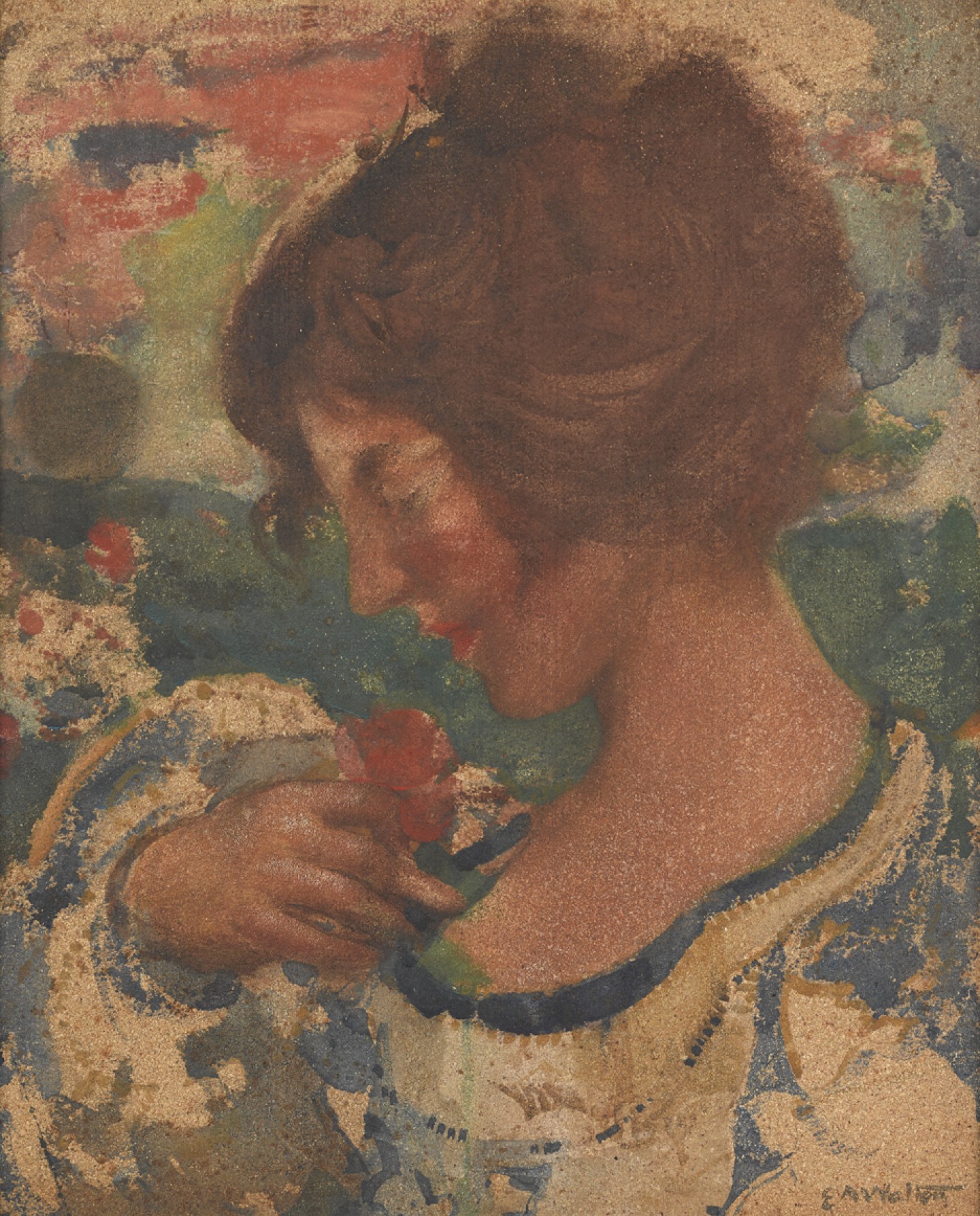
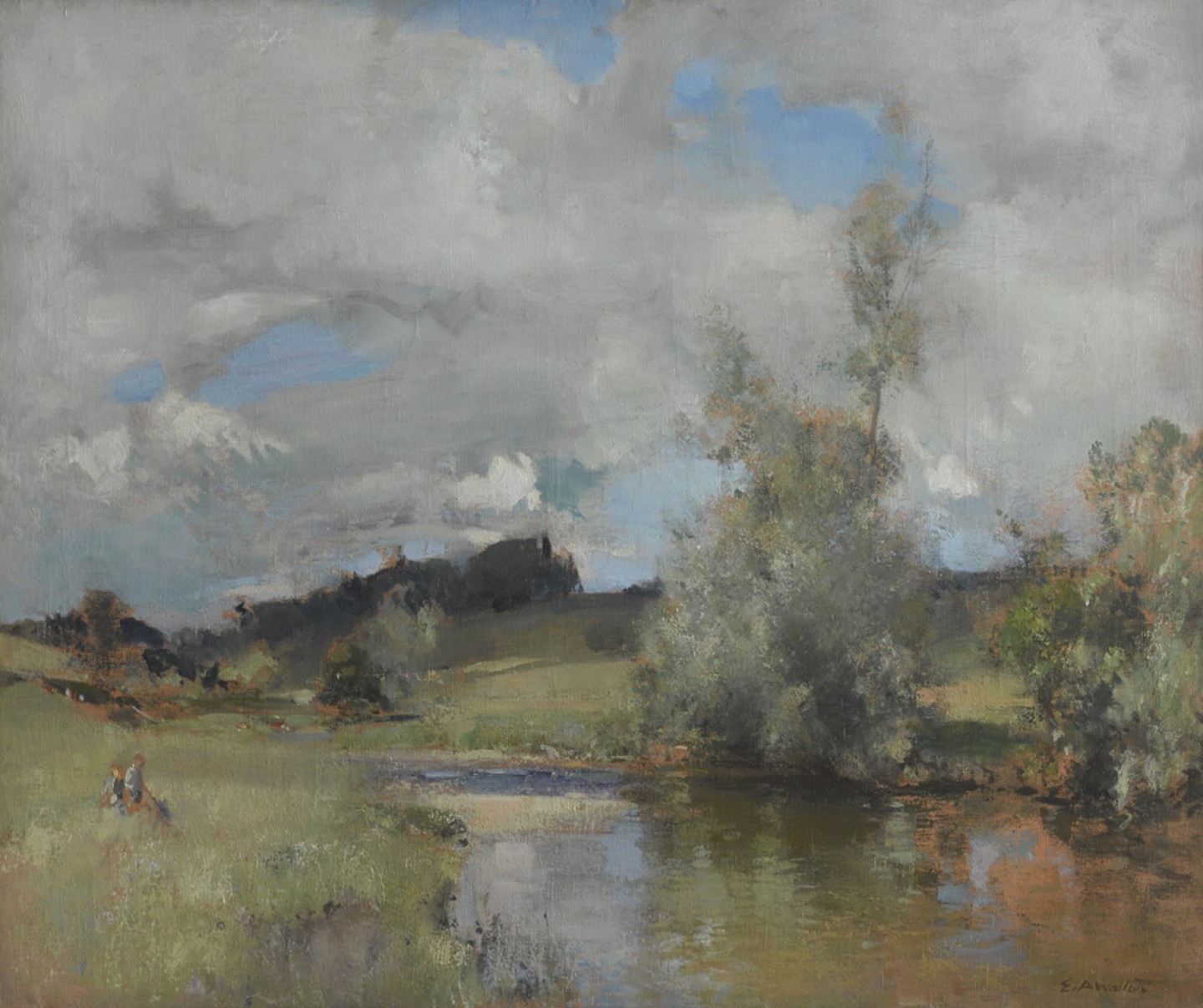
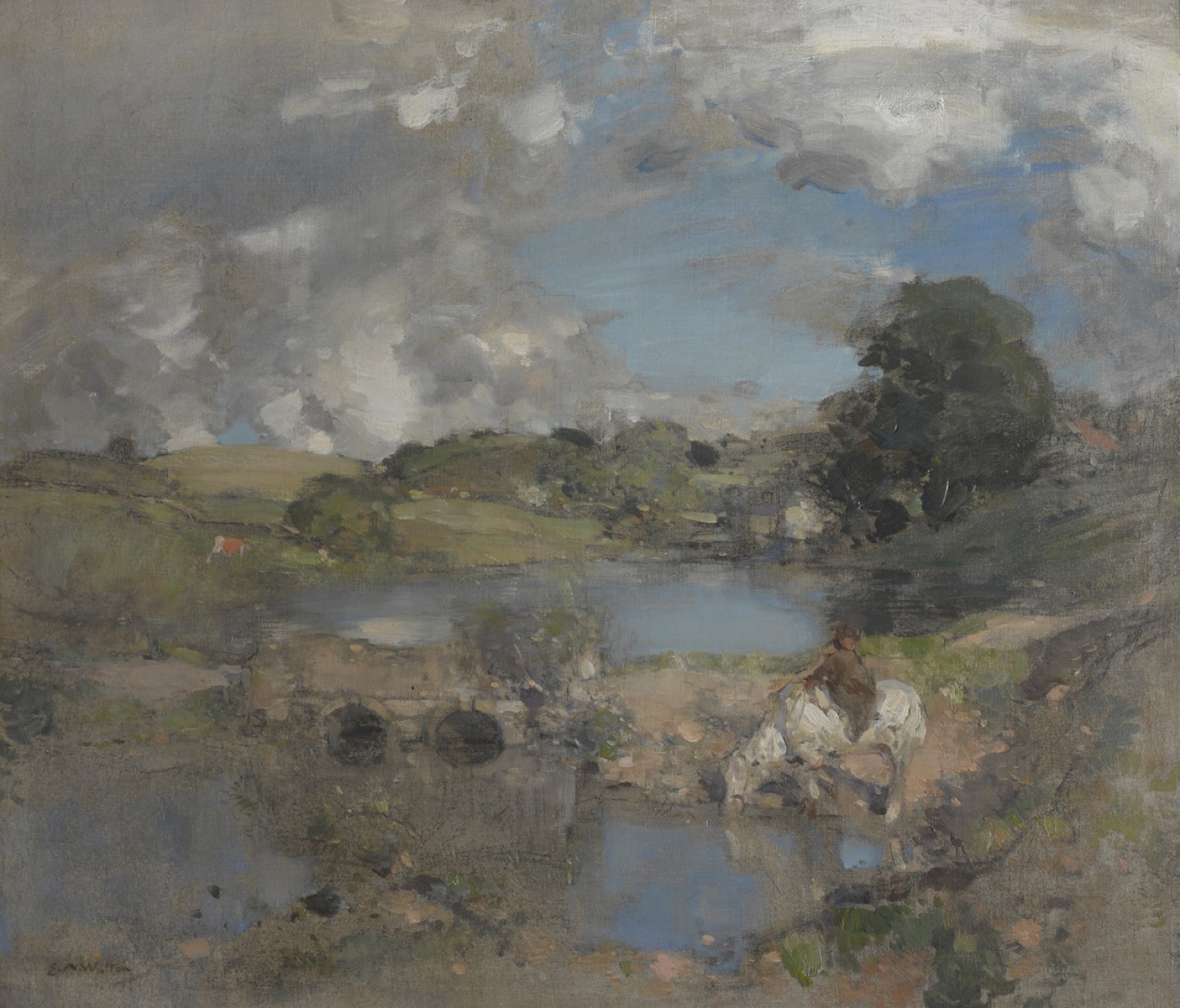
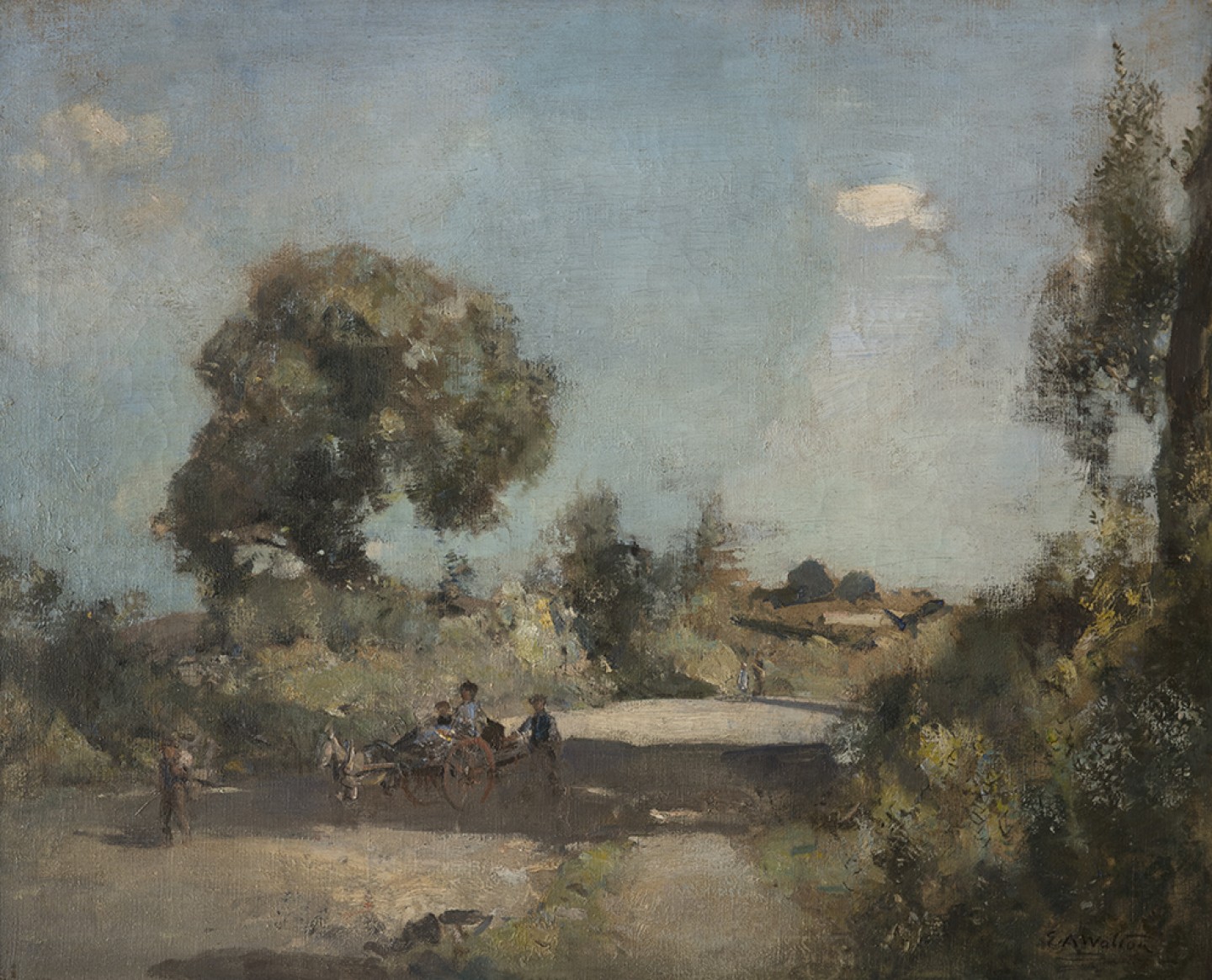
The Ford, Wenhaston
Edward Arthur Walton


DESCRIPTION
The Ford, Wenhaston by Edward Arthur Walton (1860-1922) depicts a countryside road scene with children running along a horse drawn carriage, with a woman and another child on it. The details throughout the work are soft, with Walton using feathered strokes of dryer oil paint that result in part of the blue of the sky blending in with the foliage of the trees and parts of the carriage and horse to blend in with the road. This feathered, blurred style creates a lightness to the work, characteristic of influences of Impressionism.
The feathered brush technique that Walton uses in this work is also characteristic of James Guthrie's artworks, showing their exchange of influence as they worked in the same circle. Walton was well known for painting rural landscapes, interested in the effects of light, which influenced many of the other Glasgow Boys work.
DETAILS
-
Artist
Edward Arthur Walton
-
Date
Unknown
-
Medium
Oil on canvas
-
Object number
908
-
Dimensions framed
86 × 101 cm
-
Place depicted
Wenhaston (2634535)
-
Marks
Signed bottom right
ARTIST PROFILE
Edward Arthur Walton RSA PRSW, 1860-1922
Born at Glanderston House, Renfrewshire, Walton was the son of an amateur painter, Jackson Walton, and the elder brother of the interior designer George Walton. He studied art at Düsseldorf Kunstakademie in Germany and Glasgow School of Art. He made his debut as a landscape painter at the Glasgow Institute and was elected to the Glasgow Art Club in 1878, the year he met James Guthrie. Walton, Guthrie and Joseph Crawhall formed a close and lasting friendship, painting together at various places in Scotland and Lincolnshire, and abroad.
In 1889, James Guthrie and Arthur Melville visited Paris, where Walton and Guthrie exhibited at the Old Salon. Between 1893 and 1904 Walton lived in Chelsea, London, as a neighbour of John Lavery and Whistler - it was said that he was the only man with whom Whistler never quarrelled. He became involved with Whistler's circle, and this led to his taking a leading role in the formation of the International Society of Sculptors, Painters and Gravers, which was composed of artists who had been excluded from the Royal Academy, the New English Art Club and other academies. The first exhibition included works by, among others, Toulouse-Lautrec, Puvis de Chavannes, Redon, Bonnard and Vuillard.
Whistler championed the right of the artist to choose his own subjects and find beauty where an untrained eye might not. His influence on the Glasgow Boys can be seen particularly in the last decade of the nineteenth century, when they began their gradual move away from the Realism of Bastien-Lepage towards the more decorative treatment of modern life.
Although based in London, Walton made several trips to Suffolk, where he produced a series of landscapes in both oil and watercolour. In 1904 he returned to Scotland to live in Edinburgh, renewing his friendship with Guthrie, who was by then President of the Royal Scottish Academy. Together they visited Algiers and Spain in 1907 and Brussels and Ghent in 1913. Latterly, Galloway became Walton's favourite painting ground. He was a leading member of the Glasgow Boys, but, in contrast to the majority of the group, his work in oil and watercolour was of a consistently high standard throughout his life.