Rowing the Boat
Robert McGregor


DESCRIPTION
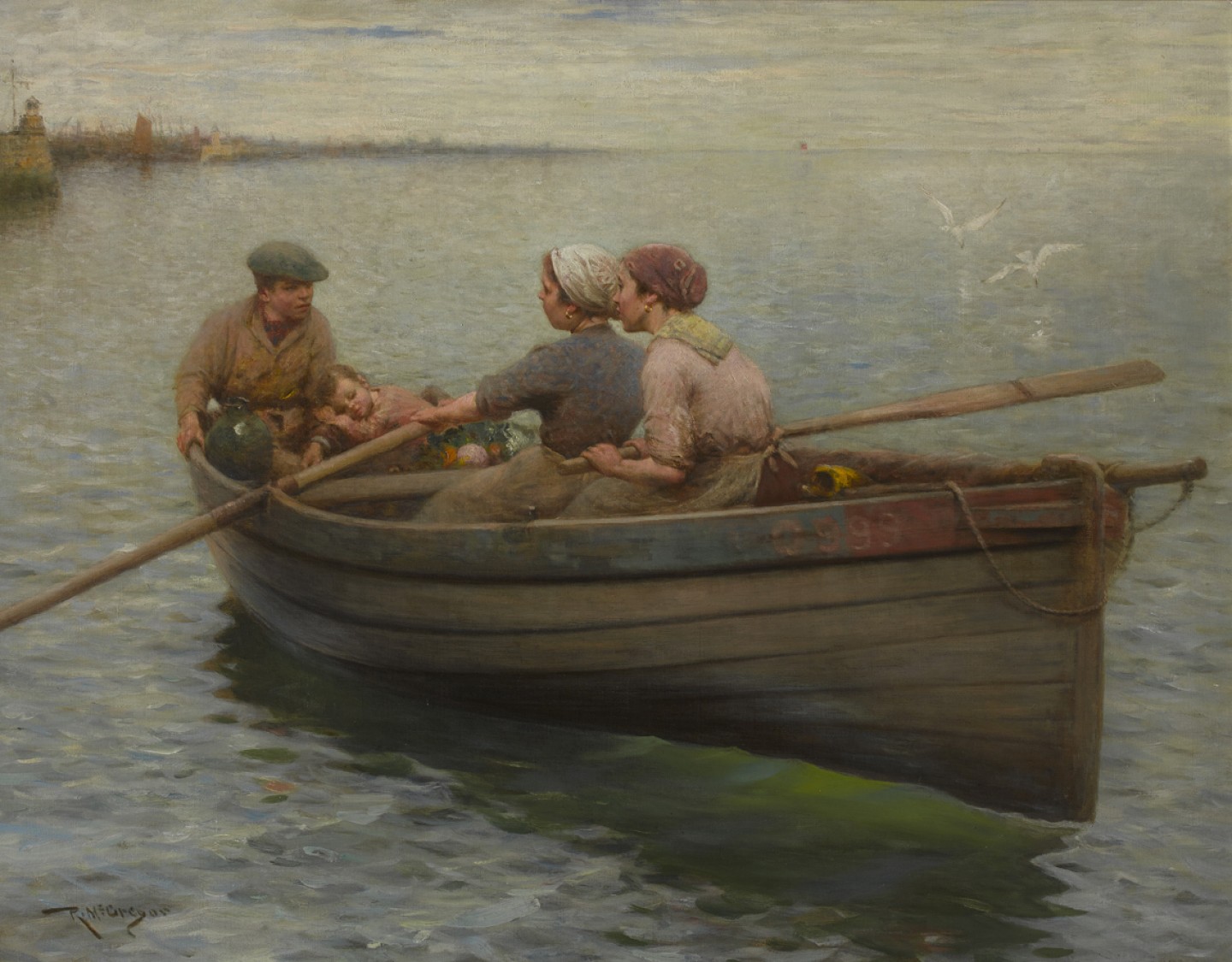
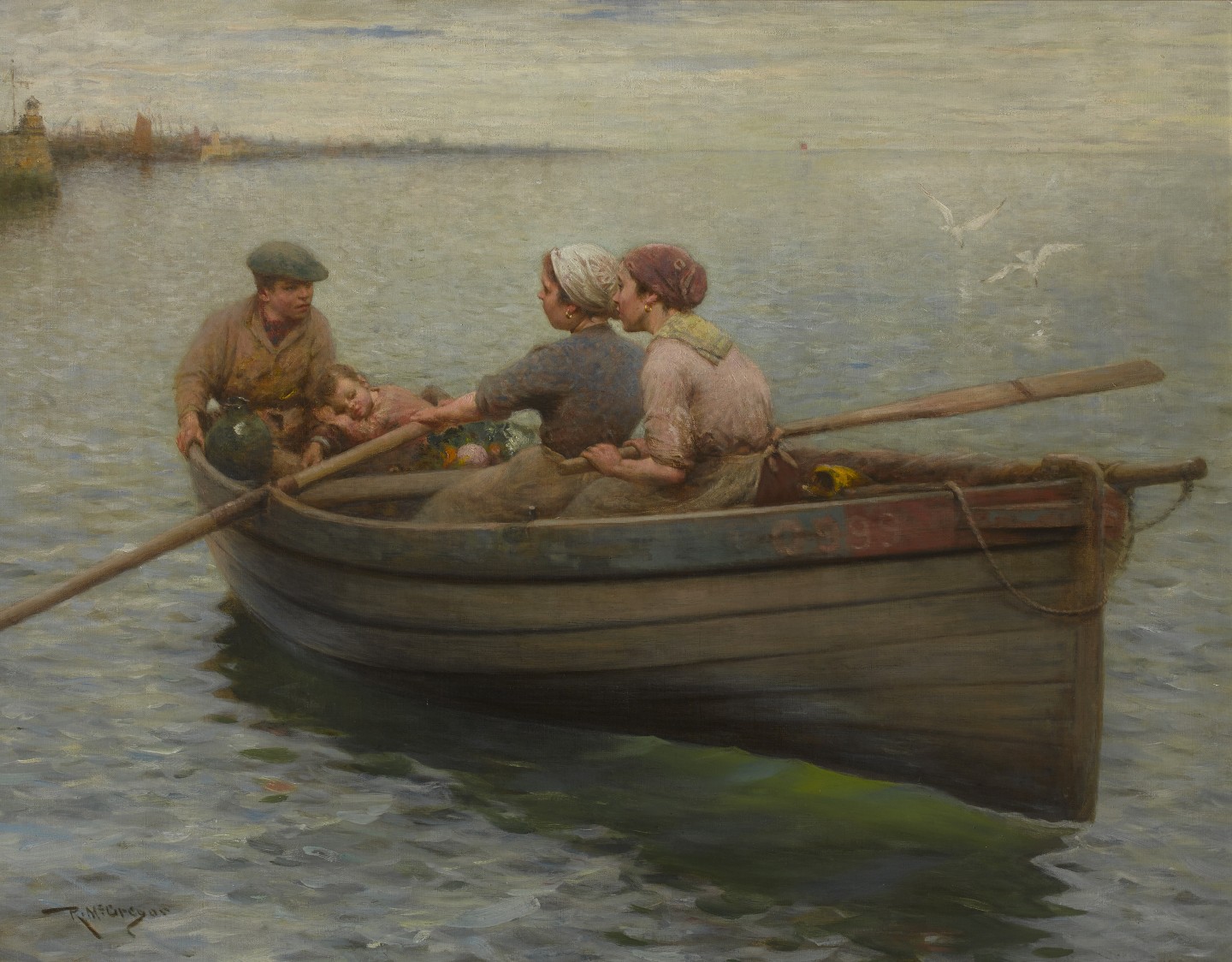
Rowing the Boat by Robert McGregor (1847-1922) depicts two women, a young child, and an older boy in a rowboat near a harbour. Two seagulls are diving for food in the distance. McGregor uses precise, solid brush strokes in this work to realistically capture the scene, particularly in the ripples on the water, with a slight highlight near the front of the rowboat and the shadows rippling off with the water's crest as it goes farther from the edges of the boat. As McGregor works up the paint into the background, brush strokes become less blended and instead can be seen as thin, layered groupings of slightly varied colour. The muted tones of colour give a severity to the scene, as though these people are fleeing or saying goodbye.
While the foreground of this work presents a more realistic appearance, the background creates a more Impressionist feel through the grouping of small brush strokes to give the impression of a harbour in the distance and the horizon line meeting the sky. Much of McGregor's work carries this combined feel of realistic qualities with a softer sense of the background, showing his focus within genre painting on the lives of people of lower classes and what they endure.
DETAILS
-
Artist
Robert McGregor
-
Date
1900-1910
-
Medium
Oil on canvas
-
Object number
591
-
Dimensions unframed
71.8 × 92.1 cm
-
Dimensions framed
87 × 109 cm
-
Marks
Signed bottom left
-
Subject
ARTIST PROFILE
Robert McGregor RSA, 1847-1922
Born in Bradford, Yorkshire, to a Scottish father, McGregor worked as an illustrator with the publishers Nelson in Edinburgh before concentrating on painting, enrolling in the Royal Scottish Academy's Life Class. He specialised in depicting incidents in the everyday life of the rural community - fieldworkers, fisherman, pedlars, children - working mostly in oil, and employing a plein-air style in low-keyed colour. His early subject-matter was found mainly in Scotland, but Norman and Breton scenes later became common. Jeon-Francois Millet, the artists of the Barbizon School an Jules Bastien-Lepage, a contemporary, were all important influences on McGregor, who developed a Realist style about the same time as Bastien-Lepage in France, and so anticipated, and may have influenced, the art of the young Glasgow Boys several years later.