Crofts Near Fearnham
William Gillies


DESCRIPTION
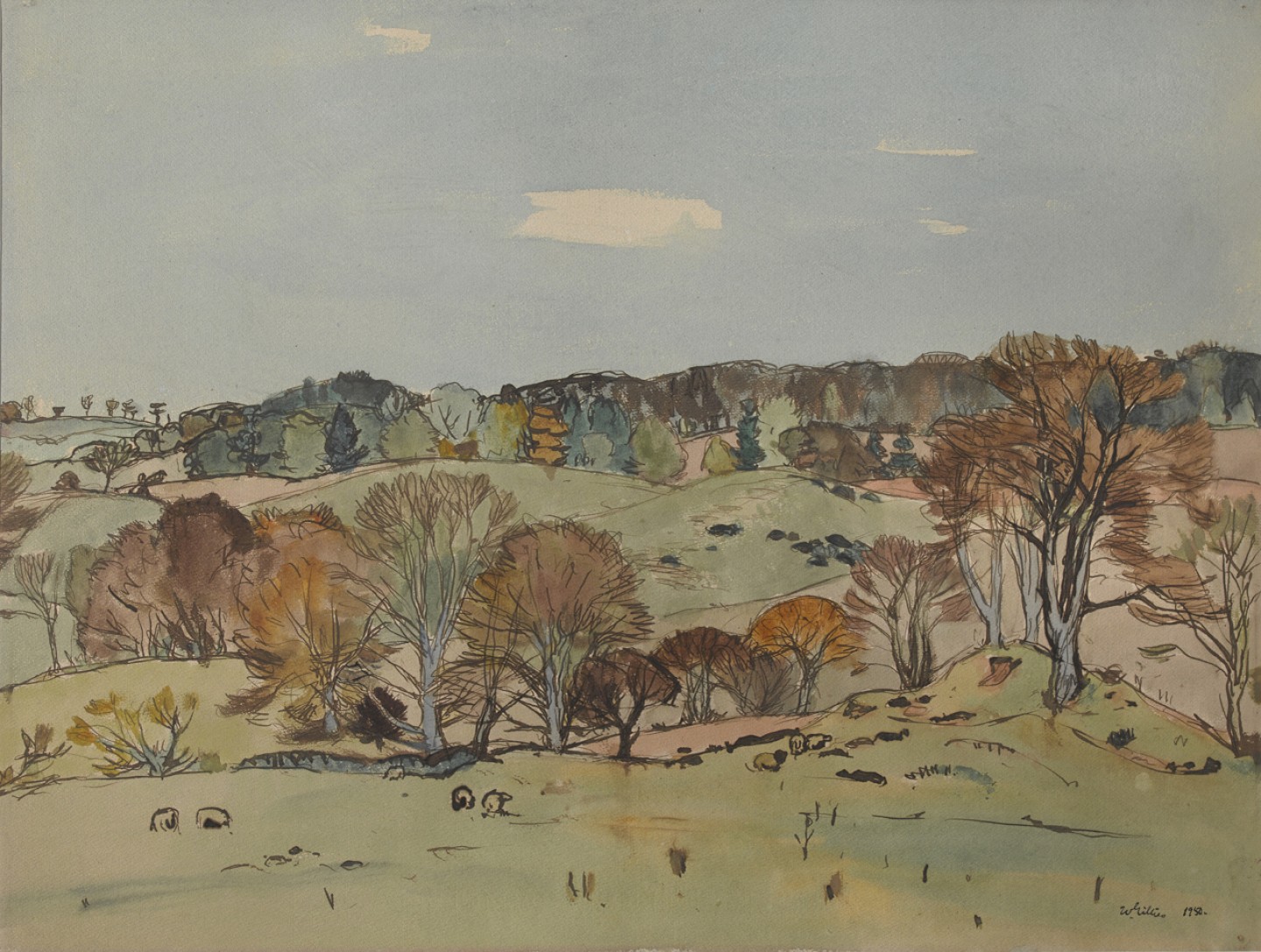
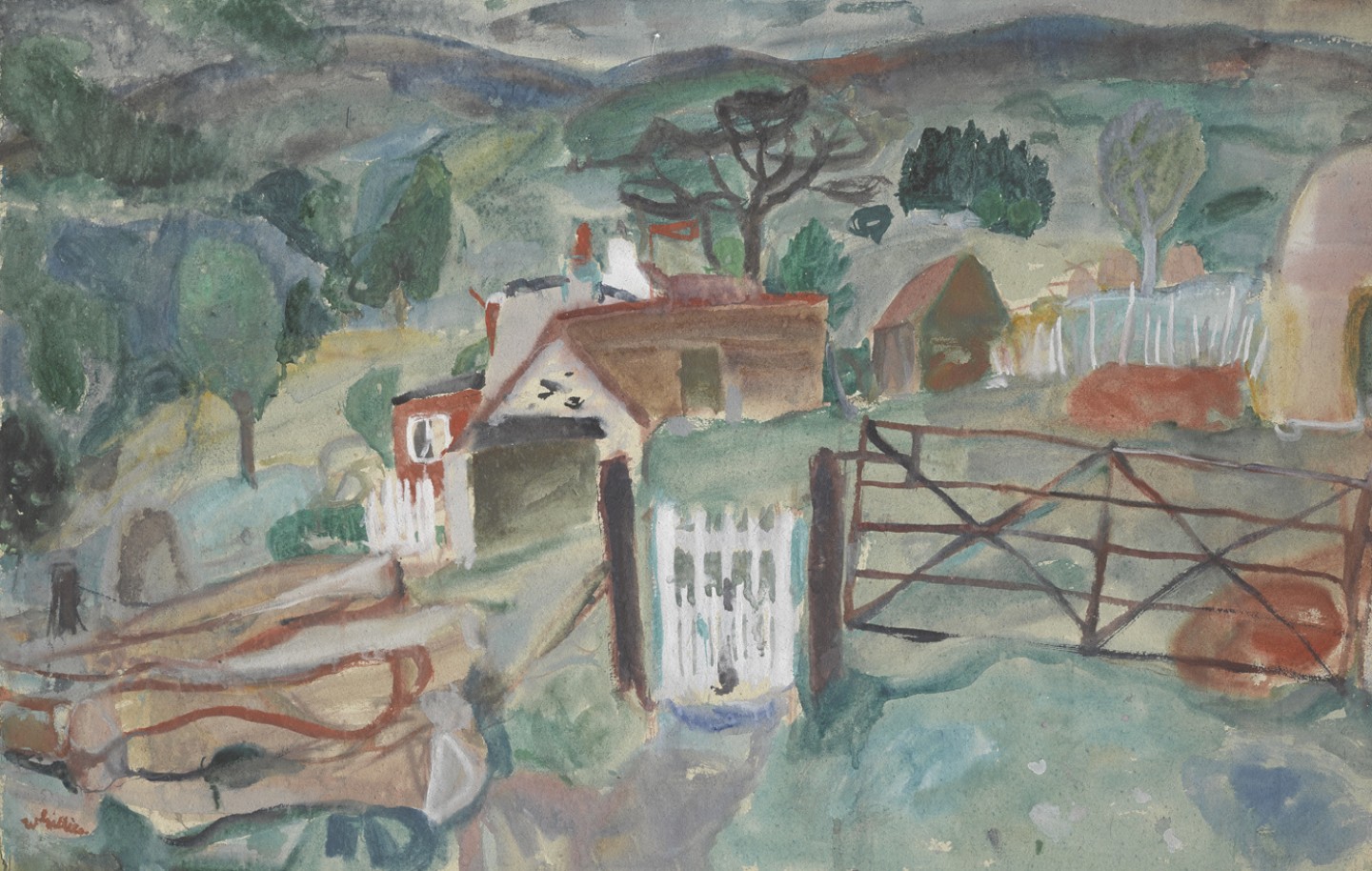
Crofts near Fearnham by William Gillies (1898-1973) depicts a farm landscape with a gate in the foreground, a farmhouse and barn in the centre of the piece, with rolling hills and trees in the background. The colour palette is varied in this piece compared to other works by Gillies, with rich red and green watercolour in contrast with each other to separate the farm area from the wilder forest. The farm structures are captured rather geometrically, with sharp edges and in blocks of colour. Meanwhile the trees in the distance are in looser strokes of paint and with more layers of various shades of watercolour, visible especially on the left side where water rings can be seen and the trees appear to have texture with the paper fibres separating.
The rich blocks of colour present in this work and the variable colour palette speak to Gillies being attributed as being a colourist. While the natural subjects in this work as loosely captured, the structures reflect Gillies's time under the cubist André Lhote with their solid, almost geometric build and flatter perspective against the rolling hills of the landscape. It contrasts with Gillies's later works that lack the cubist influence as he leaned into the wilder movement of capturing landscapes.
DETAILS
-
Artist
William Gillies
-
Date
c. 1936
-
Medium
Watercolour on paper
-
Object number
373
-
Dimensions unframed
49 × 77 cm
-
Dimensions framed
66 × 95 × 5.5 cm
-
Marks
Signed bottom left
-
Subject
-
Copyright
Ⓒ Royal Scottish Academy. All Rights Reserved 2019/Bridgeman Images
ARTIST PROFILE
Sir William George Gillies RA RSA PRSW, 1898-1973
Gillies was born in Haddington, East Lothian. His training at Edinburgh College of Art between 1916 and 1922 was interrupted by two years' war service in France. He and William MacTaggart were among the artists who formed the '22 Group, exhibiting at Edinburgh's New Gallery between 1923 and 1928. Awarded a travelling scholarship, Gillies studied in Paris with André Lhote in 1923-24 before visiting Italy. In 1926 he took up a part-time position under David Alison at Edinburgh College of Art, where he became Head of Drawing and Painting in 1946. He was principal from 1960 to 1966, exerting a powerful influence on the younger generation on painters. Gillies worked in oil and watercolour, but it is as a watercolour painter of Scotland's landscape - particularly Lothian and the Borders - that he is best remembered.