
Corner Table
John Maxwell


DESCRIPTION
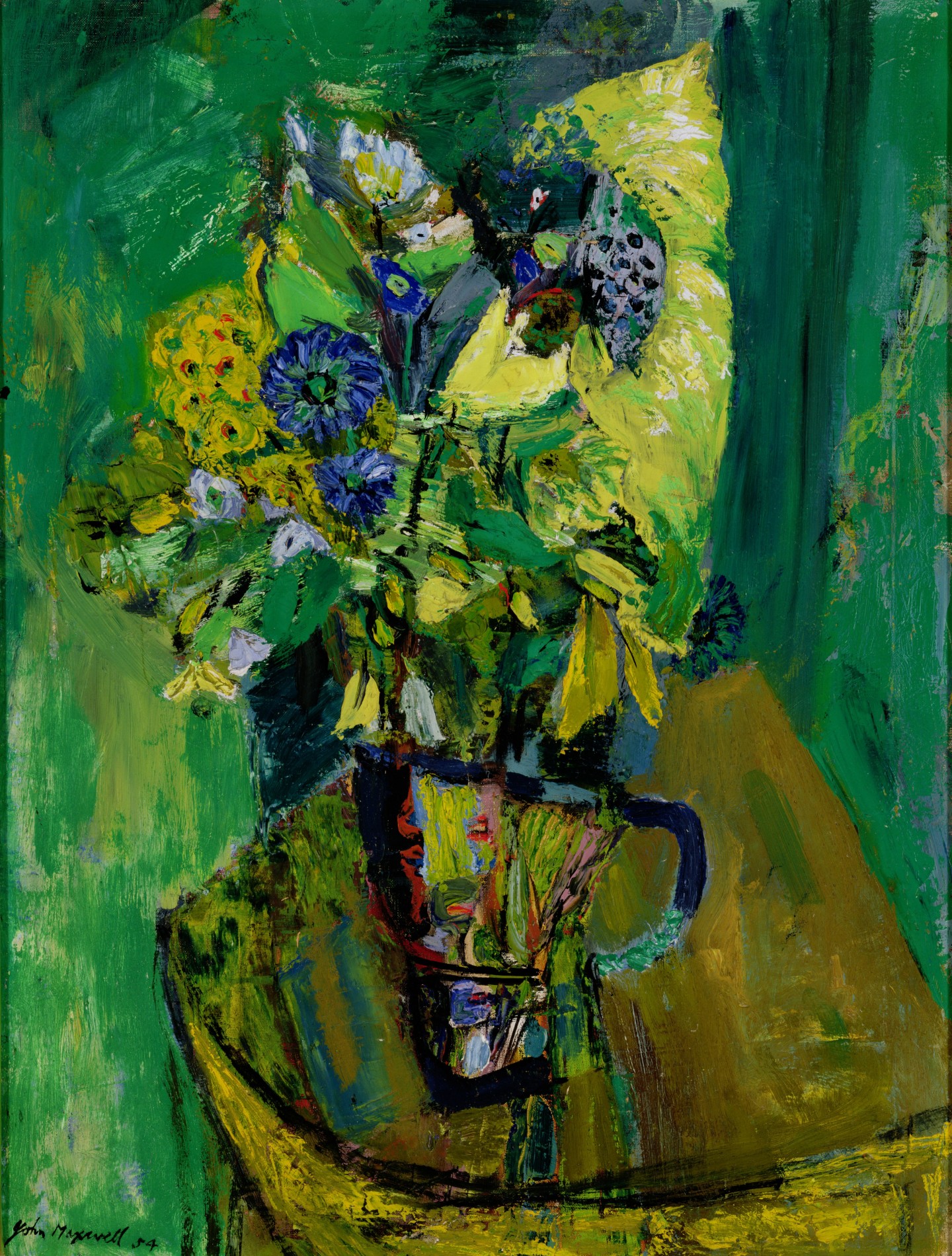
Corner Table by John Maxwell (1905-1962) is a vibrant still life that depicts in various tones of green, yellow, and blue a bouquet of flowers in a pitcher, resting on a ledge. Maxwell uses thick sweeps of paint, somewhat chaotically swiped onto the unseen canvas. This creates a blurred effect in parts of the bouquet, and a blending of edges of the pitcher and ledge. The colours are rich and bright, making the flowers still pop out against the duller green background, conveying a sense of liveliness.
Maxwell's other works share the characteristic vibrancy that this still life contains, often using bold colours and shapes to convey emotions, reflective of influences of Cubism on his earlier works. While flowers are a common subject in still life paintings, the precision some of the flowers are captured in this otherwise wild piece reflect Maxwell's love for gardening, a hobby he maintained throughout his life.
DETAILS
-
Artist
John Maxwell
-
Date
1954
-
Medium
Oil on canvas
-
Object number
555
-
Dimensions unframed
61 × 45.7 cm
-
Marks
Signed and dated bottom left
-
Subject
-
Copyright
Ⓒ The Copyright Holder
ARTIST PROFILE
John Maxwell RSA, 1905-1962
Maxwell was born in Dalbeatie, In Galloway, where his parents owned the local cinema. He studied at Edinburgh College of Art from 1921 to 1927, when he was awarded a travelling scholarship. This enabled him to visit Spain and Italy - like Anne Redpath before him, he was impressed with the work of the Italian Primitives. It also enabled him to study in Paris under Fernand Léger and Amédée Ozenfant at Léger's Académie Moderne. On his return to Scotland he spent a year at teacher-training college, taking up a part-time teaching post at Edinburgh College of art in the following year. At the same time he assisted the college's Principal, Gerald Moira, in the execution of a large mural for St Cuthbert's Church in Edinburgh.
In 1933 Maxell became the first Andrew Grant Fellow of the college, which allowed him to work full-time for two years on a commission for mural decoration in Craigmillar School in Edinburgh. In Italy Maxwell had been impressed by early Renaissance wall paintings, and their influence reappears in his own Craigmillar mural. He returned to the teaching staff at Edinburgh College of Art in 1935, before retiring to Dalbeattie in 1946 to concentrate on his panting. However, in 1955 his close friend William Gillies, the Head of the School of Painting, persuaded him to return to the college. He finally retired in 1961 through ill health.