By the Quayside, Dundee
David Foggie


DESCRIPTION
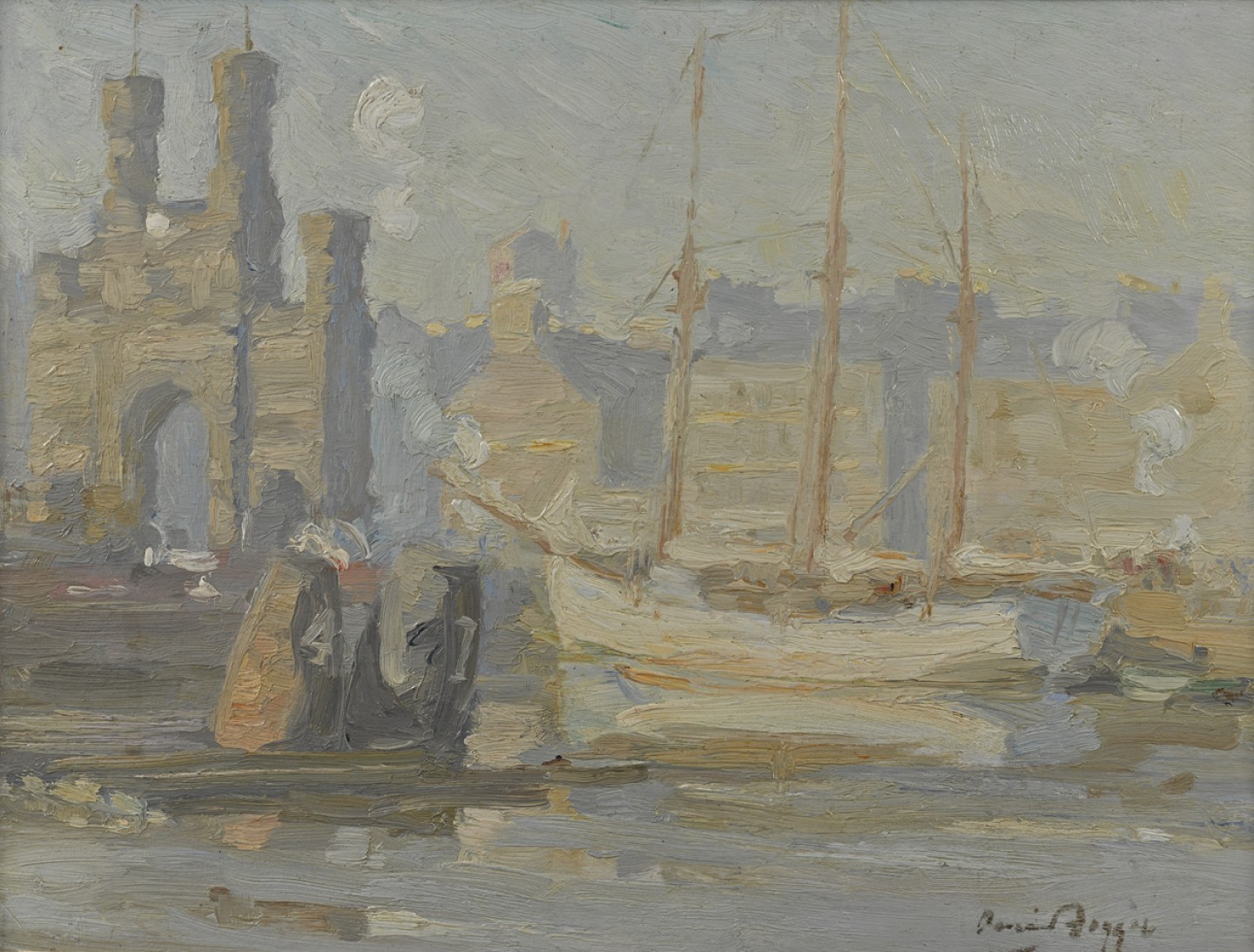
By the Quayside, Dundee by Scottish painter David Foggie (1878-1948) depicts through thick layers of paint and wide brush strokes a harbour view with a large ship against a background of grey buildings, with an arch on the left side of the piece. The colour palette of the painting is limited to grey, yellow, brown and blue, capturing a soft atmosphere to the work. Foggie builds up paint using the impasto technique with either layering long strokes such as in the white body of the ship, or in shorter strokes like in the lighter grey colour of the archway. The singular darker blue grey shade in the background gives the illusion of shading in the buildings, and separates them from the lighter blue colour of the sky. Smoke from fires is captured through twisting strokes through the thick paint in light white colour. The dimension of the painting with the impasto technique and lighter tone throughout offers the sensation of a misty morning in this painting.
The use of impasto brushwork and softer tones of light creating an overal bright piece is characteristic of the Post-Impressionism movement. Dundee was a common subject throughout much of Foggie's work, showing a deep appreciation for the location he was born and where he would spend much of his time painting. While he is more well known for his portraits, his landscapes are noted for their softness and ability to capture light in unique ways.
DETAILS
-
Artist
David Foggie
-
Date
Unknown
-
Medium
Oil on board
-
Object number
324
-
Dimensions unframed
59 × 43 cm
-
Marks
Signed bottom right
-
Subject
ARTIST PROFILE
David Foggie RSA RSW, 1878-1948
Born in Dundee, Foggie studied in Paris, Antwerp and Italy. The artist George Dutch Davidson, the most talented of the east-coast contemporaries of Charles Rennie Mackintosh, became a close friend of his in Dundee. They studied together, although Foggie was less influenced by the Celtic and Symbolist movements than Davidson.
Foggie painted portraits and figures in an assured manner, and was in demand as a robust yet elegant portrait painter between the wars. He was an accomplished draughtsman and taught drawing at Edinburgh College of Art. His contemporaries considered him a painter's painter.