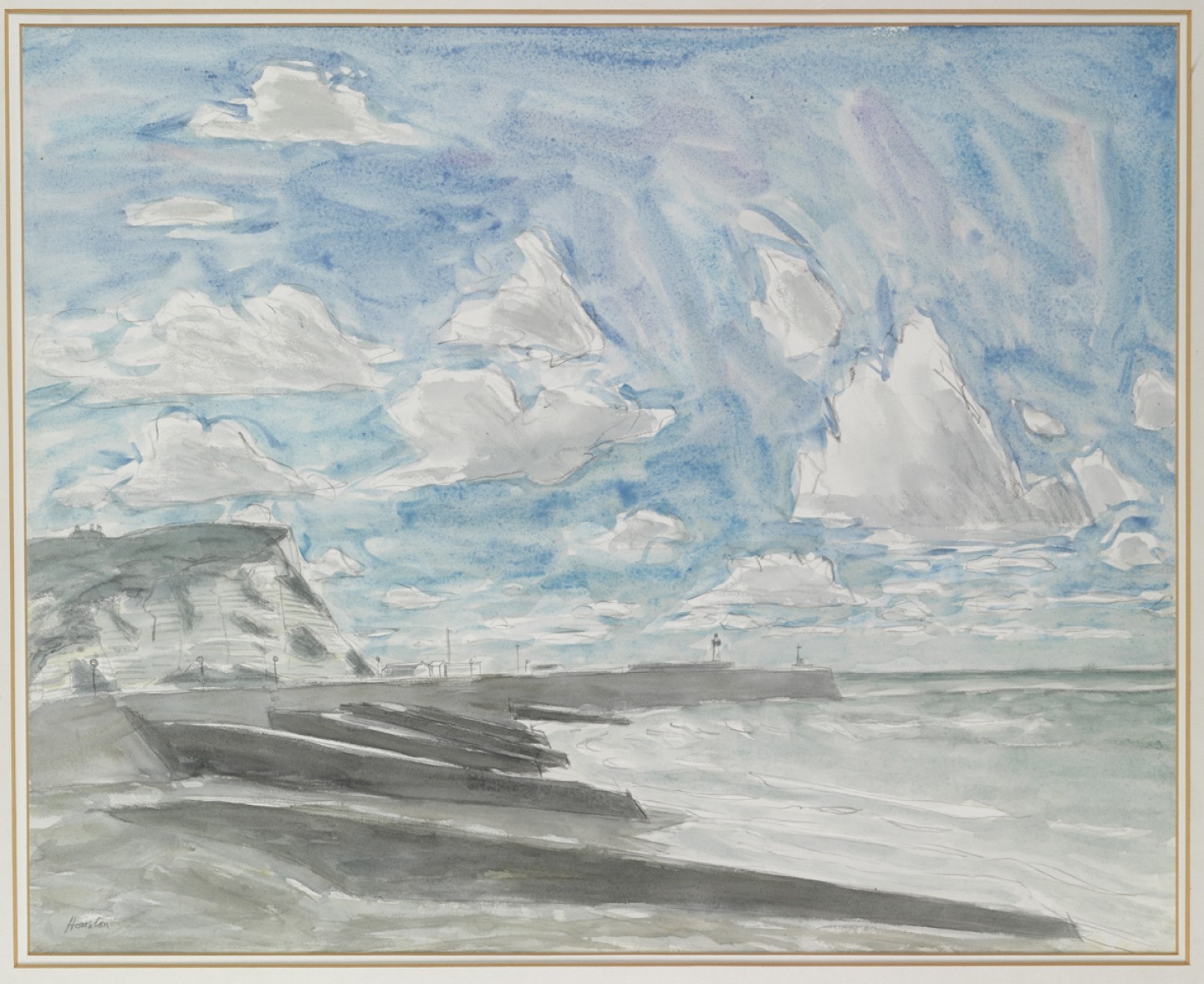
Beach and Cliffs, St Valery
John Houston


DESCRIPTION
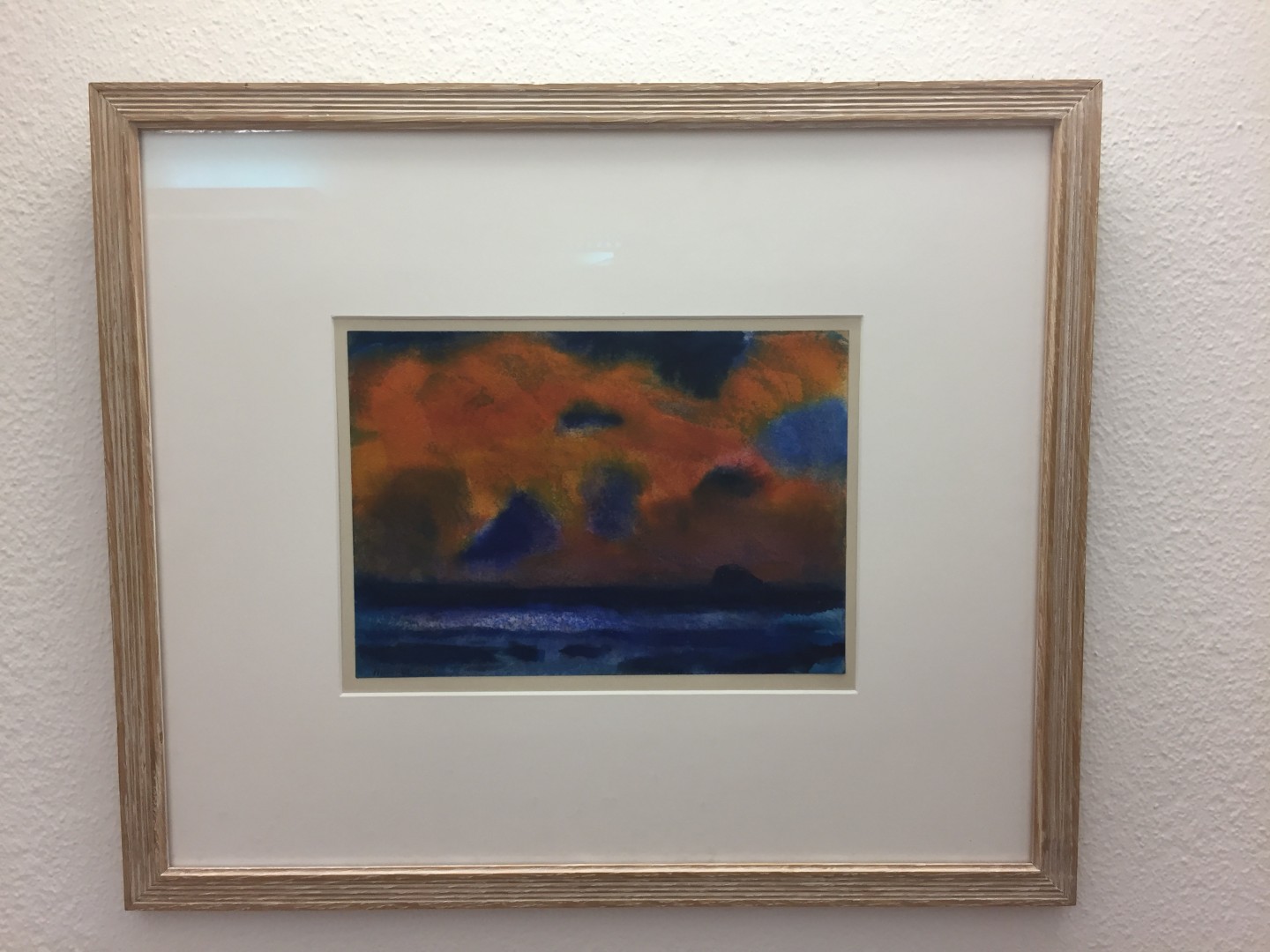
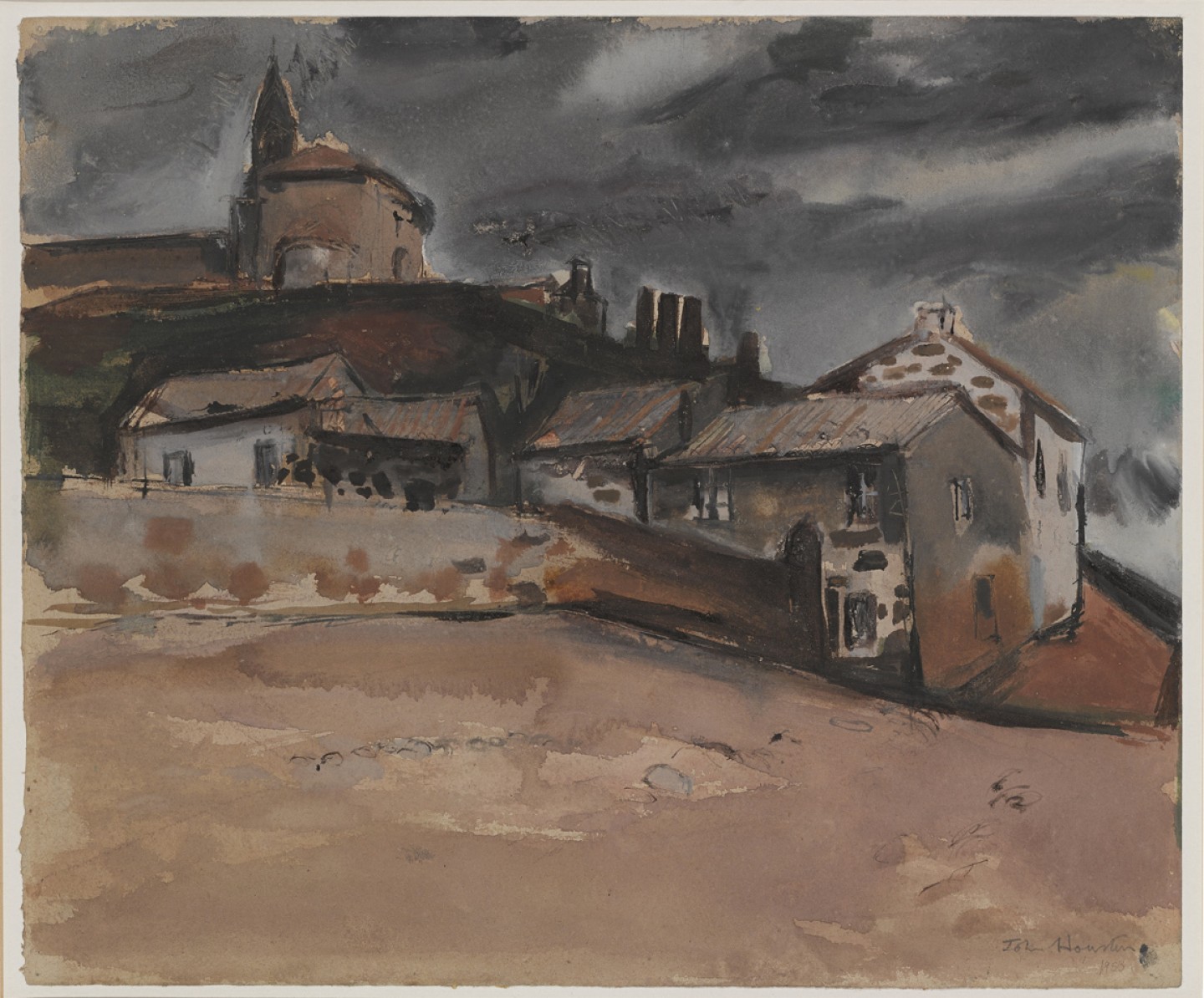
Beach and Cliffs, St Valery by John Houston (1930-2008) captures a grey coastline against a blue, cloudy sky. Houston uses wet washes of blue watercolour to fill in the sky around the negative space that makes up the clouds. In contrast, the coastline is done with dryer strokes of grey watercolour, applying extra layers to create a darker contrast that allows depth along the coastline and on the cliffs. The clouds have light, narrow washes of grey over them to create a cartoon effect of depth. The focus of the work is on the bright blue of the sky, with a more muted colour palette for the land and sea.
Houston's focus on colour reflects his influence as a defined colourist, with the bright blue colour standing out against the muted tones. Landscapes, including coastlines, were a focus of much of his work and the lively, curving lines in this painting's sky also appear in his other watercolour landscapes.
DETAILS
-
Artist
John Houston
-
Date
Unknown
-
Medium
Watercolour on paper
-
Object number
455
-
Dimensions unframed
52 × 63.5 cm
-
Dimensions framed
77 × 90 cm
-
Place depicted
Saint-Valery-en-Caux (2976703)
-
Marks
Signed bottom left
-
Subject
-
Copyright
Ⓒ The Artist's Estate. All Rights Reserved 2019/Bridgeman Images
ARTIST PROFILE
John Houston OBE RSA RSW, 1930-2008
Born at Buckhaven, near Kirkcaldy, Fife, Houston studied at Edinburgh College of Art between 1948 and 1954. He was awarded a travelling scholarship and spent six months in Italy with David Michie during his final year at the college. After joining the teaching staff of the college in 1955 he was Deputy Head of the School of Drawing and Painting from 1982 until his retirement in 1989. He married Elizabeth Blackadder in 1959. They travelled widely in Europe, as well as visiting America and Japan.
Houston is a confirmed colourist. He has long admired Turner, "a constant companion and hero", and Edvard Munch. Among other sources of inspiration are the American painter Mark Rothko and the German painters Emil Nolde, Ernst Ludwig Kirchner and Max Beckman.