
Scottish Art News
Latest news
Magazine
News & Press
Publications
Scottish Art in the Long Century: The Industrial Age 1800-1914
By Susan Mansfield, 20.02.2026
From Robert Louis Stevenson to Dorothy Wordsworth, letters by Bessie MacNicol to a lecture by Charles Rennie Mackintosh, from what Robert Scott Lauder really thought of Ruskin to what William Morris really thought of Scotland...These are just a few of the treasures brought together in a new four-volume anthology, Scottish Art in the Industrial Age 1800-1914, a collection of extracts from primary source material in the “long century” which was fundamental to the development of Scottish art.
The project began when publisher Routledge approached Frances Fowle, Emeritus Professor of 19th Century Art at the University of Edinburgh. “They commissioned it, which I was really excited about, because it’s unusual for a London-based publisher to commission anything on Scottish art,” she says. “So I gaily said, yes that’s great, and sent in a proposal and then I realised, of course, it’s huge project.”
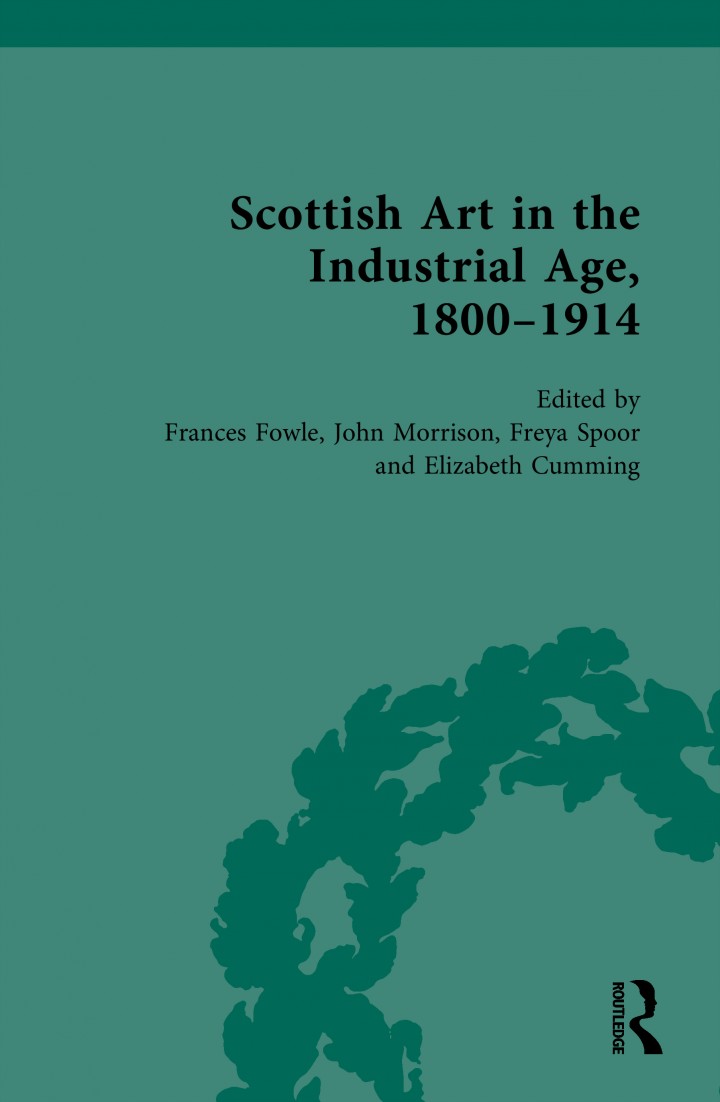 Cover, Scottish Art in the Industrial Age 1800-1914, courtesy of Routledge.
Prof Fowle became the co-ordinator of an editorial group, as well as editing the fourth volume, Collecting, Philanthropy and the Art Market 1800-1914, herself. The other three volumes move through the period chronologically: Painting, Travel and the National Identity, 1800-1860, edited by Prof John Morrison; Scottish Art in the Industrial Era, 1850-1900, edited by Dr Freya Spoor and Arts, Crafts and the Celtic Revival, 1880-1914, edited by Dr Elizabeth Cumming.
Dr Cumming, whose previous work has included books on the Arts & Crafts Movement in Scotland and Phoebe Anna Traquair, said she jumped at the chance to take part. “I thought it was really good because there is so much material out there, both published and unpublished. I never enjoyed anything more than preparing this book. We worked very well as a team, exchanging texts and making suggestions.”
The volumes are the product of several years’ work and much specialist knowledge, the first time an extensive selection of primary source material has been brought together to show the development of Scottish art in its social, economic, cultural and historical context. Drawing on histories, biographies, travelogues, letters and newspaper articles, the extracts offer us a glimpse behind the scenes the first artist-run societies and art schools, art collections and museums in Scotland, as well as into the studios of the artists themselves.
“[In this period] you have the setting up of a school of Scottish painting,” says Prof Fowle. “You have artist societies being set up, schools of art and museums evolving, and underpinning all that is Scotland’s development as an industrial nation, the emergence of rich patrons who enable this art to flourish.”
In his introduction to volume one, John Morrison describes a burgeoning Scottish art world in which increasing numbers were able to make a living as artists, supported by a new kind of patron, those who were making their fortunes in the country’s new industries and collecting art which expressed “their highest aspirations and deepest convictions”.
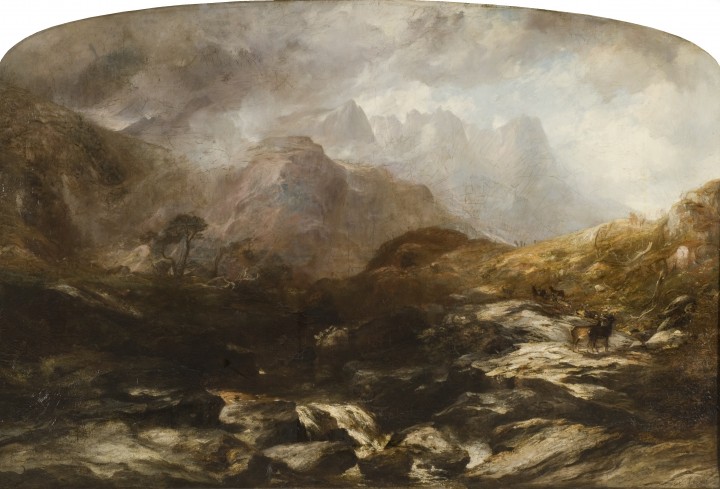 Horatio McCulloch, ‘The Haunt of the Red Deer' (1849). Courtesy of North East Museums, Shipley Art Gallery.
As institutions evolved, so did artistic style and taste. For much of the 19th century, a period of enormous social change, the most popular art was that which looked back to Scottish history and myth, shaped by romantic ideas and the novels of Walter Scott. The paintings of Horatio McCulloch, of windswept moors and mountains, stags and highland cattle, were popular both with wealthy Scots and with the increasing numbers of travellers following in the footsteps of Queen Victoria and discovering Scotland via the newly built railways.
A Scottish style of painting was developing for perhaps the first time, and artists were pushing ahead, looking further for inspiration. “Scottish identity and internationalism is something that goes right through all four volumes,” says Prof Fowle. “From the mid 19th century onwards, artists were looking at French art and Dutch art, whereas in England it’s more about Pre-Raphaelitism and Victorian narrative painting. You don’t get that so much in Scottish art.”
The Glasgow Boys, influenced by developments in French painting, began to paint Scotland in a new way, while the artists involved in the Celtic Revival looked for inspiration in the deep past: traditional crafts, archaeological discoveries and ancient myths. The third volume, Arts, Crafts and the Celtic Revival, 1880- 1914, might appear to cover just 25 years, but, as Dr Cumming points out, it begins with antiquity and ends on the cusp of the modern.
She has included a number of texts never published before, some (including Rennie Mackintosh’s lecture) transcribed by hand from original notes. “I tried to put in different viewpoints, for instance about The Evergreen, the famous four volume journal produced and edited by Patrick Geddes, I put in extracts from it, but also different criticisms of it, some positive, some negative. It’s important to show a variety of views.” There are some quirky choices too, like an extract from Para Handy author Neil Munro, ‘Erchie in an Art Tea-Room’, in which Erchie and Duffy find themselves somewhat out of place in one of Miss Cranston’s stylish modern tea salons, and an anonymous poem, ‘The New Woman in Art’, published in the Glasgow Evening News in 1894, commenting on the “spectral, hideous and lean” depictions of women in a show at Glasgow School of Art.
“It’s all about personalities and different voices, who knew who and who met who,” says Cumming. Sir John Lavery, for example, was among those eager to meet William Morris when he visited Glasgow in 1889, along with several Glasgow art dealers. Key figures such as Walter Scott and Whistler become centres around whom others orbit.
Characters emerge through their writing: James Caw, the Ayrshire-born inaugural director of the National Galleries of Scotland; Robert Alan Mowbray Stevenson, artist, art historian and first cousin of the writer; James Paterson, whose writing made him something of a spokesman for the Glasgow Boys.
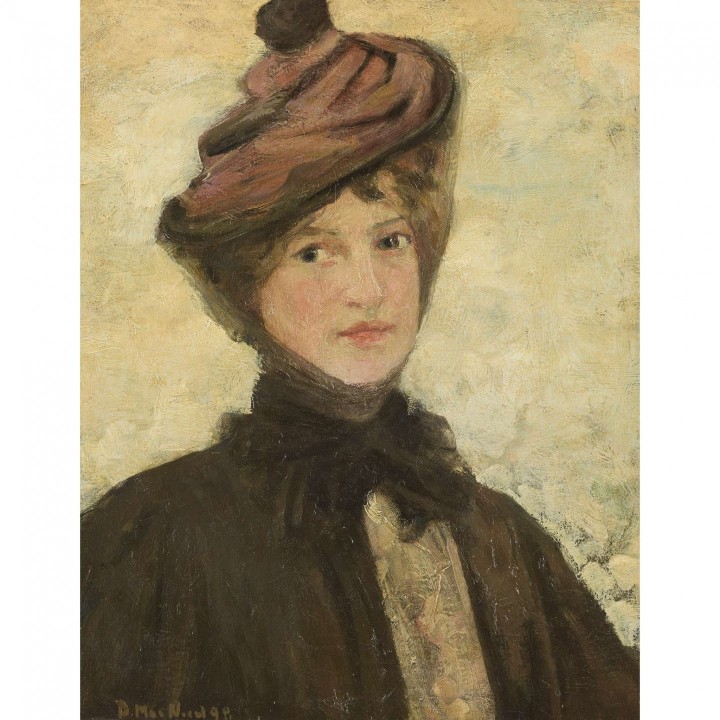 Bessie MacNicol, ‘The Pink Hat’ (c. 1898). The Fleming Collection.
The editors have tried to include women’s stories, as much as the sources allow: Christina Robertson, who painted the Russian royal family in the mid 19th century, Ann Macbeth, Jessie M King, and the painter Bessie MacNicol. She is found writing to John W Beatty, the first director of the Carnegie Museum of Art in Pittsburgh, enquiring about the suspected misbehaviour of the Glasgow art dealer Alex Reid.
In the final volume of the four, Frances Fowle aims to reveal some “forgotten Maecenas”, important patrons of the arts who might be little known today. Here, as elsewhere, the aim is to offer insights across Scotland, not only in the central belt. In Dundee, for example, a thriving art scene was extensively supported by James Guthrie Orchar, an entrepreneurial engineer who went on to become Provost of Broughty Ferry.
In Aberdeen, flour manufacturer James Forbes White was key - until he fell upon hard times and had to sell his collection. “He was a patron of the Glasgow Boys and also bought Dutch art, but because his collection was dispersed he is perhaps not as well known as he could be,” Prof Fowle says.
It was also the century when people from all walks of life began to appreciate art, in the Great Exhibitions of 1886 (Edinburgh), 1888 and 1901 (Glasgow), and in huge exhibitions of craft, such as the one which filled the RSA building in 1888 and was written about extensively in The Scotsman. Dr Cumming says: “The rising middle classes who had some spare money put it into design and craft work, going to these ever-expanding exhibitions of craft by amateurs and professionals.”
Prof Fowle says: “We all feel it is a very important project and would be of help to future generations because there is nothing else like it.”
Scottish Art in the Industrial Age, 1800-1914, published by Routledge, is out now.


