
Scottish Art News
Latest news
Magazine
News & Press
Publications
John Byrne: Blurred Boundaries
By Douglas Erskine, 19.10.2026
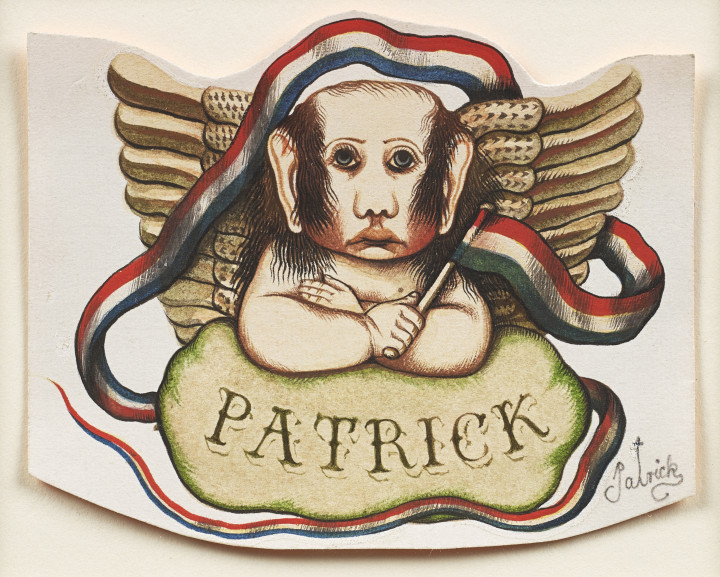
John Byrne (1940-2023) was a famously slippery character. The Paisley-born polymath left behind a dazzling body of work which marked him out as one of Scotland’s most singular and best-loved cultural forces. Out to express and, at the same time, deliberately obfuscate the facts of his life, his art sprung from an unruly and playful creative spirit which made capital of high art and popular culture alike. A new exhibition at The Fine Art Society, Blurred Boundaries, showcases the bewildering range of work which resulted and presents a happy opportunity to try and get to grips with the quintessential John Byrne.
Byrne, a painter, printmaker, theatre designer and playwright – “a juggler, a trickster, a jack of all trades” - might have been within his rights to feel that the art establishment wanted him in a pigeonhole. His creative life was a gallimaufry, and whenever galleries attempted to present his work along ordered, linear lines in large exhibitions, they usually missed the mark. Paisley Art Gallery staged an ambitious retrospective of Byrne’s work in 2000 and admitted it was best to let the work speak for itself: “let’s not try to understand him: let’s celebrate him”.
The Fine Art Society doesn’t try to carve up a life’s work into easily digestible portions, but offers a faithful statement about the man and his art with an appropriately eclectic group of paintings, drawings and prints. Works dating from the 1960s right up to the early 2020s range from faux-naïve to proto-Cubist in style. It’s little wonder that even as a student at the Glasgow School of Art, Byrne was described as a “chameleon”.
As early as the mid-1970s, Byrne enjoyed a reputation as one of the most technically gifted artists of his day. A tiny watercolour of a cherub in that faux-naïve style is testament to his talent: pin-sharp and exquisite, it shows an artist exerting total control to flawless effect. On the other hand, a portrait of Steven Campbell shows Byrne handling oils much more freely to affect a sensitive but strangely baleful image of his fellow painter, then unknowingly at the end of his life. But Byrne is playful and inventive, too: in ‘Mad Cat’, the scratches across the surface of the board suggest the subject let loose on the picture itself.
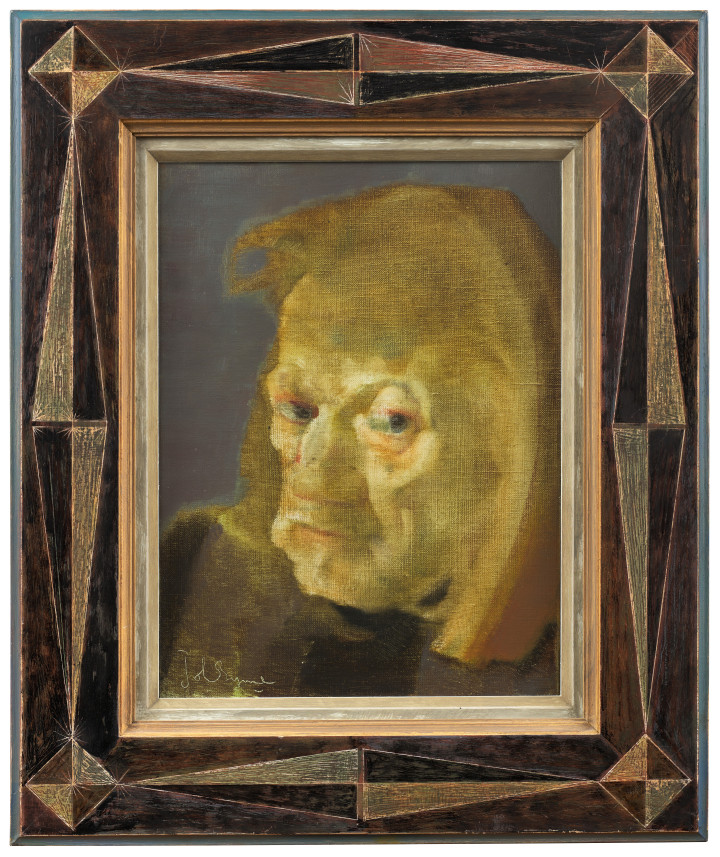 John Byrne. Steven Campbell (2005). Courtesy of The Fine Art Society.
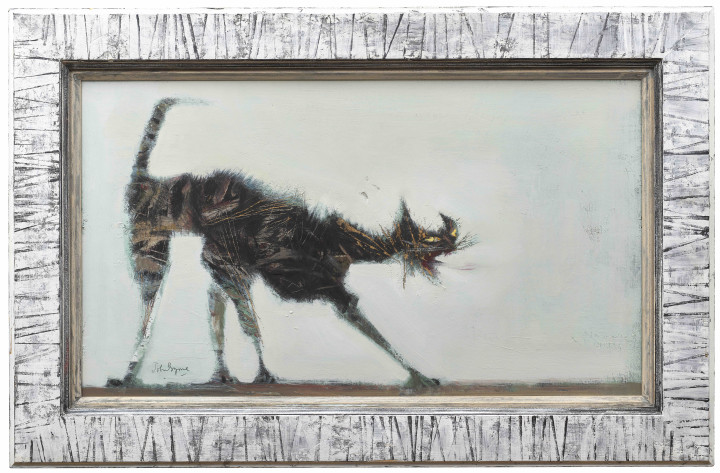 John Byrne. Mad Cat (2004). Courtesy of The Fine Art Society.
An accomplished and versatile picture-maker, Byrne looked to his artistic forebearers for inspiration. Works like ‘Boy on a Beach’, for instance, bring something of John Craxton’s flat, graphic stylisations to mind, even though this fantastically original mixed media is unmistakably Byrne’s own. Works by Craxton from Byrne’s personal collection are presented alongside the show as a tantalising hint at the heady cocktail of influences to which his work is indebted. Elsewhere in the show, the skiffle craze of Byrne’s youth and the lure of America creep in.
The hand-painted pieces of furniture on show, which also came from Byrne’s home, might suggest his regard for the Bloomsbury Group or the charm of folk art. Sometimes painted with portraits of pets like Misha the Cavapoo and Thistle the house rabbit, the pieces supply more than a measure of sweetness while revealing a saunter along a new artistic avenue. Importantly, the pieces of furniture in this show were never initially intended to be sold or even seen in public.
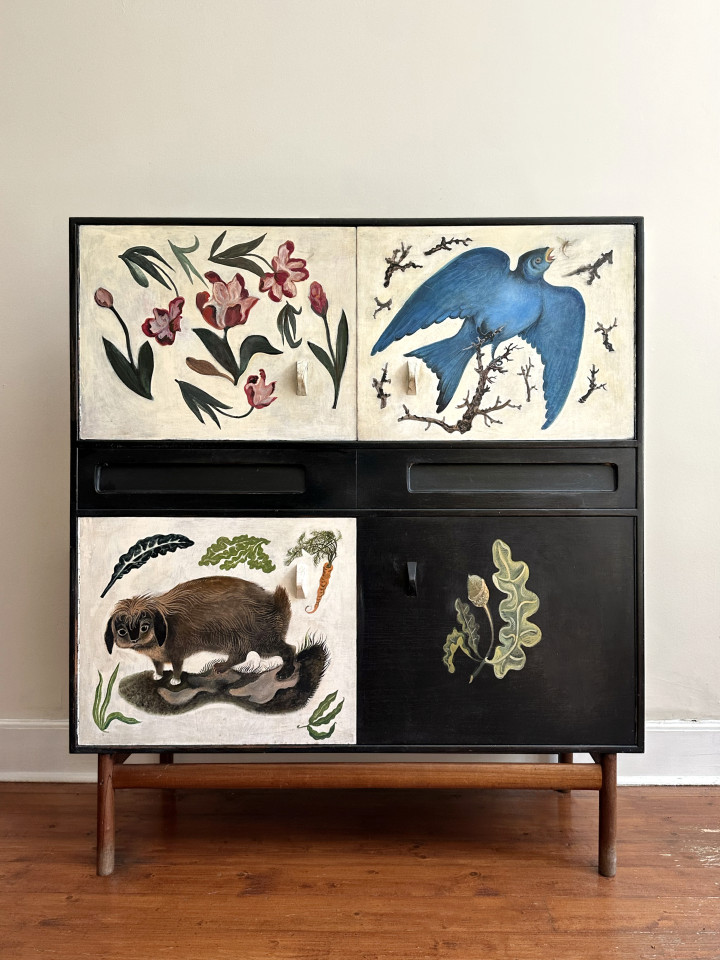 John Byrne. Cabinet with Bluebird and Thistle the Rabbit. Courtesy of The Fine Art Society.
The furniture offers an unexpected glimpse behind closed doors and hints at something central in Byrne’s creative character. As one of the only Scottish artists of his generation whose survival relied purely on the sale of his work – he didn’t take on a teaching job, as almost every artist did – Byrne resorted to inventive means when he had to put food on the table. In the 1960s, the struggling young artist adopted an alter-ego as a “hook”, galleries took the bait, and he suddenly found himself stuck painting in a style which proved wildly popular. The boredom which came with painting all those faux-naïve pictures under the pseudonym “Patrick” – remarkable though they are – eventually forced him into resistance, and his creativity tore off in new directions.
On one hand, a difficult economic reality sometimes affected what Byrne chose to paint; arguably, an eye on the market could go some way to explaining the sheer variety of the work on the gallery walls. On the other hand, much more importantly, it’s clear that Byrne’s creative spirit was always bound to bubble over the top of anything as dull and workaday as market demands. His furniture might be the most sincere expression of his passion, nurtured privately and on his own terms, for exploring new directions.
The work in Blurred Boundaries is as surprising and as free-flowing as the force which sustained its creator. The Fine Art Society, wisely, does not attempt to offer up a final word on John Byrne, and the cross-section of work on show stirs up new ways to consider his life’s work: it suggests passages of convergence and divergence which are ripe for exploration, while painting a vivid portrait of the artist in the round, all of his complexity and brilliance on full view.


